MARINE INSURANCE REDUX
I have been reading with much interest your articles about marine insurance this year (April and May 2006). Every year, I look into a number of insurance options to increase the area in which I can sail. However, there’s one avenue for insurance that I hadn’t seen much discussion about, the one I’d been using and found to be extremely reasonable, insuring your boat with the same company that maintains your homeowner’s insurance.
I have a 1997 Hunter 430 that I have owned for about four years. I have a declared value policy with additional coverage for the dinghies and personal items of $10,000. My liability limit is $300,000, which works for most purposes. I have learned it is not what some marina’s request, but I have found them to be workable with this liability limit. My premium over the last five years has been $500-$550 per year. The only limitation on coverage that I personally do not like is that I must be in or within 75 miles of U.S. or Canadian waters. With this type of coverage, it is not possible to buy a rider so I cannot participate in such events as the Baja-Haha. I have found this to be inexpensive coverage, compared to the other companies, particularly for a declared value policy. However, I have been surprised at the number of boat owners I have spoken with, who are not aware that this type of coverage is available.
Monty K. VanderMay
Hunter 430
Salem, Ore.
TACKTICK WIRELESS
As a follow-up to the comments you made regarding early obsolescence of marine electronics (Mailport, June 2006), an additional recent example is Tacktick Micronet wireless instrumentation. I already own a basic system and was considering adding their wireless mast rotation compensator. However, besides purchasing the mast transducer, I would have to replace both of my wireless displays because only the 2006 displays have the software and the displays of 2005 and earlier do not, and cannot be upgraded. Suddenly, a $1,200 upgrade becomes a $2,400 upgrade. I’ve decided to do without.
David Lannik
Portsmouth, Va.
Steve Moore, in charge of product support at Tacktick said the company tried very hard to make the mast rotation compensator backward-compatible, but had found it impossible. The sealed construction and restriction on power usage imposed by the solar power system also made it uneconomical to update the software in older displays. For upgrades, Tacktick will offer to replace the display at a 50 percent discount for displays less than 2 years old.
Since we first wrote about Tacktick’s Micronet wireless instruments two years ago (Wireless Wunderkinder, Nov. 1, 2004), reports we’ve heard on this product have generally been favorable. However, since April of this year, Practical Sailor has received four letters from customers with concerns regarding Tacktick products (distributed in North America by Ocean Equip-ment), or customer service and product support in North America. Some of those PS readers have since found a satisfactory resolution with Tacktick.
Sailors who invest in these expensive electronics should be aware of the nature of the product and the company’s repair and warranty policies.
Tacktick requires payment up front for replacement units, which is refunded when the company receives the old one. Because of the unit’s watertight design (which makes repair expensive and time consuming) and Tacktick’s continuous upgrades to its product line, people sending out-of-warranty units in for repair are encouraged to purchase new units at a discount instead. Even at a discount, the prices for such systems can run over $1,000. Tacktick is currently in the process of updating the oldest products in the Master Series. The Race Master, Speed Master and Sail Master have now stopped production and production of the new units was due to start in October. The new units have a modified design retaining the watertight approach but allowing simplified access. Like the previous units, it has a two-year warranty. Any older units failing within the warranty period may be replaced with the new style at no additional cost to the customer.
The company has agreed to send Practical Sailor one of their new units for evaluation as part of an upcoming article on sailing instruments.
A NICE SPLICE
First, thanks for including the Toss Wand and the Point Hudson Fid in your recent review of splicing tools (“A Fistful of Fids,” July 2006). I thought your writer did a fine job of comparison.
288
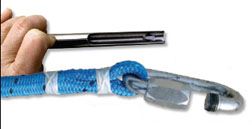
The one thing that bothers me is the double-braid splice that Selma promotes on its website. This splice is the earliest form of double-braid splice, and was abandoned by responsible parties many years ago. It is much easier to do, but is much more vulner-able to failure from chafe and/or eccentric loading.
When I was developing the Splicing Wand, I was trying to make it easier to do a good splice. If I wasn’t so con-cerned with that, I could have come up with a much simpler tool. The hardest part of doing a proper double-braid splice is burying the core into the cover a sufficient distance for proper grip.
Samson fids and Selma fids have a hard time with this, particularly with good, tightly braided rope. The problem is that the core has to overlap its standing part, inside the rope. It’s a tight fit. Constructions like Sta-Set-X, where the core has to overlap itself even further, are extremely difficult to do with any kind of “pusher” fid. Also, it is harder to run home a splice with a buried core. So, not burying the core is the hallmark of a lazy splicer, an inferior splice, and/or a tool that is too fat to put the core where it belongs. Splice failure is rare, but doing the splice correctly will prevent it altogether.
Brion Toss
Brion Toss Yacht Riggers
Port Townsend, Ore.
Excellent point. We agree that the splice described in the Selma instructions is easier to make, but potentially less secure than the more widely recommended type of double-braid splice. However, our tester found that when using the Selma fid, because it could securely grip the line, he was able to make the improved type of splice just fine. The proper “core-to-core” splicing technique is on the New England Ropes website, http://www.neropes.com/, as well as in the splicing book written by Mr. Toss, “Basic Braided Splicing,” available at his website, http://www.briontoss.com.
ULTIMATE HATS
I am writing in response to your article on the Dermafend hat (“It’s Not an Ordinary Ball Cap,” Chandlery, September 2006).
As sailors who cruise on our small boat for extended periods, we’ve learned some lessons through experience. We find we need two different types of hats on board which allow us to wear our hats in any conditions. We wear large straw hats in limited wind conditions and cap style hats in windy conditions.
For the latter, we have found the well-constructed Ultimate Cap made by Ultimate Products Inc. http://www.ultimatehat.com/ to be our favorite. We choose the 100-percent cotton duck cap because we found that in direct sunlight this type is much cooler than the one made of synthetic material (though the latter is advertised as cooler). Yes, after months on the water it may mildew slightly, but that washes out easily. We found that straw lifeguard style hats are best in limited wind conditions. Their wide brim provides much better sun protection all the way around and they are much cooler than canvas caps and hats.
Philip and Sharon Merlier
Swizzle Stick, Catalina 22
Fellsmere, Fla.
It’s been a while since we took a hard look at hats (“Hat Wars: The Tilley Vs. Original Ultimate, June 1, 1994), and a recent search at the Annapolis Boat Show convinced us that it’s time to tackle this subject again. Caps, in particular, have evolved remarkably over the last decade. Look for the results of our comparison coming this spring.
WHICH WINCH?
We would like to comment on your recent winch test (“Seven Muscular Winches,” June 2006). In your reference to offset axles, their disadvantages were not mentioned when referring to the Andersen model. The disadvantage is that you have to select the rope guide position before fixing the winch to the vessel. From then on you are committed to just that one position.
You did not mention that some of the winches had plastic self-tailing jaws. Last year, we sold worldwide 3,400 replacement plastic jaws for the Barlow, Barient, and Maxwell winches.

400
The three winches that you consider the easiest to use are LVJ, Meissner, and Andersen. What your readers were not advised is these winches have a very limited rope size range. Winches like the Hutton that accepted a larger range of rope diameters have a greater self-tailing jaw movement. This I would consider an advantage, yet you gave it a low user-friendly ranking.
While a smooth drum is kind to the sheets, its poor holding power is very hard on the self-tailing jaws and the section of sheet that’s within the jaws. This would have become apparent if you had tested the winches with a realistic load, something in the range of 75 pounds, instead of just 10 pounds.
Using the LVJ specification drum diameter of 3 inches and a gear ratio of 4.5:1 the power ratio isn’t 42:1, it’s 30:1. The drum diameter of the Hutton-Arco is incorrect; you have it stated it to be 1 inch smaller than it is.
Allen Hutton
Director, Hutton-Arco
LVJ reported it’s power ratio to our testers as 42:1. However, by the standard formula for power ratio (2 x handle length]/drum diameter) x gear ratio it should indeed be 30:1. The correct drum diameter of the Arco Hutton winch is 3 5/16 inches. The smaller measurement appearing in a table accompanying the article was a typographical error. We also mislabeled the bronze LVJ winch as the Meissner winch in one of the photos. The two are correctly identified in the inset photos above. Finally, as a result of a miscalculation, we overstated the Andersen winch’s efficiency in low gear by 8 percent. The correct efficiency rating is 82 percent. We sincerely regret these oversights. They did not change our rankings for efficiency or the overall outcome of the test.
WHERE CREDIT IS DUE
THANKS SELDÉN MAST
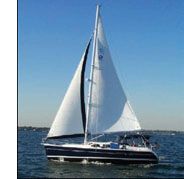
I recently noticed that an access port cover was missing from my 2004 Seldén furling mast. The last time the part was handled was by the boat dealer in the of summer 2005, and the only conclusion I could come up with was that it might have been reinstalled improperly and fallen overboard at some point. I contacted Seldén Mast Inc. (http://www.seldenmast.com/) and offered to pay for a replacement cover. They promptly responded and sent a new one at no charge. I have received the new cover and am just writing to let people know that there are some great companies out there in the marine industry that stand behind their products.
Frank Cook
Hunter 44, Mystic Blue II
Stamford, Conn.
SELDÉN SERVICE SURPRISE
288
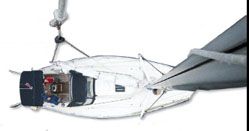
Customer service is alive and well at Seldén Mast, Inc. I have a 21-year-old Contest 36 with a 21-year-old Seldén mast. I bought new sails with full battens this year, and found that the battens were forcing the sail feed gate open when I hoisted or dropped the sail. My sail kept coming out of the mast! Frustrated while on a 10-day cruise, I e-mailed Seldén and explained my problem. Frankly, I expected little in this era of “don’t bother us unless you’re buying something expensive.” To my delight, I received an e-mail from Scott Willman at Seldén U.S. in less than 36 hours. He said that he had researched my boat and understood my problem and that he had the right replacement gate for this situation. In less than a week, I had the replacement and he told me how to install it! I did what he said. It works, and my problem is solved. The miracle part cost less than $100, including shipping. I was able to meet Scott in person at the Annapolis Boat Show. These guys are trained in the machine shop at Seldén before going to the sales force. Very squared away. I will buy stuff from them as soon as the opportunity presents itself.
Greg Costello
1985 Contest 36S, Surprise
Milford, Conn.
GRACIAS VOYAGER MARINE
Kudos go to Voyager Marine Electronics, located in Essex, Mass. (http://www.voyagermar.com/). They stand behind their products and offer superb service. I had a number of issues with the equipment and the installation of the chartplotter/radar units installed on my sailboat. Voyager walked me through the problems and replaced equipment that was faulty. They continually worked with me to help me understand the functionality of my units until the system was perfect.They are gentlemen and totally committed to providing excellent customer service.
Bob Gould
Wellesley, Mass.
WATER WITCH KUDOS
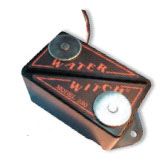
I purchased a Water Witch 230 Bilge Pump Sensor (http://www.water-witchinc.com/), based mostly on your review of the item in the January 2006 issue. I was confused about installation, since the Water Witch uses three wires, rather than the two I expected. A phone call to the company walked me through the installation, and the system worked fine. Two months later, the sensor failed. Another phone call taught me how to test the unit, (it was dead) and told me to return it if bad. Within one week of my mailing back the defective unit, I had a brand new one arrive by Priority Mail, and had it installed and working. The company answers the phone every time, advises neophytes like me, has a great product, and replaces defective units with no argument. I can’t think of higher recommendations for any company.
Jerome McDonald
Rockland, Mass.