Practical Sailor

  • Subscribe
  • Free Waypoints e-letter
  • Customer Service


Forgot Your Password?

  • Home
  • Sailboat Reviews

    Articles

    Boat Review: Marshall 22 Catboat

    The Pros and Cons of a Plumb Bow

    Boat Test: The Last Sabre 34 Mark II

    The San Juan 24

    Used Boat Review: Gulfstar 36

    Seawind 950: Some Assembly Required

    Sailboat Reviews

    Unbiased, detailed reports on dinghies, daysailers, racer-cruisers, cruising sailboats, and multihulls. Insights into boat construction and design. Solid advice on buying a sailboat.

    Sailboat Reviews - Index

  • Marine Electronics

    Articles

    Field Testing Kannad, McMurdo, and Mobilarm MOB Beacons

    Best Mid-priced Marine Stereos

    Garmin BlueCharts Mobile Sea Trail

    Where Credit Is Due: April 2013

    DeLorme inReach vs. Iridium Extreme

    Marine Electronics

    Extensive tests of GPS chartplotters, fishfinders, VHF radios, radar, AIS, navigation software, and handheld gadgets. Professional guidance on installing and operating high-tech sailing gear.

  • Sails, Rigging & Deck Gear

    Articles

    Anchor Tests: Bending More Shanks

    Mainsheet Tackle Bench Test

    Shockles Snubber Test

    Summer Sailing Gear

    Mailport: June 2013

    Sails, Rigging & Deck Gear

    Independent tests of halyards, sheets, furlers, anchors, snatch blocks, shackles, ropes, winches, vangs, cleats, booms, masts, and standing rigging. Expert guidance on choosing a mainsail, jib, or spinnaker.

  • Systems & Propulsion

    Articles

    Fuel-vent Filter Test Resources

    The Fine Art of Sensing the Wind

    DC Watermakers Head-to-head Test

    Stainless-steel Hose Clamps

    Propane-powered Propulsion

    Systems & Propulsion

    Comprehensive comparisons of pumps, batteries, solar panels, wind generators, inverter-chargers, watermakers, propellers, toilets, engines, and other marine systems. Tips on ship-shape installations.

  • Boat Maintenance

    Articles

    Mailport: May 2013

    Dehumidifier Field Tests

    Anti-Mildew Weapons

    Mailport: June 2013

    Where Credit Is Due: May 2013

    Boat Maintenance

    Bottom paints, topside paints, varnishes, waxes, protectants, cleaners, metal polishes. If it comes in a bottle or can, PS has tested it. Proven methods to protecting your floating investment.

  • Belowdecks & Amenities

    Articles

    Dehumidifier Field Tests

    Bends and Breaks: Anchor Shank Strength

    Portable Marine Toilets for Small Boats

    Portable Chairs for Sitting Under Sail

    Belowdecks & Amenities

    Our top picks in galley stoves, cookware, cabin lights, refrigeration, and entertainment systems can help turn your cruising boat into a home. Creative solutions to the challenges of living aboard.

  • Personal Gear & Apparel

    Articles

    Mailport: April 2013

    Kids’ Life Jackets for Active Sailors

    Summer Sailing Gear

    Gift Ideas for the Sailing Family

    Curing the Hardened Sole

    Personal Gear & Apparel

    Thorough test reports on binoculars, boat shoes, foul weather gear, hand-bearing compasses, sailing knives, flashlights, headlamps, sunglasses boots, and anything else that belongs in a skipper's seabag.

  • Safety & Seamanship

    Articles

    Crew Learns Along the Way

    Kids’ Life Jackets for Active Sailors

    Practical Tips for Survival at Sea

    Mailport: June 2013

    The Science of Safety

    Safety & Seamanship

    Our testers evaluate life jackets, flares, life rafts, harnesses, man-overboard strobes, medical kits, seasickness aids, and emergency devices. Tips on marine safety gear, boat-handling, and emergency procedures.

  • Mailport & PS Advisor

    Articles

    Mailport: March 2013

    Anti-Mildew Weapons

    Mailport: June 2013

    Indoor Sailboat Refinishing

    Where Credit is Due: March 2013

    Mailport & PS Advisor

    Insightful letters from sophisticated sailors. Do-it-yourself projects and reader feedback on a wide range of boats, marine manufacturers, and sailing products.

  • Inside Practical
    Sailor Blog

Features

March 2007 Issue

Story Tools

  • Share |
  • E-Mail to a friend
  • E-Mail to the editor
  • Post a Reader comment
  • Printer Friendly

Tool Tips

When it takes longer to find the right tool for the job than to actually complete the job, consider creating your own “doctor’s bag” of boat tools. Veteran cruiser and handy-man Evans Starzinger gives advice on taming your toolbox.

Having the right tool makes every boat maintenance or repair job that much easier. Having it handy makes an even bigger difference. With that in mind, PS tester Evans Starzinger decided to develop one small tool bag that would cover 85 percent of the jobs by itself. After two years of tinkering with the contents, he settled on a small tool bag that seems to fit the bill. It has four basic categories of tools: standard mechanical tools (screwdrivers and wrenches), electrical, sewing, and consumables. The tool bag was selected to be compact, easy to carry and stow, while just big enough to fit the necessary tools.

***
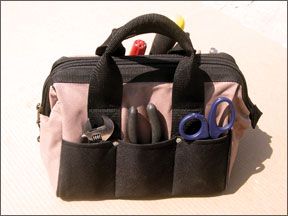
 

The oft-repeated chestnut that world cruising is fixing your boat in a series of exotic ports is true, and it implies that a cruising boat should carry a lot of tools to do all that fixing. Over the years, my partner, Beth, and I have added more and more tools to our stash. It got to the point that I had the tools sorted by type into six large Rubbermaid tool boxes and a four-drawer tool chest. I then discovered that to do almost any project required unstrapping and opening at least half of the tool boxes. This created quite a mess, a big cleanup, and a big restowing job when my project was completed. I decided to develop one small tool bag that would cover 85 percent of the jobs by itself and most of the other 15 percent hopefully by opening only one of the larger tool boxes.

After two years of tinkering with the contents, I have settled on a small tool bag that seems to fit the bill. It has four basic categories of tools: standard mechanical tools (screwdrivers and wrenches), electrical, sewing, and consumables. The tool bag was selected to be compact, easy to carry and stow, while just big enough to fit the necessary tools.

Standard
Mechanical Tools
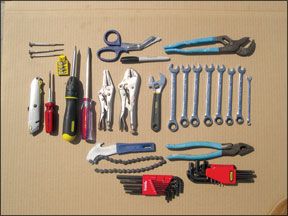
Boat ownership requires a bevy of tools that would make Bob Vila jealous. We suggest keeping your most-used tools in their very own “fix-it” bag. While the tools you use less frequently can be stowed out of the way,this “kitchen-drawer” toolbag will allow you access to what you need for smaller tasks without having to dig through those endless bins of DIY utensils. Pictured at left is an example of tools you should include in your standard mechanical bag.

This category consists of a very conventional collection of tools. I did not want to carry a full set of both metric and standard socket wrenches, so the only real learning point was to figure out exactly which box wrenches were needed to fit the bolts on our boat,

Hawk. Our hose clamps have 7-millimeter nuts, half-inch and 13 millimeter fit the adjustment screws on our two alternators (and also the mainsail batten tension adjustment bolts), 7/16 inch fits the Harken batt cars, and 12 millimeter fits the bleed screw on the engine. The hex wrenches are the only tools that seem to rust, so I keep them in a Ziplock bag sprayed with WD-40. The following tools fall into this category:

Largest flat-blade screwdriver that will fit in the bag, also used as pry bar

Two multi-blade screwdrivers (large ratchet unit and smaller one with specialty blades)

Three small jewelers’ screwdrivers two flat blades (small and tiny) and one Phillips

Eight ratcheting box wrenches two 7/16 inch, two half-inch, and one each of 9/16 inch,
7 millimeter, 12 millimeter,
and 13 millimeter

An adjustable crescent wrench

Two vice grips (needle nose and standard)

Two sets of hex wrenches (metric and standard)

Pipe wrench

Filter wrench (style with adjustable chain)

Lineman’s pliers with
heavy-duty wire cutters

Exacto knife

Heavy-duty scissors

Electrical Tools
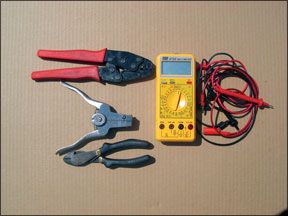
Investing in high-quality electrical tools is well worth it, if you like trouble-free connection making.

Through our own experiences and discussions with electrical component experts, we have been convinced that a good crimp connection is the way to go rather than soldering. The key is that it must be a GOOD crimp, which is almost impossible to make with the inexpensive "auto crimper kits." It requires a high-quality ratchet crimper that will make a perfect, watertight crimp every time. (Practical Sailor’s favorite crimper is the Klein 1005, Practical Sailor Aug. 15. 2003.) I also use a pair of specialty wire strippers that make a perfect strip to fit the crimp terminals. Ancor (www.ancorproducts.com) makes a quality stripper (a Practical Sailor favorite in the 2003 review) and crimper. They run about $60 each, but are worth it for perfectly trouble-free connections. I keep the multimeter in a Ziplock bag to prevent the display from being scratched by the other tools. Our electrical toolkit includes:

Digital multimeter

Ratchet crimper

Wire stripper

Wire cutters

Sewing Tools
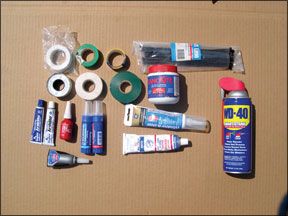
Your consumables toolkit should include frequently used items like cable ties, Loctite, and tape.

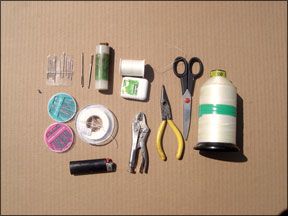
The thread needs to be strong and UV resistant. The Goretex thread (available from Sailrite, www.sailrite.com) meets that bill, as does waxed dental floss, which also holds a knot better. The small needle-nose pliers and vice grips are used to put a needle through thick cloth. We carry the following for sewing needs:

Heavy sailmaker needles

Normal household sewing needles

Goretex sewing thread

Waxed dental floss

Heavy, polyester waxed whipping twine

Small scissors

Needle-nosed pliers

Small vice grips

Lighter

Sailing knife

Fid set

Consumables

We use wire ties on most of our shackles to prevent the pins from vibrating loose. But on two of the shackles (mainsail tack and anchor), we found that the wire ties kept breaking, so we now use stainless wire to seize the pins on those. (Some Practical Sailor editors prefer monel seizing wire over stainless wire and plastic cable ties, which are affected by UV rays.) WD-40 is not much of a lubricant, but it is a terrific cleaning fluid.

Not your grandma’s sewing kit : Sailors’ sewing tools including UV-resistant thread must be able to handle heavy-duty projects.


While we have many special-purpose lubricants and adhesives, we use LanoCote www.defender.com) as our general purpose stainless-fastener lubricant, blue Loctite (www.loctite.com) as the standard thread lock, and super glue and a two-part epoxy putty as the normal adhesives. In our consumables toolkit you’ll find:

A small assortment of crimps, terminals, and heat-shrink tubing

Wire ties

Stainless-steel (or monel) seizing wire (to tie shackles closed)

A small jar of LanoCote

WD-40

Electrical tape

Rigging tape

Blue Loctite

Silicone caulk

Super glue

Epoxy

Conclusions

This single, small tool kit, along with a DeWalt (www.dewalt.com) or Makita (www.makita.com) cordless drill and carbide bits, allow me to do most common jobs without unpacking any of our big tool boxes.


Read More on These Topics
  • Other

Comments (1)

Excellent. Just what I was looking for! Love you guys! Thanks

Posted by: william w | May 2, 2013 6:22 PM    Report this comment


Add your comments ...

New to Practical Sailor? Register for Free!

Already Registered? Log in

Forgot your password? Click Here.

Advanced Search

Related Items

Articles

  • June 2013 Full Issue PDF
  • May 2013 Full Issue PDF

Current Issue

Cover Image

June 2013

  • Mainsheet Tackle Bench Test
  • Kids’ Life Jackets for Active Sailors
  • Dehumidifier Field Tests
  • Shockles Snubber Test
  • Summer Sailing Gear

Subscribe Today

Back Issue Archive

Resources

  • Practical Sailor Dinghy Survey Results
  • DIY Boatyard Survey
  • Sailboat Reviews - Index
  • DIY Projects
  • Bookstore
  • Issue Archives
  • Other Resources
  • Customer Service
  • About Us
  • Home
  • Subscribe
  • Give a Gift
  • Renew
  • Products
  • Customer Service
  • Privacy Policy
  • About Us
  • FAQs
  • Contact Us
Practical Sailor

© 2013 Belvoir Media Group, LLC. All rights reserved.