Photo courtesy of Webb ChilesPhoto by: Patrick ChildressPhotos courtesy of Charlevoix County Sheriff’s Department Photo by Frank Lanier
320
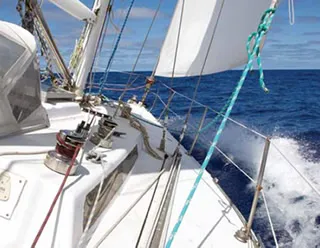
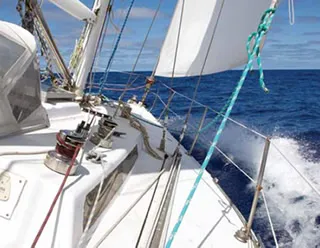
I couldn’t disagree more with the opening sentence of your Dec. 29, 2011 Waypoints e-letter: “Perhaps the biggest surprise during a circumnavigation is just how critical the engine is to a cruising sailboat.”
While I don’t doubt your later assertion that many “cruisers” use their engine to cover 25 percent of their miles, this is not because the engine is necessary. I used 40 gallons of diesel on my entire fifth circumnavigation, which included having to power through the Panama Canal, for a fuel mileage of 600 mpg.
Two of the boats on which I’ve made my five circumnavigations had no engines, and I doubt that I’ve used those on the others to cover more than a fraction of 1 percent of the miles I’ve covered.
There is no secret: Have a boat that sails well, and think of yourself as a sailor.
Webb Chiles
The Hawke of Tuonela,
37-foot Heritage
Gannet, Moore 24
Editor’s Note: Reader Webb Chiles (www.inthepresentsea.com) was the first American to sail alone around Cape Horn. He has written several books on his circumnavigations.
What a surprise it was to see a Sabre 30 named Solace in the December 2011 Mailport! Our Sabre 30, also named Solace, is homeported in Maine, and we also have several Boatleather products aboard.
I have covered the wheel, added some leather to the top of the grabrail in front of the wheel, and I added leather covers on the ends of the lifeline turnbuckles in the cockpit.
Boatleather makes great products that are easy to install. The wheel cover required at least two nights of watching football to install with its padding, but the wheel is much warmer to hold in our colder Maine climate.
David N. Taft
Via e-mail
Photo courtesy of Webb ChilesPhoto by: Patrick ChildressPhotos courtesy of Charlevoix County Sheriff’s Department Photo by Frank Lanier
320
As a retired scientist that worked in and eventually managed tech centers, I read the article “The Great Titanium Trickle-Down” in the December 2011 issue with great interest. Kudos to author Patrick Childress for his insightful article. Much useful information was presented, and I’d like to make some comments.
First, drills are not made from titanium, but are coated with titanium nitride (TiN), imparting superior wear resistance, whether made from tool steels or cemented carbide. While titanium and its alloys, particularly T-6-4, offer great strength, low weight, and outstanding corrosion resistance in the marine environment, resistance to galling is very poor. TiN coatings, applied by chemical vapor deposition (CVD), solve this problem for use in rotating applications and also provide resistance to galvanic corrosion. Machining, forming, and joining of titanium alloys are, however, best left to professionals experienced in these fields. Another source of Ti-6-4 materials is aerospace companies in the form of bar ends too short for forging items like fan and compressor blades or offal from sheet-fabrication operations. A caveat, most of the bar stock may require forging to produce stock of suitable thickness for items such as chainplates, cleats, and fasteners. Again, forging operations are best left to the experts.
Glass coatings are used to prevent absorption of nitrogen during forging. Within these companies, there may also be perfectly acceptable stock for which the specs have been misplaced and hence cannot be used for flight-critical hardware. I have an assortment of such bars and have machined parts for my yacht in my home shop. All of the above materials may be available at greatly reduced cost.
Dr. Charles F. Barth
Crazy Horse, C&C 37 TR
Lorain, Ohio
Photo courtesy of Webb ChilesPhoto by: Patrick ChildressPhotos courtesy of Charlevoix County Sheriff’s Department Photo by Frank Lanier
320
Practical Sailor Editor Darrell Nicholson opens his unfortunate editorial in the December 2011 Practical Sailor by referring to the three recent US Sailing inquiries of catastrophic sailing accidents in the summer of 2011. These are the 420 dinghy capsize at Annapolis in which a young sailor died, the capsize of WingNuts in the Chicago-Mackinac Race with the loss of two lives, and the inversion of Rambler 100 in the Rolex Fastnet Race after her keel broke off, thankfully with no fatalities. I reviewed the first accident and served on the second’s panel with [West Marine Vice President] Chuck Hawley, Sheila McCurdy, and [PS Technical Editor] Ralph Naranjo. Ron Trossbach conducted the Rambler 100 review. All of us are US Sailing-certified safety-at-sea seminar moderators. The three reports are at http://about.ussailing.org/US_SAILING_Meetings/USS_Reports.htm.
I read Nicholson’s editorial with indignation. Right away, he informs us that the three reviews are flawed: “Even if you are not a racer, these reports should be required reading — so long as you read between the lines” (my emphasis). That bomb dropped, he promptly abandons the Annapolis and Rambler reviews, leaving the reader’s imagination reeling with the possible sins of commission or omission there, and devotes the remainder of his space to the Chicago-Mackinac inquiry. He twice tells us that, in this 73-page, 21,000-word report, the “between the lines” problem is that Hawley, the panel’s chairman, works for West Marine, and that he refers to West products five times in a one-page table that he compiled.
Titled “Summary of the Personal Gear at the Time of Capsize,” this table locates WingNuts’ eight sailors in the boat, describes how the survivors swam clear of the inverted hull, and identifies most of the safety harnesses, tethers, and life jackets worn by the crew. Hawley compiled this valuable table from information I gathered from survivors of the WingNuts accident and photographs of the deceased sailors’ gear provided by the Charlevoix County, Mich., Sheriff’s Office.
In the table, two items are described using their brand names: “automatic inflating Spinlock Deck Vest” and “automatic inflation Mustang Survival MD3032.” Two tethers are identified as “West Marine double tether with a snap shackle” and “West Marine single tether with a snap shackle.” Nicholson says nothing about those four identifications, though a concern for fairness and accuracy should have led him to tell his readers that Hawley listed gear from two of West Marine’s competitors.
Nicholson hones in on the table’s three other gear descriptions, all for tethers: “West type with a cow-hitch,” “West type with beaded shackle,” and “possibly a West Marine single tether with snap shackle at chest.” Nicholson apparently feels that Hawley cobbled together these descriptions to publicize West Marine equipment (rather than, say, distinguish this gear from the Spinlock’s and Mustang’s). The fact is, however, that the two “West type” quotes are nearly verbatim from my interview with a WingNuts survivor who used that term, and the third is an informed conjecture based on the second “West type” description.
The five cryptic references to West Marine gear persuaded Nicholson to write of Chuck Hawley, “His lead role in the report on tethers and harnesses suggests a conflict of interest that could undermine the report’s credibility.” Nicholson presents no evidence that the report is incredible, inaccurate, misleading, or favorable to any gear. Yet he continues to pile on, ending the editorial, “PS urges that future ‘independent’ reports by US Sailing be directed by experts who do not have a vested interest in the outcome.”
Some publications gain our attention with facts and considered judgments. Others prefer innuendo, interjecting ironic twists on value-laden words like “independent,” tossing in wink-wink “suggests” and “coulds,” and advising us to “read between the lines.” I’ve long admired Practical Sailor as an example of the first type of publication, but now I’m having second thoughts.
John Rousmaniere
US Sailing Safety at Sea
At-large Member
I’m writing to object to the editorial in the December 2011 issue in which you warned your readers of a conflict of interest among the panel of four authors of the US Sailing WingNuts report.
The sport of sailing gains enormous benefit from the fact that [West Marine Vice President] Chuck Hawley, who has vast professional experience in the field of recreational safety at sea, is willing to volunteer his time to US Sailing. Chuck’s long employment at West Marine is well known and clearly stated in the US Sailing report, so there was no hidden conflict. The “so long as you can read between the lines” comment in the article implied that Chuck’s actions were in conflict-of-interest, yet your article contained zero evidence of any conduct on Chuck’s part that was in conflict with the interests of offshore sailors. Practical Sailor should return to its roots of writing about facts and not innuendo. If we in the sport of sailing are not able to take advantage of the individuals with the most experience, then we will be far worse off for it. Instead, let’s continue to involve those with the most experience, and let’s continue to make sure that the basis for their extensive experience is fully disclosed (as was Chuck’s).
Stan Honey
US Sailing Safety at Sea
At-large Member
Practical Sailor Editor Darrell Nicholson responds: I fully appreciate the work the volunteers put into this report. My initial comment referred to inconsistencies, omissions, and misrepresentations in the US Sailing reports that could lead to the wrong assumptions if one did not “read between the lines.” In the table that John Rousmaniere mentions, only one product is positively identified, and at least one is misidentified, and the entries for five key pieces of equipment are simply blank. If investigators had spoken with more than two of the six survivors, the report could have presented a clearer picture of the safety equipment and how it performed. We will address all three reports in greater detail in an article next month. Chuck Hawley is an avid sailor, and his concern for safety is well known. However, in my opinion, he should have recused himself as soon as he became aware that West Marine’s gear was involved in the inquiry. He would have made an excellent consultant, but he was not the best choice for committee chair, in my view. If US Sailing is to assign key decision-making roles to people who may have a personal or professional interest in the outcome of these reports, they should not be labeled as “independent.” This will only erode people’s confidence in the process.
Your article on the Parker FPM-050 Fuel Polisher (December 2011) failed to make it clear that this “fuel polisher” is not much more than a piezoelectric pump. Granted, the FPM-050 has its niche (i.e. low power allowing for continuous running, quiet with no moving parts, and meant to be retrofit to an existing fuel filter), but you can make a dedicated fuel-polishing loop for less money.
We chose a Walbro FRB-13 pump [Editor’s Note: Be sure to use a pump that’s certified for use with fuel], Racor MA500 filter, Trident A-1 fuel hose, and a Filter Minder, which is a vacuum gauge (available from Parker) that tells you when the filter is getting clogged. Add a switch and some dedicated inlets and outlets to the fuel tank, and you’ve got a dedicated loop.
It’s important to recognize a “fuel polisher” is nothing more than a pump to move fuel, a filter to polish, and some tubing and valves to control flow. DIYers have a variety of economical ideas; just search the Internet. Commercial offerings have their place, but I’d rather spend my limited sailing dollars on useful sailing gear than on a fancy commercial fuel polisher.
Marilyn Johnson
Rainshadow, 1974 Nicholson 38
Seattle, Wash.
Regarding your product advisory on Orion flares (January 2012): During a vessel safety check last summer, a skipper told me he had the new 12-gauge flares, so I asked to see the pistol and found that the barrel would not open sufficiently to allow a cartridge to be loaded. (The barrel of some 12-gauge plastic flare launchers made by Olin or Orion Safety Products (www.orionsignals.com) before the year 2000 may not open sufficiently to load a cartridge. Anyone with such a launcher should contact Orion at 800/851-5260 or [email protected] for instructions on how to get a replacement, or visit the company website.)
How many boaters have checked to see if their launcher barrel will open fully? I have come across more than one launcher and its cartridges still in the original store packaging; they are well packed and not too easy to open at the best of times. Now is a good time to check your flare launcher.
Also, I was once told in a marine store that long cartridges were designed to stop the end of the launcher barrel from melting when multiple shells were fired in quick succession. An Orion spokesperson said that the real reason for the long cartridge was that it allowed the aerial flare to reach a higher altitude (500 feet vs. 350 feet), increasing the chance of its being seen.
Another piece of misinformation I had heard is that 12-gauge flare cartridges float so you can retrieve them if dropped in the water. Orion told me that they sink. So if you have to use the pistol, take extra care handling the cartridges.
U.S. Coast Guard Auxiliary and U.S. Power Squadrons would be pleased to give your boat a vessel safety check. This can be done by contacting your local flotilla or squadron, or by going online (Google “vessel safety check”). The checks are free, and vessel examiners are not law enforcement, so any deficiencies found can be corrected without penalty.
Stuart Gelder
USCG Auxiliary, Vessel Examiner
Presque Isle, Maine.
The letter published in the December issue asking about used-flare disposal isn’t the first I’ve seen. More basic to me is whether we should have the requirement at all. It seems to me that with all the safety and signaling equipment available today, flares should be optional. It’s a requirement that’s long outlived its usefulness. Do we really need to force the public to create this stream of toxic waste. If more than 1 percent of flares get disposed of properly, I’d be surprised.
Richard Greene
J/42
Boothbay, Maine
You make an interesting point. We hate toxic waste as much as the next guy, but in our opinion, it’s still a good idea to keep aerial flares on hand in case of an emergency. While the new signaling devices have greatly improved search-and-rescue, they are not fail safe—nor are flares. For that reason, we recommend having multiple types of signaling devices on board and in a ditch bag. To see how some signalling devices work in real-world emergencies, check out the
US Sailing Independent Study Reports at http://about.ussailing.org/US_SAILING_Meetings/USS_Reports.htm.
Photo courtesy of Webb ChilesPhoto by: Patrick ChildressPhotos courtesy of Charlevoix County Sheriff’s Department Photo by Frank Lanier
320
Can the nonskid paints you reviewed in the January 2012 issue be applied over the molded non-skid, or must it be stripped off? I share a 2007 X-35 with a partner, and the molded nonskid is actually dangerously slippery when wet. I’d prefer to paint something over it to add traction, rather than trying to remove the nonskid that is there prior to painting.
John Owen
X-35
Via e-mail
While you do not need to remove the molded nonskid, you should sand the surfaces to ensure even coverage of the nonskid aggregate and good adhesion with the epoxy primer and nonskid paint. We recommend first scrubbing the texture with steel wool to abrade the low areas, then machine-sanding.