Photo courtesy of Gordon ThompsonPhotos courtesy of C. Henry Depew and GoingApps
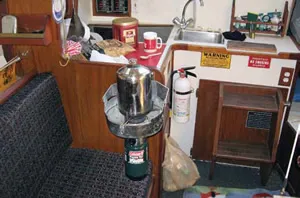
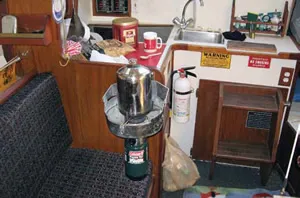
I am sorry that I did not get a chance to include my galley in the Ideal Galley article in the October 2012 issue. Actually, there was no design to it. Its a 1979 Bayliner Buccaneer 277 version. I did remove a two-burner stove to have more counter space, and I replaced it with a one-burner stove that can be used while underway or removed and stowed when not in use. It is the ideal galley for gunkholing around Puget Sound.
Gordon Thompson
Bayliner Buccaneer 277
Puget Sound, Wash.
Your Force 10 Seacook was Practical Sailors Best Choice pick in our July 2006 report on compact cookers. It has since been discontinued, but used models are still around and worth the cost. Testers agreed that seaswing stoves are handy for cooking underway; however, you should be extra cautious if you choose to use it belowdecks. The American Boat and Yacht Council (ABYC) limits the Seacook and similar stoves to outside use, mainly because they lack of a flame-failure device, which prevents gas from leaking into the boat if the flame goes out. Its also important to note that the small propane canisters used with these cookers must be stored onboard with the same care-and following the same guidelines-as large propane tanks: Keep them in a sealed locker that drains overboard.
Recently, I dripped some Interlux Sikkens Cetol wood finish on the tan, nonskid area of my deck. Ive tried to clean it up using some suggestions offered by people on the dock, but nothing seems to work. Do you have any suggestions on how I can remove the Cetol from the nonskid?
Ralph Kravitz
DY-A-NU, Tartan 3100
Cos Cob, Conn.
Sanding is probably your best bet for removing the Cetol, but the answer depends somewhat on what type of nonskid youre talking about. If its molded gelcoat and in good condition, you can try to clean it with a Scotch-Brite pad and a cleaner like Interlux 202, or you may have to sand it off. If its an older molded gelcoat thats porous, Interlux recommends pouring a solvent like acetone, Xylene, or MEK on the stain, then covering it with plastic to keep the solvent from evaporating; wait 30 minutes or so, then clean the surface with a Scotch-Brite pad. If it is a nonskid paint, then sand off the Cetol and retouch with the paint. Some paint removers may also help, but Interlux Interstrip 299E should not be used on deck, according to the maker.
Kudos on the Marincos Shorepower Solution” article (PS, August 2012). On a similar topic, why hasn’t anyone come up with a better 12-volt plug/ receptacle solution? These things are annoying. Some work well; some not so well.
The spring-loaded positive contact plays against maintaining good connection. Materials are often low-cost solutions not well suited to marine environments. In some cases, plugs and receptacles from the same source don’t always match well. In short, a problem in search of a solution.
Warren Updike
Via email
Photo courtesy of Gordon ThompsonPhotos courtesy of C. Henry Depew and GoingApps
I use current and back issues of Practical Sailor a lot, and I am frustrated by the time and effort it takes to find (if I can) past articles on a subject. Other than the year 2000, I have found no index resources for PS. Am I just missing the obvious? I can’t be the only one who is frustrated.
Will Walton
Via email
The next to last page of each December issue has an annual index for that year; and the search engine on www.practical-sailor.com is a good resource for looking for past articles. Be as specific as possible with your search terms as it searches the entire text of every article. Broad searches for common terms like “sail” or “anchor” will get thousands of hits. We recommend using the Advanced Search function to narrow the search, and again, be specific-include the year (antifouling test 2012), product type and maker (Andersen winch), etc.-and fill in all of the fields.
Another option is to use Google.com and put Practical Sailor in front of your specific terms (i.e., Practical Sailor winch test). And if the article youre looking for still eludes you, shoot us an email, and well be glad to help: [email protected].
Is there anything a sailor can do to make sure ethanol fuels do not get into his tank to begin with? I just spent both legs of a trip to Block Island draining water and crap from my Racor fuel filters. As I don’t trust the fuel providers to do it, does anyone know of some kind of filtering setup you can put between the pump and your tank? Id invest in something serious at this point. The problem is that bad. I just didnt know whether the velocity of the fuel being pumped would overwhelm a normal filter. Thoughts?
Rick Fricchione
Via www.practical-sailor.com
The only way to keep ethanol out of your tank is to buy fuel from a reputable vendor that sells only no-ethanol fuel. There are fuel docks and gas stations that still sell ethanol-free fuels, but they are becoming fewer and fewer.
To avoid contaminated fuel, find a fuel dock that regularly tests their tanks for water, changes out filters, and has a reputation for selling clean fuel. Often those that sell the most fuel know how to handle it properly.
Another way to keep contamination out of the tank is to use a deck-fill fuel filter (PS, Nov. 15, 2002) to pre-filter questionable fuel. The filter funnels work well, but the going is slow. Through-flow rates range from about 2 gallons per minute (GPM) to 5 GPM, so patience will be required.
We recommend the Mr. Funnel, sold by West Marine, and the older Baja fuel funnel, which has been discontinued but can be found used online for about $100. Both filter funnels rated well in our past tests. The Baja incorporates three different mesh-screen layers (coarse, fine, and water separator), while Mr. Funnel ($25, www.mrfunnel.com) is a more traditional plastic filter with a water-resistant filter media inside the funnel.
There are also some best-practices you can follow to ensure a clean, trouble-free fuel system. Inspect your fill cap for leaks and replace the O-rings as needed-this is a well-known water-entry spot-and be sure you winterize the system properly. Youll find more tips on maintaining a healthy fuel system in the Nov. 15, 2002 test report and advice on winterizing in the August 2012 issue.
Photo courtesy of Gordon ThompsonPhotos courtesy of C. Henry Depew and GoingApps
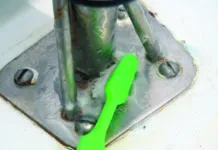
In regards to your recent chafe gear update (PS, October 2012): One trick to holding the chafe protection in place is putting a small hole at each end of the gear and running two pieces of electrical wire through them. Put one end of the wire through the chafe protection section and insert the other end through the line. (I use three-braided.) Each end of the wire is bent on itself. This holds the chafe protection section where you want it, is easy to remove when necessary, and the wire can be easily replaced when necessary.
Another option is to just use the wires as stops (as pictured above). My dock lines have this arrangement, and it works quite nicely.
C. Henry Depew
Sisu 26
Tallahassee, Fla.
Photo courtesy of Gordon ThompsonPhotos courtesy of C. Henry Depew and GoingApps
I found your list of sailing apps for iPads and iPhones very useful (PS, April 2012). There were a couple that I hadnt heard of. One more that I have found useful is Wind Meter. It tells you the wind speed, and I have found it quite accurate. I believe that it works by the sound of the wind blowing in the devices mic.
Eric Schweikardt
Via email
We found Wind Meter, designed by GoingApps, in the iTunes store (www.itunes.com) for 99 cents. Weve downloaded it, and will report on its performance.
In regard to your blog on options for reducing luff-slide friction on small boat mainsails (August 2011): Why use the full-batten sail in the first place? Our contention is that, for the most part, fully battened sails are grossly over-hyped and inappropriately recommended. Most conventionally rigged boats cannot take advantage of the additional roach that can be provided by a fully battened main. For that, you need a boat without a backstay, or be prepared to deal with a lot of chafe along the leech.
For most boats with a backstay, we recommend that the top one (sometimes two) battens are full, and the rest partial. When I say partial, Im not referring to a short-leech battens like the old days. Our partial battens are a little longer than 50 percent of chord to preclude what I refer to as hinge effect wear.
With a fully battened sail, you actually give up some of the control over sail shaping to the battens. This means you can’t easily change the shape of the sail to suit the conditions. If you are overpowered with too large a headsail, you can’t de-power a fully battened main the way you can one with conventional battens.
Cruisers suffer from a lot more chafe with fully battened mains than one with partial battens. Full-batten mains add lots of weight and friction. All that translates into the need for a track system.
I get requests for full-batten mains from people with boats as small as 20 feet. We send everyone an article to read about the pros and cons of fully battened sails and about 70 percent change their mind and go with a partial-full-batten main.
We are happy to build full-batten mains and sell track systems, but we always recommend what we would put on the boat if it was our money.
Dave Benjamin
Island Planet Sails,
www.islandplanetsails.com
Being the chief galley mate on our Shannon sailboat, I read with great interest your article on thermal cookers (PS, October 2012). However, I had quite a bit of trouble locating the 4.5-liter Thermos Shuttle Chef. Eventually, I found it at the Forum Home Appliances website (www.
forumhomeappliances.com). It cost $203, with shipping; this was less expensive than other places and the right size. This might help those looking for the Thermos-brand cooker.
Susan von Hemert
Via email
I used Pettit Barnacle Barrier with similar results (PS Mailport, September 2012). After a month, there were 1/3-inches of barnacles on the bronze prop of my boat, which is kept in warm Raritan Bay in New Jersey. I scraped them off with a spatula. However, I don’t think the Barnacle Barrier was applied properly. I put on three coats, but the last coat was about three weeks before going in the water. It should have gone on about an hour or so before splashing, and it should have been washed with fresh water just before going into salt.
I believe what happened was that the zinc oxidized and became ineffective. However, after cleaning the prop while in the water, which also removed the layer of oxidized zinc, it stayed clear until August, when a few barnacles appeared here and there, and easily cleared off. By late September, it was still fairly clean as well. Next time, I’ll apply it as recommended. Hope springs eternal.
Cliff Moore
New Jersey
Thanks for the feedback. We have several ongoing field tests of prop paints. Stay tuned for the results in an upcoming issue.
Does non-toxic antifreeze adversely affect rubber parts in marine plumbing? I just encountered an odd problem with the rubber parts in my three-year-old Jabsco head. The rubber of the flapper valve at the bottom of the pump and the joker valve both have enlarged. The flapper lengthened enough to hang up on the gasket portion, preventing it from sealing totally. The joker valve swelled to the point that it was a push to fit it in the discharge elbow. The only thing that I can think of that might have caused this is the non-toxic antifreeze that I use for winter storage.
Mark Peters
Via email
Not all non-toxic antifreeze products are safe for use in plumbing systems. Those that are propylene glycol-based and are rated for plumbing should not damage the rubber; however, non-
toxic alcohol (ethanol)-based plumbing antifreeze can attack rubber. But the alcohol antifreeze typically dries out the rubber, not distorts it.
With regard to the marine stereo kits (PS, August 2012), I found I needed about six feet from the compass to the stereo speakers on our Compac 23/II to avoid interference. Compac provided me with a partial drop board that I mounted an Aquameter compass in so it would be centered in the middle of the boat. I ran tests with the compass and the speakers in our living room where I could get the distances and measure the deviation without stuff on the boat causing magnetic distortions. A shielded speaker magnet is surely to be a help.
Gordon Allison Jr.
Compac 23/II

Last spring, I purchased an LED anchor replacement bulb from Imtra. I spent a lot of time trying to determine what base design I had in the Hella 2492 fixture, and I thought I had got it right.When we tried to swap the bulb out with the OEM incandescent, the bayonet socket on the bulb had offset pins, and the fixture called for in-series pins. I went to Imtra to get the right bulb, but they do not make it in cool white, so they kindly allowed me to return the bulb for a refund, even though the bulb base was dented during the attempted install and the bulb had to be scrapped.
Len ZawistowskiZagloba, Catalina 310Erie, Penn.