• Subscribe
  • Free Waypoints e-letter
  • Customer Service


Forgot Your Password?

  • Home
  • Sailboat Reviews

    Articles

    Boat Review: Marshall 22 Catboat

    The Pros and Cons of a Plumb Bow

    Boat Test: The Last Sabre 34 Mark II

    The San Juan 24

    Used Boat Review: Gulfstar 36

    Seawind 950: Some Assembly Required

    Sailboat Reviews

    Unbiased, detailed reports on dinghies, daysailers, racer-cruisers, cruising sailboats, and multihulls. Insights into boat construction and design. Solid advice on buying a sailboat.

    Sailboat Reviews - Index

  • Marine Electronics

    Articles

    Field Testing Kannad, McMurdo, and Mobilarm MOB Beacons

    Best Mid-priced Marine Stereos

    Garmin BlueCharts Mobile Sea Trail

    Where Credit Is Due: April 2013

    DeLorme inReach vs. Iridium Extreme

    Marine Electronics

    Extensive tests of GPS chartplotters, fishfinders, VHF radios, radar, AIS, navigation software, and handheld gadgets. Professional guidance on installing and operating high-tech sailing gear.

  • Sails, Rigging & Deck Gear

    Articles

    Anchor Tests: Bending More Shanks

    Mainsheet Tackle Bench Test

    Shockles Snubber Test

    Summer Sailing Gear

    Mailport: June 2013

    Sails, Rigging & Deck Gear

    Independent tests of halyards, sheets, furlers, anchors, snatch blocks, shackles, ropes, winches, vangs, cleats, booms, masts, and standing rigging. Expert guidance on choosing a mainsail, jib, or spinnaker.

  • Systems & Propulsion

    Articles

    Fuel-vent Filter Test Resources

    The Fine Art of Sensing the Wind

    DC Watermakers Head-to-head Test

    Stainless-steel Hose Clamps

    Propane-powered Propulsion

    Systems & Propulsion

    Comprehensive comparisons of pumps, batteries, solar panels, wind generators, inverter-chargers, watermakers, propellers, toilets, engines, and other marine systems. Tips on ship-shape installations.

  • Boat Maintenance

    Articles

    Mailport: May 2013

    Dehumidifier Field Tests

    Anti-Mildew Weapons

    Mailport: June 2013

    Where Credit Is Due: May 2013

    Boat Maintenance

    Bottom paints, topside paints, varnishes, waxes, protectants, cleaners, metal polishes. If it comes in a bottle or can, PS has tested it. Proven methods to protecting your floating investment.

  • Belowdecks & Amenities

    Articles

    Dehumidifier Field Tests

    Bends and Breaks: Anchor Shank Strength

    Portable Marine Toilets for Small Boats

    Portable Chairs for Sitting Under Sail

    Belowdecks & Amenities

    Our top picks in galley stoves, cookware, cabin lights, refrigeration, and entertainment systems can help turn your cruising boat into a home. Creative solutions to the challenges of living aboard.

  • Personal Gear & Apparel

    Articles

    Mailport: April 2013

    Kids’ Life Jackets for Active Sailors

    Summer Sailing Gear

    Gift Ideas for the Sailing Family

    Curing the Hardened Sole

    Personal Gear & Apparel

    Thorough test reports on binoculars, boat shoes, foul weather gear, hand-bearing compasses, sailing knives, flashlights, headlamps, sunglasses boots, and anything else that belongs in a skipper's seabag.

  • Safety & Seamanship

    Articles

    Crew Learns Along the Way

    Kids’ Life Jackets for Active Sailors

    Practical Tips for Survival at Sea

    Mailport: June 2013

    The Science of Safety

    Safety & Seamanship

    Our testers evaluate life jackets, flares, life rafts, harnesses, man-overboard strobes, medical kits, seasickness aids, and emergency devices. Tips on marine safety gear, boat-handling, and emergency procedures.

  • Mailport & PS Advisor

    Articles

    Mailport: March 2013

    Anti-Mildew Weapons

    Mailport: June 2013

    Indoor Sailboat Refinishing

    Where Credit is Due: March 2013

    Mailport & PS Advisor

    Insightful letters from sophisticated sailors. Do-it-yourself projects and reader feedback on a wide range of boats, marine manufacturers, and sailing products.

  • Inside Practical
    Sailor Blog

PS Advisor

January 2013 Issue

Story Tools

  • Share |
  • E-Mail to a friend
  • E-Mail to the editor
  • Post a Reader comment
  • Printer Friendly

Holding Tank Vent Fittings

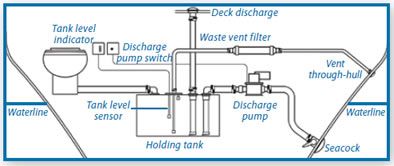
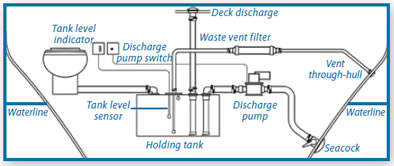
This illustration is one example of a proper onboard sewage-handling system. This one is suited for boats cruising areas where pumpouts are readily available. Instead of a Y-valve and anti-siphon loop, multiple check valves prevent back-siphoning. Most contemporary manual-flush systems incorporate a Y-valve that diverts waste to the holding tank or overboard. Note the tank-vent through-hull fitting placement above the waterline and the deck-level pumpout discharge.

As I plumb the archives for holding tank replacement info, I find excellent related articles (PS, February 2012, March 2012, and April 2012); all remind me to build in good ventilation. However, I am unable to find guidance on the merits of ventilation fittings. These stand at the interface of tank gasses and other contents trying to get out, and the marine environment trying to get in. Issues such as shape, location, mounting, and materials concern me. Can you bring some fresh air to vent fitting merits?

James Lavery

Hoku Ke’a, Southern Cross 31

Seward, Alaska

When it comes to plumbing holding tanks and their vent fittings, there are a few rules of thumb that we recommend following:

• Holding tank vents should be plastic, not metal. There are no metals that deal well with the corrosive gases being vented; all metals will either discolor or pit in this application.

• A simple through-hull design is best as it allows you to backflush the vent using a garden water hose. Follow the American Boat and Yacht Council (ABYC) standards for installing a through-hull above the waterline (section H-27), and be sure to include a beefy backing plate. Adding a seacock (PS test, Sept. 1, 1994) to the setup isn’t necessary, but it would add security.

You can find guidance on installing through-hulls and seacocks in Nigel Calder’s “Boatowner’s Mechanical and Electrical Manual,” on the BoatUS website, www.boatus.com, and on the PS website under “Fair Through Hull Fittings.”

• Clam shell vent covers should be avoided, but the worst type of vent for this application, in our opinion, is the chrome, 5/8-inch fitting with an integral screen and cover. Commonly used on power boats, this style of vent fitting is too small (it should be at least an inch); the screen can clog up; and the cover inhibits backflushing.

• A holding tank vent must be located above the heeled waterline (usually led from a high point in the plumbing). Use commonsense when choosing the location: Place it away from the cockpit and galley ports. (We’ve seen vents installed in some creative and troublesome places—like an anchor locker aboard a Tartan 34 and upwind of the cabin on a PDQ32—and nothing ruins an appetite like a holding tank off-gassing!)

• The vent line should originate from the tank’s centerline, both fore-aft and port-starboard, to avoid clogging from sloshing liquids.

• If your vent is properly sized (at least 1 inch; the bigger, the better), cross-ventilation is not usually necessary. However, if you use smaller vents—or want added ventilation—you can plumb two vents into the holding tank and run them to opposite sides of the boat.

• There should be no electrical components in the tank because of the risk of methane gas explosions. This is a Coast Guard regulation—and it may be obvious—but it’s worth mentioning.

Read More on These Topics
  • Systems & Propulsion

Comments (2)

Check out our three-article series on holding tank sensors (internal sensors, external sensors, and a long-term report) which shows the various type. Here's one. http://www.practical-sailor.com/issues/35_7/features/Holding-Tank-Sensors_5799-1.html

Posted by: DARRELL N | January 25, 2013 9:54 AM    Report this comment

The last bullet says, "There should be no electrical components in the tank", but the figure seems to show an electrical tank level gauge (the sort with three level switches) inside the tank.

Posted by: W S M | January 25, 2013 8:48 AM    Report this comment


Add your comments ...

New to Practical Sailor? Register for Free!

Already Registered? Log in

Forgot your password? Click Here.

Advanced Search

Related Items

Articles

  • The Fine Art of Sensing the Wind
  • Propane-powered Propulsion

Current Issue

Cover Image

June 2013

  • Mainsheet Tackle Bench Test
  • Kids’ Life Jackets for Active Sailors
  • Dehumidifier Field Tests
  • Shockles Snubber Test
  • Summer Sailing Gear

Subscribe Today

Back Issue Archive

Resources

  • Practical Sailor Dinghy Survey Results
  • DIY Boatyard Survey
  • Sailboat Reviews - Index
  • DIY Projects
  • Bookstore
  • Issue Archives
  • Other Resources
  • Customer Service
  • About Us
  • Home
  • Subscribe
  • Give a Gift
  • Renew
  • Products
  • Customer Service
  • Privacy Policy
  • About Us
  • FAQs
  • Contact Us
Practical Sailor

© 2013 Belvoir Media Group, LLC. All rights reserved.