The compressed gas and inflation system is regarded as the heart of the inflatable life raft. Mechanisms that trigger inflation can vary by manufacturer. The gas used to inflate the raft is usually the same—a dry mixture of carbon dioxide and a trace of nitrogen. During inspection, another source of gas is used to inflate the raft. Makers warn against testing your own raft by inflating it as this can introduce water vapor to the inflation chambers that can cause problems over the long-term if not removed before repacking. In recent years, two life raft makers Viking (Thanner 65-type valve; recall announced in 2007) and Switlik (S-2630 inflation valve; recall announced in 2008) have issued voluntarily recalls due to concerns about the inflation valves.
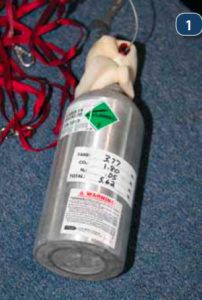
1. A gas canister used to inflate a Winslow coastal raft clearly indicates the gas mixture used in the tank.
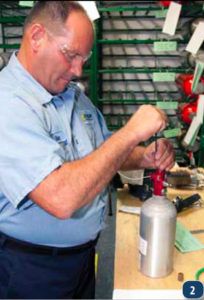
2. A technician at Winslow inspects the Miranda Research inflation valve for a Winslow life raft. Made primarily of lightweight anodized 6061 aluminum, the two-piece cutter type valve is versatile and considered to be very reliable, but like virtually all inflation systems, it is not immune to corrosion—thus the need for routine inspection.
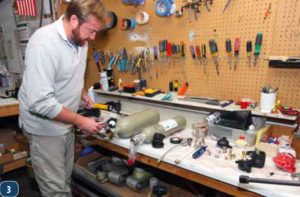
3. A technician at Landrigan Corp. inspects canisters prior to servicing. O-ring gaskets on the inflation systems are always replaced.