



The Allmand Sail 31
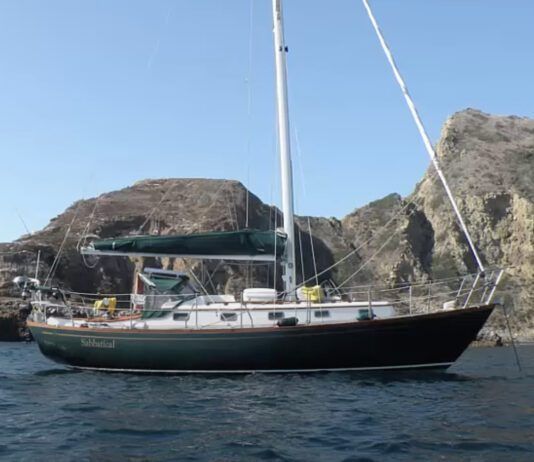
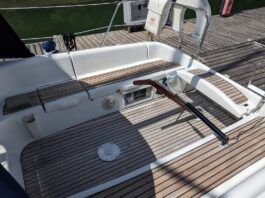
We were somewhat surpised, and impressed by the number of people living aboard the Allmand 31. For her size, she certainly does offer much space below and in the cockpit (one owner said shell easily sit six or seven in the T-shaped cockpit).The wide beam gives her a good deal of initial stability, though this is not the kind of hull form that you want to capsize as inverse stability will be greater than on a narrower boat (and one with a deeper keel).
Shannon Shoalsailer 35
With just 30 inches of draft, this model simplifies the fine art of gunkhole cruising.
Hunter Factory Blends Old and New Technology
The Hunter 33 is built in Alachua, Fla., using high-quality resins and laminates and conventional open molding hand-laminating processes.
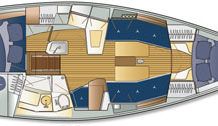
Tartan 3400
Treading a fine line between speed and comfort, Tim Jackett’s new 34-footer takes advantage of an epoxy hull and carbon spars
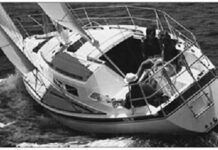
Cal 31
The Cal 31 is the thirteenth Bill Lapworth-designed Cal boat between 27' and 34' built by the Costa Mesa, California firm. Cal, a pioneer in fiberglass sailboat construction, later became a division of Bangor Punta Marine, whose boatbuilding group also included O'Day and Ranger. Cal boats went out of production in 1989. Cal and Bill Lapworth are best known for the breakthrough Cal 40, which many years ago began the trend toward moderately light displacement, fin-keel spade-rudder ocean racers.
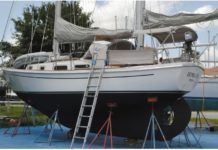
Seaworthy and Solid Seawind II
The hull of the Seawind II is a solid lay-up. The deck and cabin trunk are balsa cored. The top of the coachroof, in the way of the deck-stepped mast, is cored with solid, filled epoxy for greater compression strength.
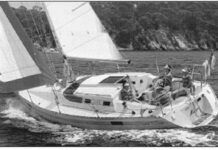
Beneteau Oceanis 350
Beneteau is the largest builder of sailboats in the world. The French company has made its mark not only in Europe, but in the U.S. as well, opening some years ago a plant in Marion, South Carolina, with headquarters in Charlotte, North Carolina. Probably more than any other company, Beneteau also has influenced sailboat styling--the so-called Euro-style, typified by smoked wrap-around windows, scoop transoms with molded-in steps, and lots of curvy interior shapes. The Oceanis 350, built between 1986 and 1993, is a reasonable example of Beneteau's impact on the sailboat market. About 144 were built in the US, more in Europe.
PDQ 32
The PDQ 32 was introduced in 1996. The concept was to offer a smaller, lighter and less expensive alternative to the PDQ 36. One of the things we like about PDQ boats is the quality materials and generally clean workmanship. A modified epoxy resin (AME 5000) and tri-axial knitted fiberglass fabrics are used in the hull and deck. The mast is supported in part by a carbon fiber-reinforced deck beam. The hulls are solid glass below the waterline and cored with Klegecell foam above the water, an arrangement we think makes a lot of sense. Each hull has an air-tight comparatment forward, which provides a measure of safety in the event of collision, and the keels also have sacrificial sections. When you poke around in lockers, you don't see a lot of unfinished glass.
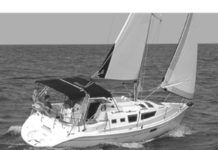
Three Big-Three 30s
The Beneteau 311, Catalina 310, and Hunter 326 represent what could be called 'entry-level' cruising boats from the major makers, and here's how they could be compared...
Mirage 33 Used Boat Review
Mirage Yachts Limited was a Canadian boat builder located in Quebec. The first production boat was a Mirage 24 introduced in 1972, their first...
How Long Do Sails Last?
How long do sails actually last? Sailmakers often say cruising sails last around 10–15 years, but what happens when you discover a sail that’s...



Latest Sailboat Review

Jeanneau 55 Boat Review
This recent sailboat from Jeanneau may as well be a spaceship. They’ve taken all the time-honored designs of a monohull aft cockpit and turned...