



Taking Our Test Anchors Out for a Wiggle-walk
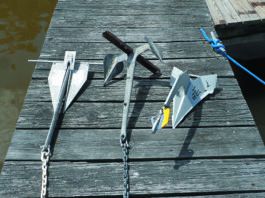
First, we established baseline holding capacities for the 2-pound anchors by pull testing each anchor after letting it settle into the bottom for 10...
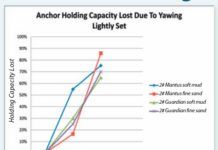
Deep Anchors Stay Put in Moderate Yawing
Setting history matters. If the anchor is deeply set, a good portion of the rode is pulled underground, the anchor is in firmer substrate,...
Fad or Function? Fathead Sails Offer A Little of Both
Full-length battens create a compression load on the luff end, requiring ball bearing luff car system for sails over about 300 square feet. Off...
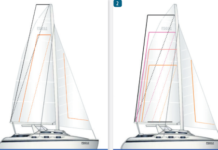
Finding Balance with Your New Fathead Sail
The center of effort will move aft compared to a pinhead and forward compared to a full roach sail. Whether this is good or...

Pros and Cons of ‘Fathead’ Mainsail
The triangular mainsail of a Marconi rig has never been the most aerodynamic shape. The narrow tip produces wasteful tip vortices and little lift.
Developmental...
Steiner Stands By its Binos
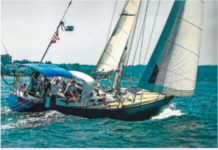
I recently had an experience with the service department at Steiner Optics that deserves mention in your Where Credit is Due, feature.
The Case of the Painted Jib
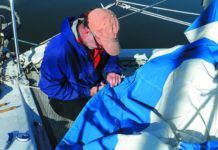
Polyester sailcloth is amazingly strong and durable stuff, often completing trips around the world or decades of weekend sailing. Its Achilles heel is the sun. After just 2-3 years in the sun, depending on the latitude, it becomes so rotted by UV that its little stronger than a cotton bed sheet. Mainsails are safely bundled under a Sunbrella cover. Nylon Spinnakers are bagged and stored below. Genoas, on the other hand, remain furled on the headstay, often year round, with the last 12 inches of the leach and foot continuously exposed.
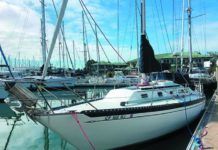
Mailport: Iron Keels, Clothes for Cold, Anchor Roll Bars
It would be useful for PS to list which manufacturers use iron encapsulated in their keel. I am surprised to learn that many old sailboats have iron instead of lead as encapsulated ballast.Edward Addeo via PS Online

Product Update: From Solar Panels to Electronic Flares
Several products caught our eye at the Newport Boat Show in Newport, Rhode Island in September, along with some updates to past tests.
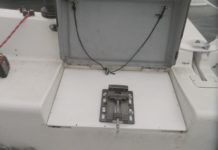
A Handy Cockpit Vise Is Ready in a Pinch
Most times when I need a third hand, I can secure whatever I'm working on by jamming it in the groove between dock boards, or against a piling and placing a knee on it, or some combination. Work surfaces can incorporate cleats or holes for this purpose, but sometimes more specific clamping measures are required.

O’Day 40 – A Budget Cruiser for the Bahamas
The O’Day 40 (1986) is one of those cruising sailboats that somehow slipped through the cracks of sailing history. Built during the final years...


Latest Sailboat Review
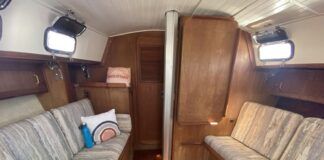
Caliber 33 Used Boat Review
The Caliber is a peculiar blend of tradition and innovation, of security and performance, of practicality and pizzazz. All of the owners we heard from were "satisfied." One called the 33 his favorite boat over six decades of sailing.