


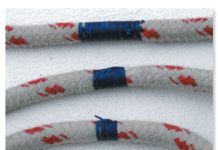
Fitting a Roller Furling Line
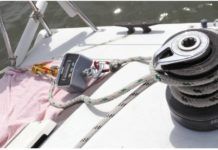
Replacing the roller-furling control line is an easy do-it-yourself job for the boat owner. Inexpensive, double-braid Dacron is a fine choice for furling lines on most boats shorter than 40 feet. On longer boats, you can opt for a furling-line material of more esoteric double-braids with less stretch. However, any line smaller than 3/8-inch diameter is too difficult to grip.
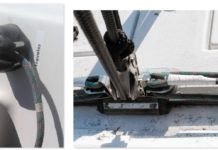
Testing a Dynamic Traveler
Sailors gaze longingly at the rope wall at the local chandlery, coveting rope made from exotic fibers that promises ultra-low stretch and light weight, perfect for every halyard, sheet, and running-rigging application. But are they really? Certainly, there must be applications where a little stretch is a good thing, perhaps the best thing.
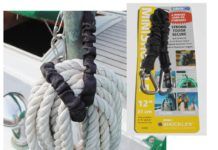
Gear Wrangler: Davis MiniShockles
When it comes to boats, theres never a shortage of stuff to secure, coil, or hang up. Bungee cords are the default go-to in many cases, but they gradually lose strength and degrade over time due to UV damage; also, the hooks rust and can scratch finishes. We recently looked at a product thats advertised as being a bungee cord on steroids: the Davis Instruments MiniShockles.
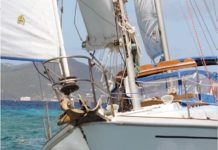
A Sunny Look at Ketches
My affinity for cruising ketches like the Allied Seawind II we feature this month runs contrary to the view of their many detractors. Their criticism goes something like this: Ketches were popular in early days of cruising when undersized winches and friction-bound hardware conspired to make handling large sails a chore. With efficient winches and modern hardware, split rigs are obsolete on boats under 50 feet, they say.

Dinghy Anchors: Big Anchor Tech Scaled Down
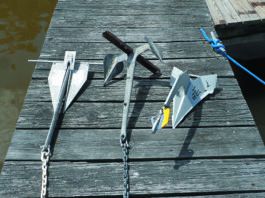
Sailors spend considerable time pondering their anchoring arsenal for the mothership, but what about the dinghy? With the new Mantus Dinghy Anchor, it seems that all of the design schools are now represented in small sizes. We were interested to determine which of these might offer the best performance.
Testing the Limits of Tiny Anchors
Each anchor was pulled in both a straight line and at 90 degrees in both soft mud and firm sand at a 10:1 scope. All findings regarding load were recorded with a calibrated load cell. Testers performed the 90-degree test by lightly setting the anchor (with a 15-pound load in mud, 40 pounds in sand) and then slowly pulling at a 90-degree angle, as though the wind or tide changed. Additionally, each anchor was used day-in, day-out aboard an inflatable dinghy to evaluate ease of use and real-world effectiveness.

The Science of Headsails Part II
The right roller-furling headsail is as beneficial to a sailor as a good zoom lens is to a photographer. But just as the zoom lens has limits, even the best furling headsail is challenged at the extreme ends of its range. In the October 2015 issue, we explored the basic sail needs of a daysailor. For this report, the second and final in our series on headsails, we asked five professional sailmakers from around the country to weigh in on the ideal sail inventory for coastal cruising.

Tame Bigger Breezes with a Forestaysail
Getting rid of the big genoa is usually easy thanks to roller furling, but what do you do then? Changing sails on the furling unit is a daunting task when short-handed, and sailboats don't power particularly well in a big sea. Heres an easy, safe, and seamanlike solution: Set your boat up with an inner forestay, and when these conditions arise, roll your big genoa up, set your forestaysail, and away you go.
Adding a Solent Stay
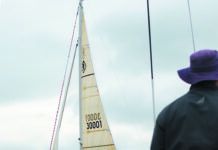
Whether you view it from the top down or the bottom up, a Solent rig needs to be carefully thought out, well-engineered, and strategically located. Some sailors add a short bow sprit or U-shaped, tubular extension that includes a bobstay and supports the attachment of a new headstay. The old headstay chainplate becomes the new tack point for the Solent stay. Another approach is to retain the existing headstay and simply attach a new tang just a bit below the headstay sheave box. Then add a deck fitting to attach the Solent stay and tack the sail(s). The deck must be reinforced with a transverse member, or a tie rod must be mechanically fastened to the stem so that the tension loads don't damage the deck.
Untangling Furling-line Fairlead Logistics
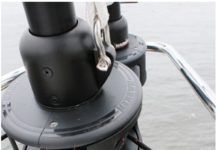
Headsail furling on sailboats 40 feet and shorter should be able to be accomplished with a hand-over-hand pull on the furling line. If a large genoa is set and the breeze fills in abruptly, it may take a little coaxing with a winch to get things going, but when its a fairly light-wind day and you need to start cranking away on a primary winch to instigate the furl, something is wrong with the system.

O’Day 40 – A Budget Cruiser for the Bahamas
The O’Day 40 (1986) is one of those cruising sailboats that somehow slipped through the cracks of sailing history. Built during the final years...



Latest Sailboat Review
Island Packet Estero Used Boat Review
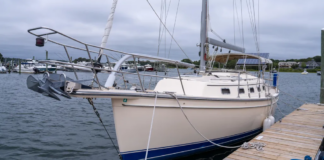
Florida-based Island Packet targets a relatively narrow niche, so the toughest competitors to its new boats are often older Island Packets. Introduced in 2010, the 36-foot, shoal-draft Estero is the company’s latest attempt to introduce a distinctive model that doesn’t stray too far from the company’s proven formula for success: moderate displacement, full-keel cruisers designed to be lived on, sailed far and in comfort, and endure the bumps, scrapes, and storms that cruising boats inevitably encounter. After sailing the Estero on Florida’s Sarasota Bay and inspecting its interior, construction, and systems, Practical Sailor testers noted that the shoal-water cruiser will appeal strongest to Island Packet fans who’ve been waiting for a shoal-draft, easy-to-sail boat that compares to the IP37 in terms of interior space. These strengths will be most apparent on intracoastal or riverine adventures like the Great Loop.