


A Look at the Latest Generation of Genoa Furlers
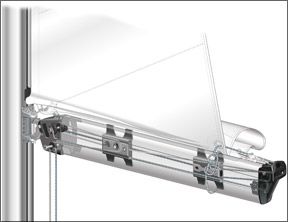
To get an idea of whats on the market and see how the newer products fare against the simpler, tried and true furling systems, Practical Sailor rounded up 11 new headsail furlers suited for 30- to 35-foot sailboats. This, the first of a two-part report on the evaluation, focuses on the seven products that use a head-swivel design and range in cost from $950 to $3,200. (The report of integral systems will follow in an upcoming issue.) The following furlers were reviewed: Facnor LX 130, Harken MkIV and Cruising 1, Profurl LCI32, Schaefer 2100, Furlex 200S (Selden Mast), and US Spars (Z-Spar) Z-780.
Synergy Dock Line Stands Up in Tests
In July 2008, Practical Sailor looked at products for docking, anchoring, or mooring in a storm. Among those mentioned was the Synergy docking line, an abrasion-resistant polyester braid with a short length of industrial-grade rubber in the core. Synergy also makes a stretchy, floating tow-rope for dinghies. We put Synergy dock lines into use for six months on a fixed dock and during a two-week Mississippi River delivery cruise. They held up as well as similar braided lines and proved to be more convenient to use than its nearest comparison, a dock line with a rubber snubber. One drawback noted was that the woven cover was more prone to snagging than more tightly braided lines.
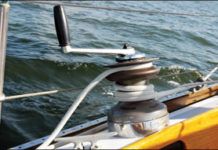
Winch Makeover
The Winchmate is one answer for sailors who are considering upgrading to self-tailing winches but find the price tag too intimidating and have otherwise perfectly functional non-self-tailing winches that are too good to toss out. Now theres another option: Older Barient or Barlow winches can be retrofitted with a carefully machined upper drum assembly that adds a rugged and reliable self-tailing feature. To test the concept, we retrofitted a set of near museum-aged Barlow two-speed 28s with the easy-to-install Winchmate system. Combining the upgrade with normal annual cleaning and maintenance makes the changeover quite simple and straightforward. The process can be "e-assisted" with Winchmates step-by-step online installation video.With the drum removed and bearings, gears, and pawls cleaned, greased and reassembled, a spindle extender is threaded to the top of the winch spindle. A Delrin spindle extension bushing is added, and attention is then turned to the drum itself.
Furling-friendly Storm Sails: Are They a Sensible Solution?
The advent of roller-furling headsails has generated a new area of concern for sailors: the inability to hank on a storm jib when the need arises. Practical Sailor prefers a dedicated storm jib on a staysail stay or a storm sail on a solent stay, over any over-furling storm sails. That said, Practical Sailor did evaluate two products that claim to restore the missing storm jib capability on vessels with roller-furling headsails. Testers compared the ATN Gale Sail and the Storm-Bag from Banner Bay Marine, two very different products. The evaluation compared basics such as cost, quality of construction, ease of use, and other characteristics related to each particular sail design.
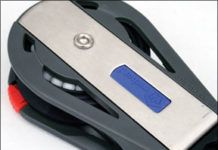
Practical Sailor Tests and Reviews the Latest in Boat Ratchet Blocks
The racket block is one of the most recent innovations in the world of line-handling blocks. The most common use of a ratchet block is on smaller racing boats, where you are adjusting a spinnaker sheet or mainsheet by hand, without using a cleat. Uses on larger boats include running a line through a ratchet block when releasing the control line on a headsail furler, and for traveler control lines and genoa lead adjusters. In a search for the best ratchet block, Practical Sailor tested four ratchet blocks with on/off switches; three ratchet blocks with auto-sensing that will automatically flip the ratcheting on or off; and one ratchet block that has both an on/off switch and an automatic sensor. The head-to-head ratchet block comparison included products from top marine hardware makers Selden, Wichard, Ronstan, Holt Allen and Harken.
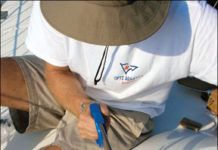
Practical Sailor Tests the Alado Jib Furler
Practical Sailor finds the Alado Nautica headsail furler to be easy to install and a worthwhile sail-handling tool. One feature that sets the Alado apart from other jib or genoa furlers is its staggered slotting of five-foot foil sections that slide together and interlock over a conventional wire or rod headstay. This design allows the do-it-yourselfer to fit each foil section over an attached headstay, and simply push the formed furler up the wire or rod. Mainstream headsail furlers tend to be assembled on the ground and installed with the mast horizontal. The Alado furlers design uses integral halyards to place a compression load on the foil, eliminating the need for Loctite, set screws, and a top swivel. We tested the Alado over five months of coastal cruising and daysailing.
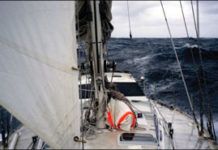
Heavy Weather Sailing Gear
From sea anchors, drogues, and trysails to forereaching and heaving to, tactics and gear for surviving a storm at sea vary greatly. During a high-latitude circumnavigation, Evans Starzinger and Beth Leonard, aboard their 47-foot Van de Stadt sloop, had several opportunities to test heavy-weather sailing tactics. The couples main storm gear was a Galerider sea drogue, made by sailmakers Hathaway, Reiser and Raymond, is a webbing bowl with a wire hoop. Deploying the drogue involved a bridle of strong nylon lines connected to the Galerider rode via an oversized galvanized swivel. Starzinger and Leonard used the Galerider when running before the wind in gale-force conditions. The drogue helped slow the boat, kept it from surfing down the face of a wave, and provided directional stability, which allowed their autopilot to maintain control. Drogues and other storm-survival gear and tactics are particularly necessary for short-handed crews and boats that tend to surf in heavy weather. Other storm gear for sailboats that Practical Sailor looked at included the Jordan Series drogue and the Seabrake drogue.

Farewell to Skip Allan’s S/V Wildflower
Anyone who has ever run before a gale knows how exhilarating it can be. On the right boat, in the right conditions, the adrenaline rush is as intense as any we’ll feel in this world. Bull riders, surfers, and skydivers get a few seconds of excitement. An ocean gale can last for days ... and that’s where the problem lies. With your senses completely in tune with the boat, wind, and sea, the experience of hurtling down an ocean wave stirs the soul. But as the hours pass and day turns to night, the thrill gives way to exhaustion. Mostly, you’re too busy to be afraid, but each mountain of green water that fills the cockpit brings doubt. How high will these waves get? How long can I last? Even with a drogue streaming off the stern to slow down the boat, running before storm-driven waves entails a great deal of risk. There’s danger enough aboard a fully crewed boat, as the rig, sails, and steering gear get pushed to the brink.
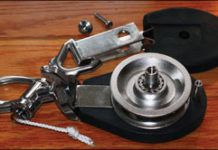
Snatch Block Test Update
Practical Sailor evaluated six snatch blocks in August 2007, with the Harken 1609 receiving the nod as the best all-around snatch block. As a follow-up, Practical Sailor compared two Ronstan snatch blocks, the Ronstan 6831 and the Ronstan 6751, to the Harken block. The Ronstan RF-6751 sports an investment-cast stainless-steel sheave, a heavy-duty latch, and side plates covered with thick, thermoplastic rubber cheeks. The block’s ruggedness and user-friendly latching function make it ideal for heavy duty applications on a cruising boat. Ronstan’s RF-6831 has a stainless-steel frame and tough PVC cheeks. It is representative of Ronstan’s alloy-sheave blocks with its high-quality construction, mid-range cost and working load. Although Practical Sailor prefers the Harken for everyday use, both Ronstan blocks are well-suited for cruising sailors.
A Tale of Two Trysails
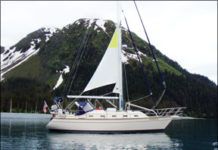
Storm trysails rarely get the close look they deserve. Designed to replace the mainsail in a severe storm, it spends most of its life in the sail locker. Trysails should be cut flat, and the center of effort located to optimize stability and helm balance. Generally, the trysail’s clew should be just above the boom, its tack just above the furled mainsail’s head and its head near the mid-point of the mast. It is best to work closely with a sailmaker or a boat’s designer to get the right size and shape trysail. When inspecting or commissioning a trysail, pay close attention to detail at the head, clew, tack, leech, and luff.

Morgan 382 – The $30K Boat Nobody Talks About
The Morgan 382 might be one of the most overlooked cruising sailboats ever built. Designed by legendary naval architect Ted Brewer and produced between...


Latest Sailboat Review

Jeanneau 55 Boat Review
This recent sailboat from Jeanneau may as well be a spaceship. They’ve taken all the time-honored designs of a monohull aft cockpit and turned...