





Riding Sails to Tame Those Anchor-Dancing Boats
Practical Sailor recently evaluated a radically new designed riding sail, the FinDelta Anchoring Sail from Banner Bay Marine, which uses three panels instead of the traditional single panel. According to Banner Bay, as the boat tries to swing, the sails forward fin generates a thrust vector to one side only, gently realigning the boat. By comparison, a traditional, single-panel anchoring sail still allows some degree of sailing at anchor as the sail backs and fills from one side to the other, often resulting in flogging. The FinDeltas design also reduces one of the most common complaints of traditional riding sail users: noise. The FinDelta doesn't require attachment to the backstay-an excellent conduit to transmit the vibration from flogging anchor sail-and so noise is greatly reduced. While the single-panel riding sail has served sailors well for centuries, this new design intrigued our testers, and a head-to head-comparison between it and the traditional Sailrite riding sail was launched.

The Multifarious Mainsheet
The mainsail is a big part of the motive power of almost every sailboat. The art of mainsail control, however, is a relatively modern one. One tool that greatly facilitates mainsail control is the traveler.

High-Tech Rope Test
We'd read about problems with terminations in high-modulus line. They're true.

Buyers Guide: Choosing a New Cruising Main
As with any big ticket item, choosing a new mainsail involves a number of choices, each of which are driven by an equally diverse list of factors to consider, from the type of boat (cruising, racing sailboat), and area sailed (inshore waters, coastal waters, or bluewater), to the type of sailor you are (performance-oriented hard charger or weekend warrior). Practical Sailor offers a step-by-step rundown of the available options and the selection process our testers experienced when we shopped for a new mainsail for our Chesapeake Bay test boat. While the decisions will vary, the exercise can serve as a template for any sailor looking to upgrade a mainsail.

Un-Stepping the Mast for America’s Great Loop
As a family on a sailboat traveling on the Great Loop, our crew of four aboard Fika was a bit out of the ordinary....
Plea-Free Tacking
I wonder how many people have given up sailing because of the effort it takes to tack a genoa shorthanded. Aside from hitting hard...
Offshore Log: Rigged For Downwind
Nick Nicholson critiques his downwind rig that uses a carbon fiber spinnaker pole from Hall Spars with Forespar end fittings.

Snatch Block Test Update
Practical Sailor evaluated six snatch blocks in August 2007, with the Harken 1609 receiving the nod as the best all-around snatch block. As a follow-up, Practical Sailor compared two Ronstan snatch blocks, the Ronstan 6831 and the Ronstan 6751, to the Harken block. The Ronstan RF-6751 sports an investment-cast stainless-steel sheave, a heavy-duty latch, and side plates covered with thick, thermoplastic rubber cheeks. The block’s ruggedness and user-friendly latching function make it ideal for heavy duty applications on a cruising boat. Ronstan’s RF-6831 has a stainless-steel frame and tough PVC cheeks. It is representative of Ronstan’s alloy-sheave blocks with its high-quality construction, mid-range cost and working load. Although Practical Sailor prefers the Harken for everyday use, both Ronstan blocks are well-suited for cruising sailors.
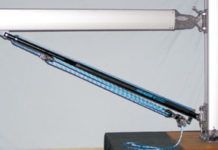
Solid Vang Showdown
Vang Master pushes to the top; steer clear of the Ocean Vang
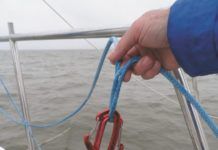
Adding a Polyester Cover to Dyneema Single Braid
Extremely low friction allows Amsteel and other high molecular weight polyethylene (HMPE) lines to run like lightening through low friction rings. Unfortunately, they also run right through cleats, jammers, and your hands. If a jammer did hold-and it wont-the load would probably exceed the capacity of any device that matched the lines tiny size.

How Long Do Sails Last?
How long do sails actually last? Sailmakers often say cruising sails last around 10–15 years, but what happens when you discover a sail that’s...



Latest Sailboat Review

Jeanneau 55 Boat Review
This recent sailboat from Jeanneau may as well be a spaceship. They’ve taken all the time-honored designs of a monohull aft cockpit and turned...