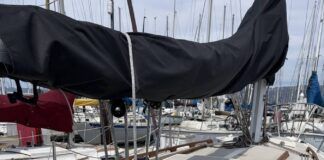

Canvas dodgers and biminis are the hallmark of a cruising yacht, keeping the sun at bay and allowing the crew to “dodge” the worst of the weather. On board, canvas also protects sails, windows, and machinery. Collectively, these represent a substantial financial investment, and we wanted to find the best way to protect the investment and get the most life out of the canvas.
Sunbrella makers recommend that routine maintenance include frequent freshwater rinsing plus spot cleaning the fabric. After a more thorough cleaning, Sunbrella advises owners to apply a treatment (specifically Gold Eagle Products’ 303 High Tech Fabric Guard) to restore the fabric’s repellency. In this article, we take a look at treatments designed to keep on-board canvas water repellent and looking its best.
Waterproofing canvas is based on making the surface hydrophobic enough that water cannot wet the surface. Factory canvas comes with some pretty effective treatments, but after two to three years in the sun, they tend to wear off. Treatments containing waxes, PTFE (Teflon), and silicone promise to renew the repellency, if only for a month or so.
When we refer to “canvas” here, we mean acrylic marine fabrics like Sunbrella, not cotton duck, which some traditionalists still use. The chemistry of cotton and acrylic are quite different—cotton accepts treatments more readily, but acrylic is more naturally repellent—and we’ve previously tested water repellents for cotton duck (PS, June 2004).
For maximum water repellency, boat owners could use impervious waterproof fabric instead of canvas, but that typically isn’t a good idea. Waterproof sail covers hold moisture, mildewing sails more quickly. Waterproof dodgers sweat and hold condensation, drying slowly and mildewing. Waterproof machinery covers would trap salt and humidity, accelerating corrosion. For most on-deck equipment-protection tasks, water-repellent, breathable, durable acrylic fabrics are best. These include Top Gun, Weathermax, and Sunbrella, which we tested and reported on in the December 2011 and November 2012 issues available online.
For more mildew prevention tips, check out Volume 1 of The Mildew-Free Boat Series from Practical Sailor.