


Marine Weather Forecasting
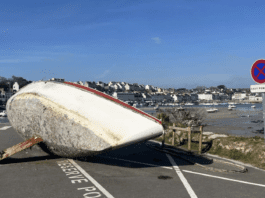
Over the last few decades, theres been exponential growth in the availability of accurate weather forecasts and the net result is safer voyaging. Government spending on weather data gathering and forecast development has soared. Satellites and data buoys have filled in some of the oceanic gaps caused by an absence of weather balloon sampling at sea. State of the art, algorithm-driven, model data and ensemble-based forecasting have turned electronic guesswork into a better understanding of atmospheric volatility. The net result is an increase in the validity and reliability of marine forecasts and a trend that has stretched 24-hour forecast accuracy into 48- and 96-hour time frames. So, if anything deserves the label don't leave homeport without it, it is todays, better than ever, marine weather forecast.
Fuel Level Sensor/Return Line Durability
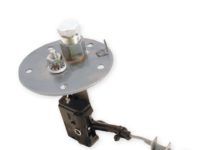
I have a 2008 Gemini 105MC catamaran that I purchased new, and the fuel tank level indicators on both tanks failed a couple years ago. However, I noticed that the fuel-return line is attached to the top of the fuel level sensor. It seems to me that this may be the problem-fuel spraying down on the level indicator shortens its useful life. All the other Gemini owners that I know also have had the level indicators fail. It is not a huge problem. My tanks are transparent so I can see the fuel level in the tanks. My friends who have black non-transparent tanks use a wooden stick-which can be inserted down the fill hose.

Testing for a Life at Sea
Without the keen eye of experts who know what to look for, product testing can offer only a partial picture. The insight gained through hard won experience becomes more valuable at sea, which is why this months issue focusing on offshore sailing turns to four noted experts for advice on topics ranging from gear selection, to weather forecasting, to boat maintenance.

Best Boat Bottom Paint 2017
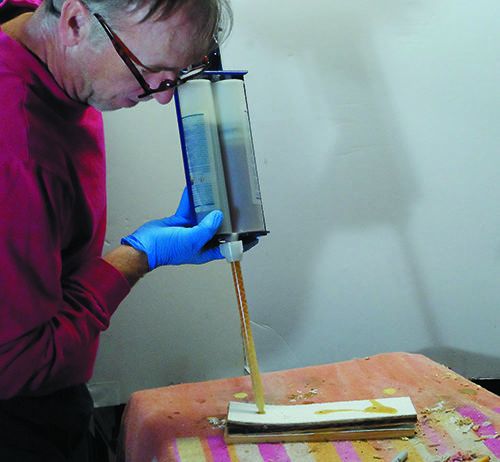
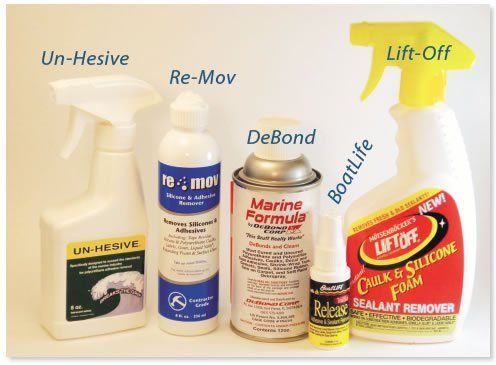
The list of contradictions that define our sailing affliction is long. We need an anchor that buries deep but can be freed at a moments notice. We want a sealant that sticks to anything, but releases its grip for easy disassembly. We want a boat that can weather any storm, and still make way under sail in a whisper. And we want an antifouling paint that repels every sea creature, but will never harm the sea.
Tests Include Panel Testing & Field Trials
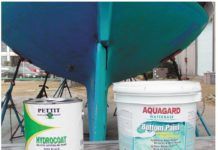
Our test fiberglass panels are taped into sections and paints are applied following the manufacturers instructions. Testers rate the paints with no reference to the paint name or manufacturer.

Where Credit is Due: Promariner Steps Up with Inverter Fix
I just wanted to take a moment to pat ProMariner on the back for superb customer service. We appreciated our ProMariner True Sine 1500 for about 6 months when it apparently overheated in our warm engine room. The failure resulted in some melted fuses and burned traces. We were able to repair the unit at sea. When querying PMs support team about the problem, they insisted on replacing the unit. No hassle, no argument, even though the warm engine room contributed to the melt-down. This customer service is rare in our experience. My hat is off to team ProMariner.
Propeller Paints that Last
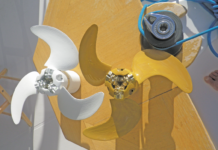
A cheap, effective antifouling paint for a propeller is as rare as a good pun. The coating must not only ward off all marine growth, it must present a smooth slick surface that can stand up to the constant water friction when the boat is under power. And in the case of a folding prop, the coating must also adhere in nooks and crannies and, in some cases, even withstand metal-to-metal contact. These demands are well beyond the reach of any run-of-the-mill marine coating. Thus, our search for-wait for it-a prop(er) paint.
What’s the Best Anode Material?
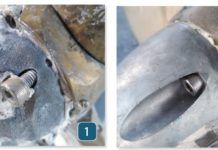
Every fall, as the hauled-out boats are sardined into boatyards, a walking tour reveals the casualties from the underwater war. Saildrives are deeply pitted and shedding paint. Bottom paint is burned near seacocks. Folding props no longer fold. Most often, these losses are blamed on the zinc anodes-or lack of them.
Measuring Anode and Cathode Degradation
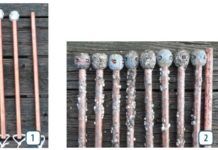
The anodes were cleaned, weighed, and installed on 2-foot lengths of 3/4-inch, copper pipe (type M), which were also weighed. We hung the samples between slips in the mid-Chesapeake Bay near Rockhold Creek for one year, cleaning quarterly to mimic light use. At the end of the test period, the samples were cleaned with a plastic scraper and scrub brush, and their interiors were scrubbed with a snugly fitted multi-knotted rope. Testers gave them a light acid cleaning to loosen barnacle residue and scrubbed them again before weighing them. We also measured potential driving force and current for each anode before and after exposure. Salinity at the test site varied from brackish to seawater salty. We will be testing in full-strength salt water for a followup article.
Durabak Nonskid Coating Long-term Test Update
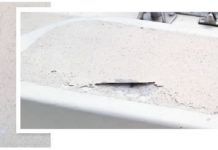
In the January 2012 issue, we evaluated the application ease and traction performance of do-it-yourself nonskid options. A few months prior to the report, a Practical Sailor tester applied the tests Best Choice pick, Durabak, to the coachroof of his Chesapeake Bay-based 1978 Union 36; this served as a real-world test of the coating systems application ease and coating longevity. That field test has reached the five-year mark, so we wanted to offer an update on the coatings long-term performance.
O’Day 40 – A Budget Cruiser for the Bahamas
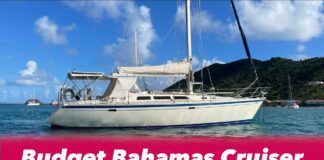
The O’Day 40 (1986) is one of those cruising sailboats that somehow slipped through the cracks of sailing history. Built during the final years...


Latest Sailboat Review
Island Packet Estero Used Boat Review
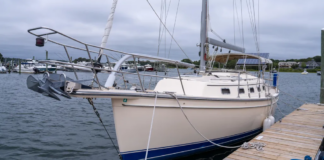
Florida-based Island Packet targets a relatively narrow niche, so the toughest competitors to its new boats are often older Island Packets. Introduced in 2010, the 36-foot, shoal-draft Estero is the company’s latest attempt to introduce a distinctive model that doesn’t stray too far from the company’s proven formula for success: moderate displacement, full-keel cruisers designed to be lived on, sailed far and in comfort, and endure the bumps, scrapes, and storms that cruising boats inevitably encounter. After sailing the Estero on Florida’s Sarasota Bay and inspecting its interior, construction, and systems, Practical Sailor testers noted that the shoal-water cruiser will appeal strongest to Island Packet fans who’ve been waiting for a shoal-draft, easy-to-sail boat that compares to the IP37 in terms of interior space. These strengths will be most apparent on intracoastal or riverine adventures like the Great Loop.