




Taking the Spill Out of Fill-ups
Fueling a boat has never been as easy as fueling a car. Spills-exacerbated by poorly designed fill pipes and vents-are common. The U.S. Environmental Protection Agency (EPA) has updated the fill and vent requirements on boats to prevent these spills, but they only apply to new gasoline-powered boats. New jerry cans designed to prevent spills and comply with new emission standards arent making things easier. Most are hard to control and slow during filling, spill prone, and break after limited use.

Practical Holiday Gift Ideas for Sailors
Looking for gift ideas for the sailors on your holiday gift list (or to add to your wishlist)? Here are some that will please a variety of budgets and sailors.

5 Sailing Book Gift Ideas
[IMGCAP(1)] If you have a sailing-photography enthusiast on your holiday gift list-or are like us, and simply enjoy the pleasure of poring over beautiful photographs of the sailing life-then check out these stunning coffee-table books that recently came across our desks. Yachting: A Visual Celebration of Sailing Past and Present (Adlard Coles, 2015, $23), written by Olivier Le Carrer, and Nic Comptons The Anatomy of Sail: The Yacht Dissected and Explained (Adlard Coles, 2015, $39, $20 Kindle)…

Cleaning the Holding Tank
Weve noticed an odor and a buildup of caked-on solids in the holding tank. My thought is to fill the holding tank with fresh water and the right additive, then let that slosh around underway, and then pump it out. What do you suggest for an additive?

Mailport: Custom Medical Kit, Bug-bite Solutions, and More!
I have taken courses (most recently with Jeff Isaac, organized by Ocean Navigator) on offshore emergency medical issues, and there are many who believe that suturing on board is generally not wise. Its much better to butterfly bandage or some other less zip-locked method of repair. The thinking appears to be that it is impossible to have a sterile environment on a vessel, so the bad stuff is likely to get locked into the wound, where it will cause infection. So, its much better to have a more open repair.
Revisiting the Rigging Quiz with Brion Toss
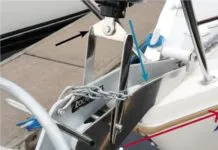
Reader Fred Jensen and his wife, Barbara, of Sandusky, Ohio, pointed out an error in our illustration in the August 2015 issue of Practical Sailor. The photo-illustration depicted a bow-roller and headstay, and lines indicated wire stays with turnbuckles that were required to counter the headstay loads when the boat is under sail. It was the published answer to a puzzle that rigger Brion Toss posted in the May 2015 issue of Practical Sailor in his photo-essay The Hidden Causes of Rig Failure. The corrected illustration appears at right.

Stitching Sails for Long Life
Spend some time around sailmakers who specialize in building sails for offshore sailors, and youll hear a familiar lament: If you do your job right, you might not ever see your customers again. This is particularly true if their clientele are sailors who are bound on oceanic loops, circumnavigations, or open-ended cruises.

Bottom Paint Makeover
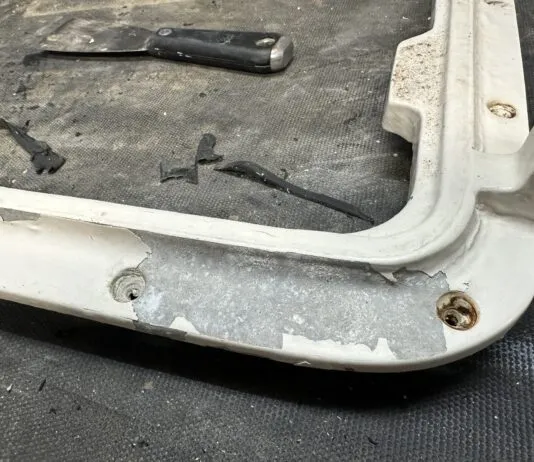
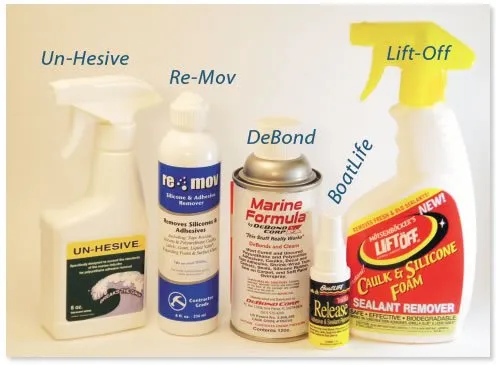
Practical Sailor has made its mark by diving deep into the boat owners rite of bottom painting. Over the years, we have slaved away, painting fiberglass samples with a multitude of formulations and placing them in harms way in various locations to gauge their performance. Weve come away with some strong ideas about what works and what doesn't for the do-it-yourselfer-and that includes the myriad ways boat owners can remove layers of bottom paint so they can start afresh.

Antifouling Paints Abroad
Practical Sailor has been conducting antifouling paint trials for years, but our focus almost exclusively has been on those paints that can be bought off-the-shelf at U.S retailers or are widely available in U.S. boatyards. Nevertheless, we often receive email questions from sailors abroad regarding antifouling paints sold in other countries. A number of readers have also have asked us about certain paints that are generally used only on commercial ships. These commercial paints can sometimes be procured at shipyards in major ports both in the U.S. and abroad.
Mailport: October 2015
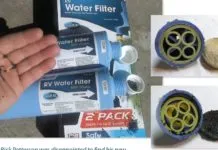
On the recommendation of Practical Sailors water filter test (see PS June 2015), I bought a two pack of Camcos RV Taste Pure water filters through Amazon after finding sediment in my water tank. One of the filters dumped 1/8-cup of the carbon/KDF granuals all over when I took the protective cover off the filter, and it continued to shed the media when I shook the filter. If I had connected the filter to my water supply, it would have contaminated my water system and probably ruined my water pump. Only one of the two filters is dumping carbon/KDF material, so I assumed that this is a product defect.

Lithium Batteries on Sailboats: The 3 Mistakes Everyone Makes
Lithium batteries are one of the most popular sailboat upgrades today—but they’re also one of the most misunderstood. In this Practical Sailor Saturday episode,...



Latest Sailboat Review
Island Packet Estero Used Boat Review
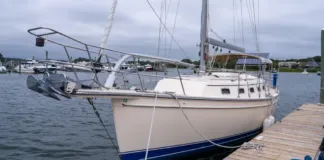
Florida-based Island Packet targets a relatively narrow niche, so the toughest competitors to its new boats are often older Island Packets. Introduced in 2010, the 36-foot, shoal-draft Estero is the company’s latest attempt to introduce a distinctive model that doesn’t stray too far from the company’s proven formula for success: moderate displacement, full-keel cruisers designed to be lived on, sailed far and in comfort, and endure the bumps, scrapes, and storms that cruising boats inevitably encounter. After sailing the Estero on Florida’s Sarasota Bay and inspecting its interior, construction, and systems, Practical Sailor testers noted that the shoal-water cruiser will appeal strongest to Island Packet fans who’ve been waiting for a shoal-draft, easy-to-sail boat that compares to the IP37 in terms of interior space. These strengths will be most apparent on intracoastal or riverine adventures like the Great Loop.