



Exposure Test Results: Varnishes, Teak Oils, and Other Exterior Wood Coatings
Exterior wood finishes-including one-part varnishes, two-part varnishes, synthetics, sealers and stains, and teak oils-were evaluated one year after application. Testers rated the wood finishes on ease of application, the integrity of the gloss and appearance, and how they fared over the 12-month period during which they were exposed to Florida sun and weather. Testers looked at color retention and gloss retention. After a year, 20 of the original 22 one-part varnishes were still performing well, and all six of the original two-part varnishes remained in the running. Varnish alternatives like teak oils and teak sealers struggled to make the 12-month cut, but the Cetol-coated panels still looked good. Products that were doing well 12 months after application included Interlux Cetol Marine and Cetol Marine Light, both with the clear gloss overcoat; Pettit Clear High Gloss and Pettit Wood Finish; Interlux Perfection; and Nautiking NautiThane.

Mailport: 12/09
I have a Pearson Ensign 1962 now at a slip in New Rochelle, N.Y. This season marked the first time we had the luxury of keeping our boat at a slip. In order to maneuver through the marinas byways without worrying, I bought a 24-volt Minn Kota outboard (80 pounds of thrust) and two 12-volt batteries, which I hook up in series. Not only am I able to stop start, turn, etc., in the marina, but-to my surprise-in the calm sound water, I can nip along at about 3-4 mph with myself, two crew, and the 3,000-pound boat. The result is that Ive only used my 5-horsepower Mercury outboard once this year. My electric outboard doesn't stall; it has variable speed like no ones business; reverses with relative ease, and is less expensive-though more cluttered-than the self-contained electric outboards you recently reviewed. Am I part of a growing trend or just weird? If the former then it might be worthwhile testing electric outboards for boats my size (22.5 feet) and commenting on their applicability.

Mailport: 11/09
To keep from being pulled under in a collision between a tanker and my sailboat, I "pulled the ripcord" to release the snap shackle on my Standard West Marine Safety Tether . The tether release lanyard was outfitted with a series of balls. (See bottom photo at right.) I had rehearsed reaching for and feeling the release toggle many times so it would come naturally in an emergency. The balls have a distinct feel. There was nothing on my PFD or foul-weather jacket that resembled them. The replacement tether I bought from West Marine (ISAF Specification Safety Tether, No. 9553504) has a new toggle on the snap-shackle release lanyard that consists of an open triangle of plastic. This is dangerous, in my opinion! In my first few hours of using the new tether, in moderate sea conditions, I managed to snag the triangular loop on something and release the snap shackle. I am now replacing all triangular loop pulls with bead pulls that I have crafted myself.
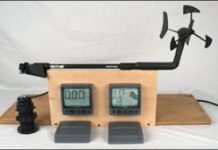
Testers Take Tacktick and Nexus Wind Instruments for a Spin
Practical Sailor testers compared Tackticks improved Race Master system to the Nexus Start Pack 3, a hybrid wired/wireless system. The Tacktick Micronet wireless wind instrument, a compact system featuring wireless display and a masthead sensor, has a strong following among racers. It has proven to be a good choice for those sailors serious about improving race performance as it has many options for tracking performance on the course in real time. Its ability to work with a 12-volt system makes it a good choice for small boats. The versatile, expandable Nexus hybrid has an impressive and intuitive interface and a graphic analog wind representation. It provides all of the basic functions a cruiser or racer uses most, and testers found the analog wind display appealing.
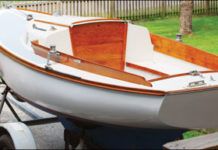
Topside Paint Exposure Test Checkup
In August 2008, Practical Sailor launched a topside paint test in search of a high-gloss, easy-to-apply, durable coating for fiberglass hulls. The initial report focused on the application characteristics for 29 topside paints, including multiple white coatings and a handful of colored topside coatings. This report taps the best topside paints after their being exposed to the New England weather for a year. Testers rated each paints appearance, abrasion resistance, scratch resistance, hardness, and stain resistance. PS compared seven enamels, 12 mono-urethanes, eight two-part linear polyurethanes (LPUs), and two water-based paints. After 12 months exposure, the majority of the topside paint test field was holding up admirably. Test paints included products from Interlux, Crystalac, Epifanes, Insignia Coatings, Kirby Paint Co., Pettit, Sherwin-Williams, Signature Finishes, and West Marine.
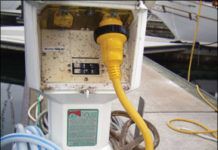
Shorepower Cop
Billed as the worlds only shorepower corrosion detector with reverse polarity indicator by West Marine, Marincos new Galvan-Alert attaches to your existing 30-amp shorepower inlet and power cord and monitors galvanic and stray current corrosion flowing through the green ground wire ground of your shorepower system. Appearance-wise, the GalvanAlert is similar to a miniature Marinco power cord. It is well constructed and utilizes the same plugs, connectors, and locking rings that are familiar to most every boater with an AC shorepower cord. The GalvanAlert has four LED indicators-a green LED to indicate power, a red LED indicating reverse polarity, and two other LEDs to show medium (green) and high (red) galvanic corrosion activity.
Affordable Marine Antifouling Paint
Practical Sailor tested bottom paints from seven major makers of boat maintenance products. In this report, we compare the 12-month performance of 39 ablative paints and 31 hard paints. We also offer the test results of 18 antifoulings after 24 months in the water, and rate the top specialty antifoulings in specific niches, such as eco-friendly bottom paints, aluminum-safe paints, race-ready antifoulings, fast-drying bottom paints, and budget bottom paints. The bottom paints were tested in both Florida and Connecticut waters. The manufacturers include Alwgrip, Blue Water, Epaint, Flexdel, Interlux, Pettit, and Sea Hawk. Some of the best bottom paints included Epaint EP-21, Pettit Hydrocoat, Epaint ZO, Blue Water Kolor, Interlux Fiberglass Bottomkote, and Sea Hawk Sharkskin.
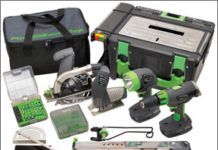
Shop-to-Go
It probably comes as no surprise to our readers that Practical Sailor editors are serious gadget junkies. Our jobs feed our habits with a steady supply of gear to play with, disassemble, and subject to mild abuse. The latest product to evoke the "kid in the candy store" reaction from our staff was the Power8workshop Delux. Powertools, in particular, hold a special place in our hearts, and this was a whole box of cordless powertools, neatly kitted in a plastic and stainless carrying case, promising workshop capability anywhere with space enough to put the 23-by-12-by-16-inch setup.
Mailport: 10/09
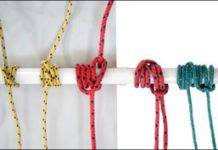
The way I was taught towing Lightnings to LIS regattas, you used a towing hitch around the mast for the line ahead and a similar hitch around the mast for the line to the boat astern. A towing hitch (two wraps around the mast, a wrap around the standing part, back the other way around the mast and two half-hitches around the standing part) could be cast off under tension or even eased under way to place the boat astern on the second wave. Bowlines, we were told, presented a danger of catching a finger in the knot if the towline came under tension while you were catching on or casting off the tow.Recently, a sailing director setting up a tow of Ideal 18s, directed us to tie a bowline with a generous bight around the mast and then to take up the towline from the boat astern and tie a bowline through the bight around the mast. He asserted that this would produce no pressure on the mast at all, as the forward pressure of the tow would be offset by the aft pressure of the boats behind. Can you advise on the best method for securing sailboats in a tow? And what is the optimal distance between boats in a tow?
How Do Acrylic Finishes Hold Up Compared to Boat Waxes?
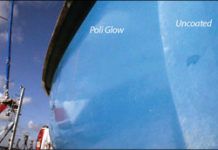
Our July 2009 issue compared 26 bottled waxes and gave an update on our test of 10 traditional paste waxes. This month, we offer a one-year checkup on acrylic coatings. Acrylic coatings differ from paste waxes in their chemistry and how they are applied. Acrylic finishes penetrate pores and chemically bond to the boats surface. We tracked down seven products, applied them to our blue-hulled test boat, and rated them at the one-year mark. Products tested were Vertglas from Lovett Marine, Poli Glow, NewGlass2, Star brite Glass Cote, Klasse High Gloss Sealant Glaze, Higley FiberGloss Restorer, and Presto Gelcoat Rejuvenator.

O’Day 40 – A Budget Cruiser for the Bahamas
The O’Day 40 (1986) is one of those cruising sailboats that somehow slipped through the cracks of sailing history. Built during the final years...


Latest Sailboat Review
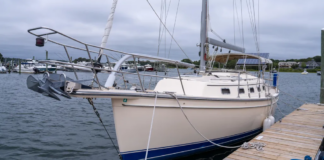
Island Packet Estero Used Boat Review
Florida-based Island Packet targets a relatively narrow niche, so the toughest competitors to its new boats are often older Island Packets. Introduced in 2010, the 36-foot, shoal-draft Estero is the company’s latest attempt to introduce a distinctive model that doesn’t stray too far from the company’s proven formula for success: moderate displacement, full-keel cruisers designed to be lived on, sailed far and in comfort, and endure the bumps, scrapes, and storms that cruising boats inevitably encounter. After sailing the Estero on Florida’s Sarasota Bay and inspecting its interior, construction, and systems, Practical Sailor testers noted that the shoal-water cruiser will appeal strongest to Island Packet fans who’ve been waiting for a shoal-draft, easy-to-sail boat that compares to the IP37 in terms of interior space. These strengths will be most apparent on intracoastal or riverine adventures like the Great Loop.