




Mailport: 08/09
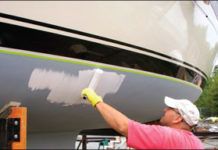
As a new boat owner, I have no end of questions, but here’s a quickie: I have recently had my boat hauled and sanded to the gelcoat, and repainted with all the right stuff. (The bottom was coated with Interlux CA Bottomkote.) Now, how often should I have a diver clean the underside, bearing in mind I live in San Diego? The service providers have a vested interest in selling frequent cleans—one company running a special at the moment wants me to sign a contract for a bottom clean every three weeks, but that sounds way too often to me. I realize it may well vary with geography and ambient temperature, but there should be some kind of general rule of thumb, perhaps?
PS Advisor: Synthetics for Marine Diesels?
Mobil 1 extended performance oils for automobiles are advertised as providing engine protection and performance at extended intervals of up to 15,000 miles or one year, whichever comes first. Its 5W-40 Turbo Diesel Truck oil meets American Petroleum Institute (API) standards for diesel truck lubrication, and except for the price ($5-$8 per quart, or three times the price of conventional multi-grade oil), would seem to be an attractive option for ocean voyagers who might otherwise have to carry out an oil change at sea. However, the official party line at Mobil 1, as we expected, is that you should defer to your manufacturer’s recommendation on oil type, weight, and service ratings appropriate for your engine. Typically, if an engine maker does certify the use of a high-mileage oil, it is in combination with routine sampling of the oil to determine its condition.

Mailport: 07/09
Were trying our best to provide subscribers with the most value for their money, but for now, we must continue our policy of charging everyone to download articles published more than two months prior. Subscribers get a discounted rate on these archive articles, available at www.practical-sailor.com, and all subscribers have full access to this months issue and the previous months issue, as well as to other subscriber-only online content. Readers who register online get e-mail notifications, along with issue highlights, when each new issue is posted online. We encourage readers to download and save the articles (features are now available in PDF format) as soon as they become available. We recognize the value of having access to archive tests and are working to expand subscriber access.
PS Advisor: Waterline Stains Revisited
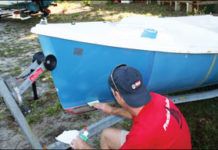
I own a 1978 Columbia 9.6, which I sail on freshwater Lake Erie four to five months each summer at Sandusky Harbor Marina in Ohio. My problem is keeping the 1-inch white bootstripe between the bottom-paint line and the molded-in black stripe clean. After three or four weeks, the scum buildup requires heavy brushing or sanding to remove.

Mailport: 06/09
Practical Sailor conducted a series of tests on childrens PFDs in October 2006. Disappointed with the offerings, we presented a conceptual infant-toddler vest in June 2007. The relevant articles are posted in the "Tools and Techniques" section of our website at www.practical-sailor.com. The challenges of designing a universal infant/toddler PFD are great, and we would not want to instill a false sense of confidence in these devices. Habituating your child to wearing a vest and finding one with a proper fit is important, but even the best fitting jackets had trouble keeping our test children in the face-up position. These jackets may buy you some seconds should your child slip into the water from a dock or an anchored boat, but constant vigilance and proactive measures such as lifeline netting, safety harnesses, and swim lessons should be high priorities. Key components in an infant jacket are crotch straps, head-up collar flotation, and a collar strap for lifting/supporting the child when moving from the dinghy or dock to the boat.
PS Advisor: Boat Buyers on the Prowl
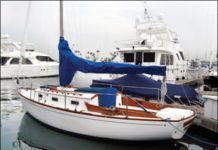
Every so often, I find myself boat shopping and turn to the reviews in "Practical Boat Buying." I’m looking for a trailerable, 20- to 26-foot, easy to rig, singlehandable boat—and fast wouldn’t hurt either. I am a beginner, thinking about the Rhodes 22, Tanzer 22, O’Day 23, or Balboa 26. Did I mention I didn’t have a lot of money to spend?

Mailport: 05/09
In light of your recent letters on copper/epoxy antifouling bottom coatings, Id like to share my experience. Near the end of my Searunner trimaran boatbuilding project, I decided to apply a product known at the time as Copperpoxy. I applied the coating to all three hulls to about 20 mils thick, and then sanded this "orange peel" surface down to about 10 mils. I finished up with 220-grit sandpaper. In the end, it was beautiful. It was just like a perfectly smooth, new copper penny, and just a bit thicker than recommended. We started our cruising adventure in the foul waters of Beaufort, S.C. Very soon, I was doing a huge scrape job every week. The bottom was covered with grape-size barnacles. I noticed that the aft half of the main hull, the part with underwater metals, was fouling the worst. (I was changing zincs every week.) Two years later, in Pensacola, Fla., we decided to give up on this product and paint over it with Pettit Trinidad SR bottom paint. When doing the weeks-long prep for this painting, we could see that the skin of our epoxy/ply boat was electrically conductive and corroding all the way through in the entire area of the bonded shaft, strut, prop, gudgeons, and copper mast ground. We put on three coats of Trinidad, waited a few days, and splashed the boat. Within two weeks, the new paint had peeled off in the electrically active area. We re-hauled, stripped the paint in this area, and coated the problem Copperpoxy area with three coats of epoxy. After sanding and repainting, we set off for the Western Caribbean. Over the following six months, we noticed that even the epoxy would not stick to the Copperpoxy.

PS Advisor: DSC Group Identity Numbers
I’m a member of the Stonington Harbor Yacht Club in Stonington, Conn., and we need a better way to contact members on the water. We would like to use the full features of DSC (Digital Selective Calling) group calling for that purpose, but it is not clear to us what the best way is to obtain a group identity call number for DSC calls.
Mailport: 04/09
I read with interest your evaluation of first aid kits, which wrapped up with the final installment in the December 2008 issue. Id like to add a couple of points: Weekend, cruising, and bluewater sailors should invest in a good up-to-date first aid and CPR course. It is as important as a functional bilge pump. The responsible sailor can outfit a substantial and superior first-aid kit for much less money than a commercially available kit. The kit should be appropriate for the expected duration a victim will need treatment prior to evacuation. Most commercial kits contain a lot of fluff and are unnecessarily redundant-a lot of Band-Aids. I stress to distance sailors stocking a few prescription items and aggressive treatment for seasickness, beyond Bonine. I favor a solid medical text such as "A Comprehensive Guide to Marine Medicine," by Dr. Erick Weiss and Dr. Michael Jacobs, or "Medicine for Mountaineering and other Wilderness Activities," by James Wilkerson. The latter is available from Mountaineer Books. Both texts give guidance on stocking kits appropriate for your boat. Remember, the victim may be the captain or medical officer, and a novice may be the one rendering treatment. A medical guide is an invaluable resource.

Shopping Sail Shape
Sailmakers put spin into more than their spinnakers, and when all is said and done, their art lies in turning flat material into a carefully controlled curved shape. The best-shaped sails-and the most expensive to build-are tri-radial shapes that are made from many smaller panels radiating from each corner of the sail. These sails have many more seams and require more sewing but allow the bias, or strength axis, of the cloth to be critically aligned. Most racers and performance-oriented cruisers opt for the cut because the sail shape can be better developed with this approach. A cross-cut and a miter-cut are both valid but simpler approaches to sailmaking. They lessen the number of panels and consequently the labor involved with manufacture. As long as the material used affords appropriate load handling characteristics associated with panel alignment, all is fine, especially for a cruising application where lighter weight and the final nuance of shape are less critical. More important than whether the sail is cross cut or miter cut is how well it fits and sets on your boat, and the sailmaker to choose is the one who will come aboard and make sure that his or her handiwork actually fits properly. If they both agree to do that, then take a close look at the detail work in their sails. Is the area around pressed-in rings well-reinforced? Are leech lines easy to operate? How is UV protection handled?

How Long Do Sails Last?
How long do sails actually last? Sailmakers often say cruising sails last around 10–15 years, but what happens when you discover a sail that’s...



Latest Sailboat Review

Jeanneau 55 Boat Review
This recent sailboat from Jeanneau may as well be a spaceship. They’ve taken all the time-honored designs of a monohull aft cockpit and turned...