



Mailport: 10/08
Your recent assessment of the locator service SPOT (Practical Sailor September 2008) was spot on. We recently took it along on a Pacific Coast, offshore delivery of a 50-foot sailboat. We hit bad weather and had several mechanical failures. Our families ashore were able to follow our progress on the SPOT website throughout our trip. The problem came when a panicked crew, unknown to me, hit the "911" button. I was able to cancel the 911 call a few hours later. Our families were simply alerted that we had a serious problem but did not know anything more for a couple days. The SPOT command central repeatedly called my cell phone, which was with me, 250 miles offshore and obviously out of range. They claimed they could not determine our position despite several days of track records.

All Plywood Not Created Equal
I was wondering if you folks have ever evaluated the various kinds of plywood for use in marine environments. Needing to replace a bulkhead, I went plywood shopping with a friend. Its his belief that theres little difference between regular plywood and marine plywood, other than the price. He says its all the same glue, and that different glue wouldnt matter because wood is wood and it all delaminates the same when exposed to water. What are your thoughts?

Mailport: 09/08
In your June 2008 article "Comparing the Latest Inflatable PFDs," you mention at the beginning of the article that Personal Flotation Devices (PFDs) should be cleaned and stored as directed by manufacturers and that inflation mechanisms should be routinely inspected. In the case of inflatable PFDs that meet Safety of Life at Sea (SOLAS) standards, such as the Viking products you reviewed, it is a SOLAS requirement that they be inspected and tested in the premises of an approved service station every 12 months. In all other cases, this is highly recommended for an item of lifesaving equipment. Your article goes on to say that re-arming and re-packing a PFD generally is easily carried out. I suggest that this information is dangerously misleading. A manufacturers manual for a PFD can run into more than 100 pages covering the unpacking, cleaning, inspection, testing, repair, and assembly. Hopefully, you will be able to enlighten your readers to the risks they take by not having a PFD professionally inspected once it has been used.
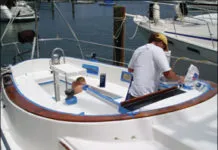
Painting Your Own Deck
My wife and I have owned our boat since 1985. We now keep it in the British Virgin Islands, where the Caribbean sun is tough on finished wood and fiberglass. The reason I am writing you is to get your true feeling about novices handpainting our decks. We want to keep the nonskid and the white border design we currently have. The decks were Awlgripped by the factory in 1992, but this has turned chalky and shows tremendous wear. Is it feasible to try such a project? Or should I just pony up the money to have it done? We have time and plenty of elbow grease and a willingness to try.

Mailport: 08/08
Presto Protech was among several acrylic coating-type products recently applied to one of our test boats, a 1974 ODay Javelin. Drying almost upon contact, this UV-activated product was one of the quickest to apply. Its gloss compared to that of a conventional paste wax. How long it lasts is a key question that we have yet to answer. A full report on Presto Protech and similar products will appear in a future issue. Our most recent long-term test of these types of products ("Hull Restorer Test," May 2007), showed that one product, Poli Glow, retained gloss on the bow section of our white test powerboat for three years, longer than any conventional boat wax that we have tested. Keep in mind that the acrylic-type products do not "restore" gelcoat. They only cover it-imperfections and all-with a clear, glossy plastic coating that, in some cases, hides minor scratches. For best results, you will still want to eliminate as much oxidation as possible prior to application. Finally, strictly follow the instructions on these products. Buffing the hull with a product that has silicone, Teflon, or some other agent can inhibit adhesion. You might have to avoid using certain cleaners that can peel off the coatings. While the acrylic coatings have outlasted waxes in our tests and several readers have reported great results, we believe that the simpler, more forgiving buff-and-wax routine is suitable for the vast majority of boat owners. PS is currently testing paste waxes as well. And if youre ready to paint, check out our topside paint test, which kicks off on page 27.
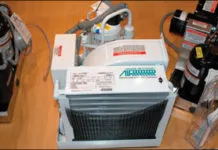
Troubleshooting AC Units
I have an air-conditioning unit with more than 14,000 BTUs. Here in Florida, with a 38-foot boat, that just doesn’t hack it. The unit’s been checked for efficiency by a technician. My prior boat (also 38 feet) had two units totaling over 20,000 BTUs. Those were effective, but that output is enough to cool a small store ashore. How are boat A/C BTUs determined? I suspect the temperature of coolant water is a major factor. Also, what is the effect when coolant water is suppressed by a clogged filter? Are they built to automatically shut down the compressor?

Mailport: 07/08
I just completed a family, 17-year, and 50,000-mile circumnavigation onboard Hippos Camp, our 1985 Morgan 43. And I think the Morgan 43 should be included in your list of strong and reliable boats. In addition to 17 years at sea, Hippos Camp has endured-unscathed-36 hours in the 1994 Queens Birthday storm in the South Pacific, and dealt with the vertical seas of the Agulhas current in 40 knots of wind in the Mozambique Channel. The gelcoat and nonskid on our 22-year-old boat are original and look almost new after polishing. The Perkins 4-108 has 5,700 hours and runs like a Swiss clock. The Morgan 43 is also a remarkable performer in light air. We crossed the Bay of Bengal at an average speed of 4 knots with never more than 8 knots of wind. This is, in my opinion, a real asset. The Morgan 43 was made by Morgan Yachts before it was bought out by Catalina. I think Morgan made 77 43s, and a few more 44s before it stopped.

Tinned Wire Myth Busted
I recently purchased an older boat. Not long before the purchase, the previous owner had the wiring replaced. All the workmanship seems to be in good order, with all connections and terminations made with Ancor crimped connectors and sealed in shrink tubing. All the wiring is the proper gauge (AWG) stranded wire. The only problem is that the wire used was not marine-gauge tinned wire. I am wondering what the risks are to leaving it as it is. Clearly to rip it all out and do it again would be very expensive. I am not using the boat that much and don’t intend a circumnavigation any time soon. If the connections are well made and the wire sheathing remains intact, what is my risk of wire corrosion with the un-tinned wire in a marine environment?

Mailport: 06/08
I have been following your articles on teak maintenance with great interest. I have an Oyster 56 with teak decks and teak toerail. I live in South Florida, and this is my second Oyster. I damaged my first teak deck as well as the metal fittings around it with too much love. With this deck, I have been very careful and only lightly wash. The deck is OK, but I have a toerail that overhangs the sides. I was reluctant to varnish it as it often gets scratched, but it is beginning to look bad. After reading your April 2008 article, Im thinking that applying one of the teak oils may be a solution. Did any of those you tested seem suitable for touch-ups when scratched or nicked? Was there one that could be easily wiped off gelcoat without staining it?
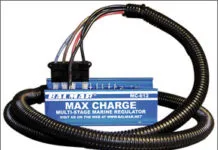
Multi-stage Battery Regulators
I am building an electrical system that will hopefully support wife and two teenage daughters. With this objective, I am planning approximately 1,000-amp hour battery bank. I see lots of hype about the external three-stage voltage regulators. Do they really provide more amp hours during the limited engine running time? If so, I have not found any definitive side-by-side comparisons that convince me that three-stage regulation is more efficient than a single-stage constant voltage regulator.

Morgan 382 – The $30K Boat Nobody Talks About
The Morgan 382 might be one of the most overlooked cruising sailboats ever built. Designed by legendary naval architect Ted Brewer and produced between...



Latest Sailboat Review

Jeanneau 55 Boat Review
This recent sailboat from Jeanneau may as well be a spaceship. They’ve taken all the time-honored designs of a monohull aft cockpit and turned...