

Flicka
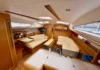
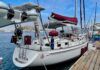
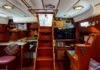
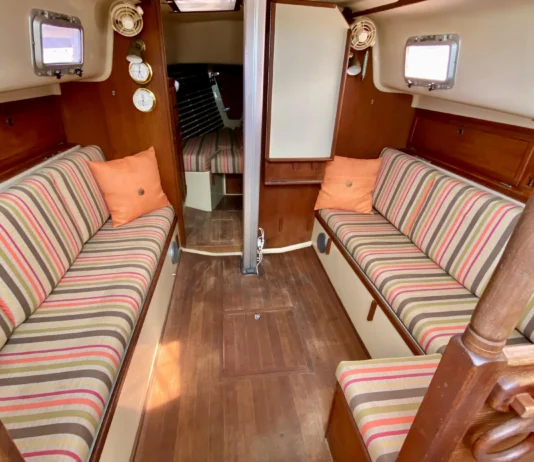
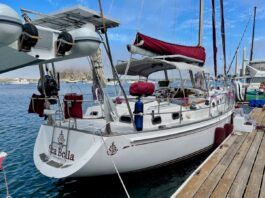
The Flicka is unique. There are no other production boats like her, and only a few that offer the Flicka's combination of traditional (or quasi-traditional) styling and heavy displacement in a small cruising yacht. As the number of Flickas built by Pacific Seacraft passed 300 plus an indeterminate number built by amateurs early in its history, the boat seems to have become almost a cult object. High priced, distinctive, relatively rare but with wide geographical distribution and easily recognized, the Flicka invariably attracts attention and seems to stimulate extraordinary pride of ownership.
J/24
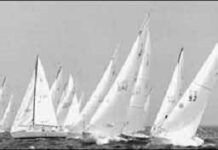
The J/24's PHRF rating ranges from 165 to 174, depending on the handicapper. The J/24 is best suited for racing; there are many boats in her size range that are far more comfortable and practical for daysaiIing. However, the J/24 is a joy to sail under mainsail alone. Unlike most boats, she balances and sails upwind at a respectable speed, and her maneuverability gives her tremendous freedom in crowded harbors.
Hunter 30
Hunter is offering an almost bewildering variety of models, with frequent updates and design changes. Model lines called "Hunter," or "Vision," or "Legend," have little in the way of family resemblance. The Hunter 30 is a John Cherubini design, as was the companion Hunter 27. The third of the original Hunters--the 25--was designed by Cherubini and Robert Seidelmann.
Jeanneau Arcadia
Like most of the Jeanneaus, the Arcadia (pronounced "Are-caw-dee-yah") is rare in America--only a few were imported--but, also like most of the Jeanneaus, the total production run is incredible--the factory popped out 600 completed boats in the Arcadia's first two years. The only American company that could even aspire to such numbers in a 30-footer is Catalina, and they produce a miniscule number of models compared to Jeanneau.
Lancer 28
The Lancer 28, built from 1977 to 1985, seems a rather tame and ordinary boat. Part of the variety in the Lancer line stems from the use of a number of different designers. Turner designed both the 25 and 28, the smallest Lancers from 1977 to 1983. Both are shoal-draft fixed-keel trailerables. The 25 and 28 are attractive boats with short ends, flattish sheer, and Swan-type bubble deckhouses.
Newport 28/28 II
There is a strong family resemblance between the Newport 28 and other C&C designs of the same period. In addition to the Newport 28, Capital built the Newport 41, another mid-1970s C&C design. The styling of both boats is characterized by the sweeping attractive sheerlines for which C&C is justifiably known.
O’Day 22
O'Day Boats was around a long time by fiber-glass boatbuilding standards--about 30 years. When it was introduced, the O'Day 22 was touted as a competitive contender on the race course, a contrasting companion to the rather hazy 23-footer which it would soon phase out. The 22 had a masthead rig, a stylish rake to the transom, shallow (23") draft with a short stub keel and no centerboard, and a light weight (advertised 1,800 lbs) for trailering. Later, the 22 acquired a fractional rig, a centerboard and 300 advertised pounds.
Olson 30
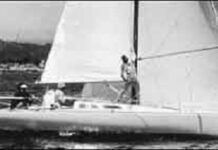
The Olson 30 is of a breed of sailboats born in Santa Cruz, California called the ULDB, an acronym for ultra light displacement boat. ULDBs are big dinghies--long on the waterline, short on the interior, narrow on the beam, and very light on both the displacement and the price tag. ULDBs attract a different kind of sailor--the type for whom performance means everything.
S2 7.9
Originally known for cruising designs, S2 Yachts opened their second decade in business by entering the high performance field, building first a trailerable racer/cruiser, the S2 7.9. The 7.9 stands for meters, which translates into American as 25' 11". The boat stayed in production up until S2 shut down its sailboat operations in 1986.
S2 8.5 Meter
In the early '80s, S2 8.5 Meter reached more for the performance market with the Grand Slam series of small boats, and the 10.3 "offshore racer-cruiser." These higher performance boats were designed by Scott Graham and Eric Schlageter, well known for their MORC and smaller IOR designs. The S2 8.5 is a 28-footer cast in the company's traditional mold. Her hull dimensions, sail area, displacement, and general design characteristics put her square in the middle of the modern 28-footers such as the Tanzer 8.5, Newport 28, O'Day 28, and the Pearson 28.
Latest Logbook

Practical Sailor Logbook – September 2026
This month we tour the Hans Christian 48T — the offshore cruiser many sailors call the holy grail — walk the custom Antigua 60...
Video: Morgan 44 Review – The Catalina Cruiser Everyone Forgot
The 1989 Morgan 44 is a big center-cockpit cruising sailboat with Catalina DNA—but it may be one of the most overlooked boats of its...


Latest Sailboat Reviews
Bayfield 32 Used Boat Review
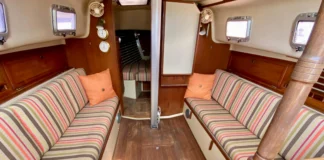
At first glance, the Bayfield 32 looks less like a fiberglass production boat from the 1980s and more like somebody shrank a traditional sailing...