

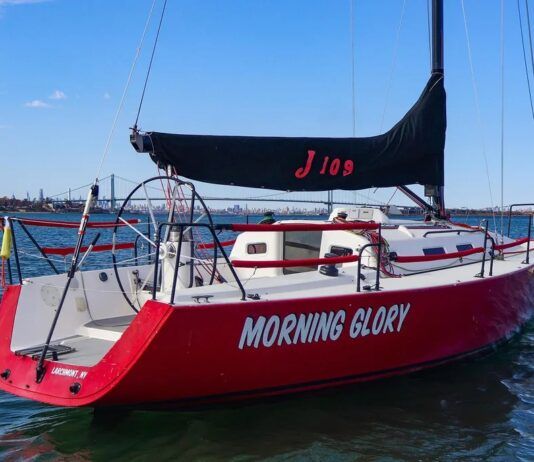

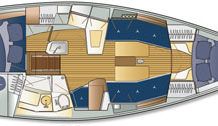
Tartan 3400
Treading a fine line between speed and comfort, Tim Jackett’s new 34-footer takes advantage of an epoxy hull and carbon spars
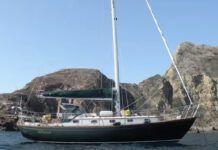
Mason 33 Used Boat Review
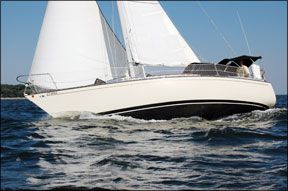
The Mason 33 was built in the mid and late '80s by the Ta Shing yard in Taiwan, and imported by Pacific Asian Enterprises in California. She is a moderate traditional design that harks back to the CCA handicapping rule of the 1960s. It might best be described as a modern full-keel hull, with a cut away forefoot and sharply turned bilges to reduce wetted surface. Though narrow and short on the waterline compared to modern lightweight fin-keelers, she is beamier, with shorter overhangs, than you would find on a typical 1960s design.

Hunter 310
This innovative family boat typifies Hunter’s design philosophy with its B&R rig, radar arch, circular cockpit and good value, but owners cite numerous niggling problems.
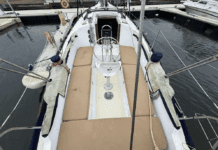
Pearson 35
The Pearson 35 was introduced in 1968 and remained in production for the next 14 years. In all, 514 P35s were built, almost all for East Coast and Great Lakes owners attracted by the 35's shoal draft (3' 9" with centerboard up) and "classic" proportions. Even the popular Pearson 30, usually heralded as the enduring boat from a builder otherwise noted for its frequent introductions of new boats and short production runs, remained in production only 10 years, albeit with almost 1,200 boats built.

Hand Laid in the USA
Workers at Pacific Seacraft laminate these hulls by hand, using vinylester resin and layers of biaxial fiberglass laid at 45- and 90-degree axes for enhanced multidirectional strength. The decks are cored with balsa wood except for those areas where fasteners pierce through or fixtures are mounted; those spots are cored with either marine plywood, high-density foam, or solid fiberglass. The two-tone deck is accomplished by masking off the nonskid areas in the mold prior to gelcoat application. This yields a very durable surface.
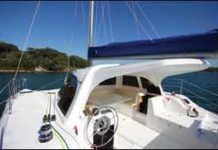
Seawind 950: Some Assembly Required
Seawind Catamarans, Australias most successful sailboat builder, introduced its new Seawind 950 last year. The 31-foot cruising multihull can be delivered in two 40-foot containers and can be assembled by two people (with a forklift or crane) in less than two days, ready to sail on coastal passages. The $220,000 Seawind 950 was designed as an entry-level catamaran with a minimalist fit-out. The container concept allows the yacht to be delivered economically anywhere in the world with truck access.
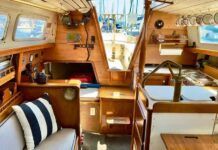
Ranger 33 Used Boat Review
The Ranger Yacht division of Jensen Marine was created in 1969 to build performance-oriented boats designed by Gary Mull. Jensen's Cal division had been successful with both racer/cruisers and pure cruisers, but the Ranger line was racier, with consistent styling and appearance throughout the series. Ranger stopped building the 33 in 1978, after 464 boats had been turned out. Many minor changes were made over the years of production, and boats built after 1974 are generally more desirable, with restyled interiors and a diesel engine option.
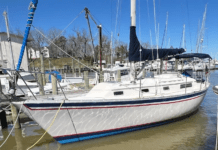
Irwin Citation 34 Used Boat Review
The Irwin 34 is in many respects a typical Irwin boat. It was originally called the "Citation 34," which was meant to indicate that it was more of a plush cruiser than the race-oriented Irwins at the time, but more of a racer than the larger cruisers. According to the company, 305 Irwin 34s were built in the production run, from 1978 to 1985, a moderate but successful model for the era. Near the end of its production, the boat was advertised as the Irwin 34 rather than the Citation 34. There were no major changes in the boat from beginning to end, just the details and equipment that are typical of any long production run.
PDQ 32
The PDQ 32 was introduced in 1996. The concept was to offer a smaller, lighter and less expensive alternative to the PDQ 36. One of the things we like about PDQ boats is the quality materials and generally clean workmanship. A modified epoxy resin (AME 5000) and tri-axial knitted fiberglass fabrics are used in the hull and deck. The mast is supported in part by a carbon fiber-reinforced deck beam. The hulls are solid glass below the waterline and cored with Klegecell foam above the water, an arrangement we think makes a lot of sense. Each hull has an air-tight comparatment forward, which provides a measure of safety in the event of collision, and the keels also have sacrificial sections. When you poke around in lockers, you don't see a lot of unfinished glass.
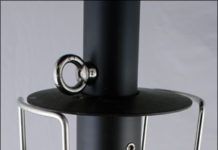
A Look at the Latest Generation of Genoa Furlers
To get an idea of whats on the market and see how the newer products fare against the simpler, tried and true furling systems, Practical Sailor rounded up 11 new headsail furlers suited for 30- to 35-foot sailboats. This, the first of a two-part report on the evaluation, focuses on the seven products that use a head-swivel design and range in cost from $950 to $3,200. (The report of integral systems will follow in an upcoming issue.) The following furlers were reviewed: Facnor LX 130, Harken MkIV and Cruising 1, Profurl LCI32, Schaefer 2100, Furlex 200S (Selden Mast), and US Spars (Z-Spar) Z-780.
How Long Do Sails Last?
How long do sails actually last? Sailmakers often say cruising sails last around 10–15 years, but what happens when you discover a sail that’s...



Latest Sailboat Review

Jeanneau 55 Boat Review
This recent sailboat from Jeanneau may as well be a spaceship. They’ve taken all the time-honored designs of a monohull aft cockpit and turned...