




Bulletproof Companionways
The used boat review of the Tartan 37 in the January 2015 issue mentioned that several companies specialize in producing bullet-proof companionway door arrangements that can be customized to fit almost any boat. I would like the names of such companies in the U.S. as I am looking for ways to improve my boats current companionway arrangement.

Editors Tap Top Sailing Gear of the Year
Each fall, Practical Sailor editors sort through the best test products of the past year to pick those deserving of a spot on our PS Editors Choice roster. To be named to the list, products must earn the Best Choice rating among their respective peers and clearly stand out above others in their field.

The Best of Bottom Paints
Our Editors Choice roster would not be complete without the top performers in our semiannual bottom paints tests (PS October 2014 and April 2015). The most recent test looked at 55 different paints from Blue Water Paints, Interlux, Epaint, Pettit, and Sea Hawk. This years hard paint standouts were Interluxs Micron Extra with Biolux and West Marines Bottomshield. Made by Pettit, the West Marine-branded PCA Gold was the top ablative paint. Micron Extra and PCA Gold tied for best performance of the bunch.

VHFs, SSBs, and Reading the Weather
In the April 2015 issue, Practical Sailor evaluated four handheld VHF radios loaded with all the bells and whistles, including longer battery life, positive flotation, internal GPS, and digital selective calling (DSC) capabilities. Out performing VHFs from Icom, West Marine, and its own product line was the Standard Horizon HX870, which grabbed a spot on our Editors Choice list.
Fishing Rigs for Sailors
The low-cost, space-saving yo-yo hand reel is the most basic, efficient fishing gear you can find-its essentially a handline modernized with a molded plastic reel wrapped with monofilament.

Pull it Until it Breaks
All testing was carried out at an approved test facility in Newcastle, Australia: J.L. Robertsons, which is adjacent to one of Australias large coal-mining areas. The test rig is used to certify lifting components for the local mining industry on a daily basis. The facility can test up to 95 tons, far more than we require. This is the same facility where we tested all of our anchor chains. (See PS June 2014, November 2014, January 2015, and March 2015 online.)
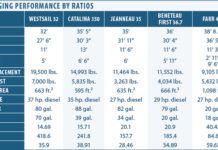
A Closer Look at the Rationale Behind the Ratios
Sailboat performance varies based on the eye of the beholder. Racers want light-air alacrity and a willingness to plane while cruisers want directional stability and reasonable speed with moderate sail area. A boats design dimensions and a few simple ratios give some hints about these attributes.

Anchor Chain and Shackles
If I use 3/8-inch Acco G43 proof-coil chain, why is the same-size galvanized shackle so much weaker? West Marine shows the Acco G43 chain rated at 5,400 pounds maximum working load (MWL), but the similarly sized shackle is rated at only 2,000 pounds MWL. It seems as though whatever size chain I select, the shackle is the weak link. How can I use a larger shackle on smaller chain?

Step By Step: Threaded Terminal Fittings
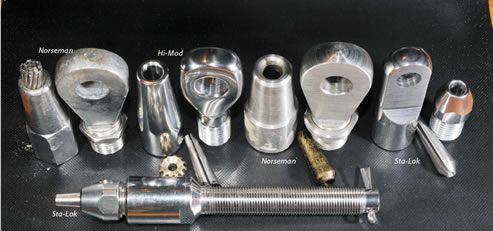
Each manufacturer offers specific guidance for terminal assembly, and some do a better job than others. The following is a generic description of the assembly process using a Norseman fitting as an example. The other two fittings in our comparison, the Sta-Lok and the Hi-Mod, incorporate a third component, a crown that helps guide and hold the wire strands in place.
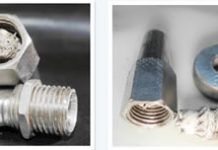
A Decade-long Norseman Fitting Sea Trial
A couple of months ago, PS Technical Editor Ralph Naranjo disassembled a headstay that he had used aboard his Ericson 41 sloop, Wind Shadow, for nearly a decade. It was set up with Norseman fittings as terminals for 3/8-inch diameter, 1x19 stainless-steel wire that had supported a Harken roller-furling system. During disassembly, neither the wire nor the end fittings showed signs of corrosion or physical wear. And when the fittings themselves were taken apart-requiring heat to free the sealant in the terminal-the wire bundle was pristine and showed no sign of any slippage or corrosion.

Lithium Batteries on Sailboats: The 3 Mistakes Everyone Makes
Lithium batteries are one of the most popular sailboat upgrades today—but they’re also one of the most misunderstood. In this Practical Sailor Saturday episode,...



Latest Sailboat Review
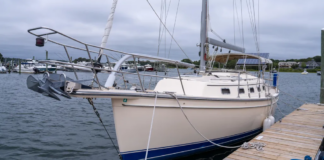
Island Packet Estero Used Boat Review
Florida-based Island Packet targets a relatively narrow niche, so the toughest competitors to its new boats are often older Island Packets. Introduced in 2010, the 36-foot, shoal-draft Estero is the company’s latest attempt to introduce a distinctive model that doesn’t stray too far from the company’s proven formula for success: moderate displacement, full-keel cruisers designed to be lived on, sailed far and in comfort, and endure the bumps, scrapes, and storms that cruising boats inevitably encounter. After sailing the Estero on Florida’s Sarasota Bay and inspecting its interior, construction, and systems, Practical Sailor testers noted that the shoal-water cruiser will appeal strongest to Island Packet fans who’ve been waiting for a shoal-draft, easy-to-sail boat that compares to the IP37 in terms of interior space. These strengths will be most apparent on intracoastal or riverine adventures like the Great Loop.