



Hidden Causes of Rig Failure
When rigs fail, it is often a spectacular event, precipitated by the sudden breakage of a rig component-a wire, a terminal, or a chainplate, for instance. Because this so often comes as a surprise, and because it has been known to happen even to conscientious sailors who regularly inspect their rigging, it is natural to assume that at least some of the causes must be hard to detect; they must be, to some extent, hidden. And this is true. Ish.

Mounting an SSB Antenna on a Gaff-rig boat
Any suggestions for an SSB-radio antenna installation on a 32-foot boat with a gaff rig and no backstay? Also, the hull is mild steel, and the standing rigging is galvanized wire, except the forestays, which are stainless.
Rig Tips that You Can Use
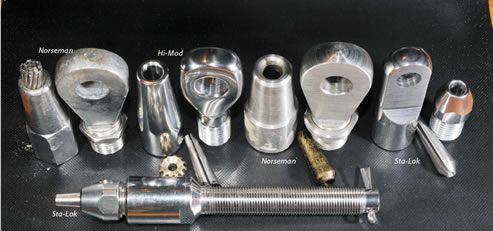
This issue of Practical Sailor offers a wake-up call for owners of sailboats with rigs of an indeterminate age. But it also offers some hope. Over the years, weve published a variety of articles on the hidden risks of stainless-steel hardware-chainplates, tangs, toggles, clevis pins, etc.-important bits that keep a rig from coming down.
Manson vs. CQR Sea Trials
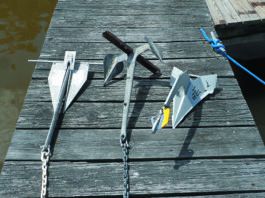
When the forecast turns bad, and its time to find shelter in a new cove or harbor, questions arise about the holding ground, swinging room, and the influence of tide, current, and surge. But there should be little question about the ground tackle and whether or not its up to the challenge at hand. Its true that no anchor comes with a written guarantee to always set and hold, and there are conditions in which each may fail, but the more time one spends anchored out, the more overkill or ground tackle safety margin is warranted. During our acquisition of sea sense, we inevitably discover the range of conditions that our primary (working) anchor can handle, usually discovering its limitations the hard way.
Managing the Manson as a Working Anchor
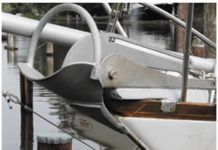
During the initial swap, I couldnt help but notice how much more fluke area the Manson provided compared to the CQR. And the claw-like geometry seemed to more efficiently grab the bottom when compared with the CQRs plow shape. These assumptions were supported during initial anchoring efforts. The Manson grabbed hold of the bottom with very little scope deployed; breakout took a more concerted effort; and the amount of sand, and mud and other detritus retrieved from familiar anchorages was much greater than what the CQR hauled to the surface. The value of a pressure wash-down pump rose considerably.

Is Hand-stitched, Nylon Webbing Strong Enough?
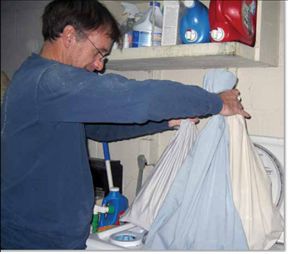
Rope is the mainstay of sailboat rigging, and knot-craft and splicing are the marks of a seaman. Sewn joins are also practical-and weve explored those in depth (see PS October 2014 online)-but there are times when flat webbing serves better; for example, reefing strops, jacklines and tethers, and straps for attaching sails and tackle to spars. But how do you form the loops required to attach them to hardware and other fittings?
Going Soft on Shackles
Fiber shackles have been in use for centuries-the simple knotted toggles provided all manner of service on square-riggers and even older craft. When made correctly with the right material, fiber shackles are strong, can be released without tools, and are jam-proof in the most severe weather. Like cotton sails, this 200-year-old technology has been updated through the use of modern materials.

The Mystery of the Bulging Fin Keel
I was reading a Mailport letter in the December 2014 issue of Practical Sailor, and it led me to your May 27, 2014 blog regarding keel failure. We have a 1977 Islander 28 with a bolted-on fin keel that is creating a safety issue. I am confident I know what the proper repair is (remove the keel and re-secure it), but I am more wondering if youve ever seen anything like this. On the starboard side of the keel, below the keel joint, a square chunk of lead is bulging out of the keel side. Ive had a few surveyors take a look at it, and theyve never seen anything like it either. The keel bolts do not leak-at least water doesn't come in. Thoughts?
Abrasion and Break Testing
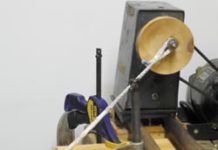
Testers first task was to determine whether any of these coatings could weaken line in the near term. To do this, we formed 20-inch loops of 1/8-inch polyester braid and nylon braid, coated a 1-inch length of the loop with each of the products, and broke these in our test rig.
Sherardizing Alternative
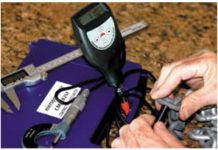
In order to impart corrosion resistance to steel, the items are commonly galvanized, immersed in a bath of molten zinc. Hot-dip galvanizing is well established and accepted, but there are alternate technologies like sherardizing.
Lithium Batteries on Sailboats: The 3 Mistakes Everyone Makes
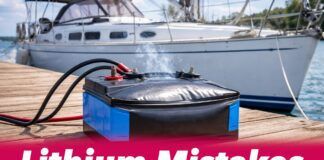
Lithium batteries are one of the most popular sailboat upgrades today—but they’re also one of the most misunderstood. In this Practical Sailor Saturday episode,...



Latest Sailboat Review
Island Packet Estero Used Boat Review
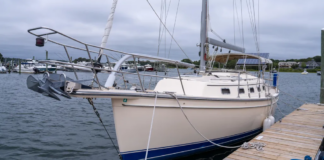
Florida-based Island Packet targets a relatively narrow niche, so the toughest competitors to its new boats are often older Island Packets. Introduced in 2010, the 36-foot, shoal-draft Estero is the company’s latest attempt to introduce a distinctive model that doesn’t stray too far from the company’s proven formula for success: moderate displacement, full-keel cruisers designed to be lived on, sailed far and in comfort, and endure the bumps, scrapes, and storms that cruising boats inevitably encounter. After sailing the Estero on Florida’s Sarasota Bay and inspecting its interior, construction, and systems, Practical Sailor testers noted that the shoal-water cruiser will appeal strongest to Island Packet fans who’ve been waiting for a shoal-draft, easy-to-sail boat that compares to the IP37 in terms of interior space. These strengths will be most apparent on intracoastal or riverine adventures like the Great Loop.