



A Closer Look at the Rationale Behind the Ratios
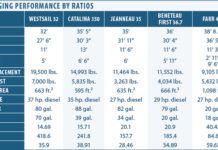
Sailboat performance varies based on the eye of the beholder. Racers want light-air alacrity and a willingness to plane while cruisers want directional stability and reasonable speed with moderate sail area. A boats design dimensions and a few simple ratios give some hints about these attributes.

Anchor Chain and Shackles
If I use 3/8-inch Acco G43 proof-coil chain, why is the same-size galvanized shackle so much weaker? West Marine shows the Acco G43 chain rated at 5,400 pounds maximum working load (MWL), but the similarly sized shackle is rated at only 2,000 pounds MWL. It seems as though whatever size chain I select, the shackle is the weak link. How can I use a larger shackle on smaller chain?
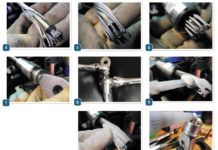
Step By Step: Threaded Terminal Fittings
Each manufacturer offers specific guidance for terminal assembly, and some do a better job than others. The following is a generic description of the assembly process using a Norseman fitting as an example. The other two fittings in our comparison, the Sta-Lok and the Hi-Mod, incorporate a third component, a crown that helps guide and hold the wire strands in place.
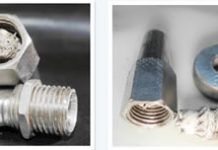
A Decade-long Norseman Fitting Sea Trial
A couple of months ago, PS Technical Editor Ralph Naranjo disassembled a headstay that he had used aboard his Ericson 41 sloop, Wind Shadow, for nearly a decade. It was set up with Norseman fittings as terminals for 3/8-inch diameter, 1x19 stainless-steel wire that had supported a Harken roller-furling system. During disassembly, neither the wire nor the end fittings showed signs of corrosion or physical wear. And when the fittings themselves were taken apart-requiring heat to free the sealant in the terminal-the wire bundle was pristine and showed no sign of any slippage or corrosion.

Hidden Causes of Rig Failure
When rigs fail, it is often a spectacular event, precipitated by the sudden breakage of a rig component-a wire, a terminal, or a chainplate, for instance. Because this so often comes as a surprise, and because it has been known to happen even to conscientious sailors who regularly inspect their rigging, it is natural to assume that at least some of the causes must be hard to detect; they must be, to some extent, hidden. And this is true. Ish.

Mounting an SSB Antenna on a Gaff-rig boat
Any suggestions for an SSB-radio antenna installation on a 32-foot boat with a gaff rig and no backstay? Also, the hull is mild steel, and the standing rigging is galvanized wire, except the forestays, which are stainless.
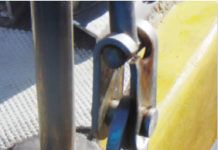
Rig Tips that You Can Use
This issue of Practical Sailor offers a wake-up call for owners of sailboats with rigs of an indeterminate age. But it also offers some hope. Over the years, weve published a variety of articles on the hidden risks of stainless-steel hardware-chainplates, tangs, toggles, clevis pins, etc.-important bits that keep a rig from coming down.

Manson vs. CQR Sea Trials
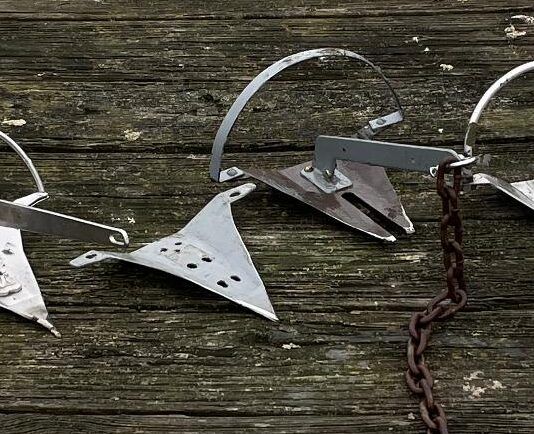
When the forecast turns bad, and its time to find shelter in a new cove or harbor, questions arise about the holding ground, swinging room, and the influence of tide, current, and surge. But there should be little question about the ground tackle and whether or not its up to the challenge at hand. Its true that no anchor comes with a written guarantee to always set and hold, and there are conditions in which each may fail, but the more time one spends anchored out, the more overkill or ground tackle safety margin is warranted. During our acquisition of sea sense, we inevitably discover the range of conditions that our primary (working) anchor can handle, usually discovering its limitations the hard way.
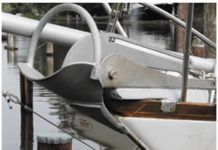
Managing the Manson as a Working Anchor
During the initial swap, I couldnt help but notice how much more fluke area the Manson provided compared to the CQR. And the claw-like geometry seemed to more efficiently grab the bottom when compared with the CQRs plow shape. These assumptions were supported during initial anchoring efforts. The Manson grabbed hold of the bottom with very little scope deployed; breakout took a more concerted effort; and the amount of sand, and mud and other detritus retrieved from familiar anchorages was much greater than what the CQR hauled to the surface. The value of a pressure wash-down pump rose considerably.

Is Hand-stitched, Nylon Webbing Strong Enough?
Rope is the mainstay of sailboat rigging, and knot-craft and splicing are the marks of a seaman. Sewn joins are also practical-and weve explored those in depth (see PS October 2014 online)-but there are times when flat webbing serves better; for example, reefing strops, jacklines and tethers, and straps for attaching sails and tackle to spars. But how do you form the loops required to attach them to hardware and other fittings?
Latest Logbook

Practical Sailor Logbook – September 2026
In September we tour the Hans Christian 48T — the offshore cruiser many sailors call the holy grail — walk the custom Antigua 60...

Video: The BEST Sailboat You Can Buy for $35,000 – Catalina...
If you’re searching for a mid-30-foot sailboat, affordable cruising sailboat, liveaboard sailboat, first sailboat, or a capable used sailboat for coastal cruising, the Catalina...



Latest Sailboat Reviews
Learning by Doing on a $5,000 Catalina 30 Mk II
When Davis’s mother started talking about wanting to do something “big” for retirement, Davis and Gloria half-jokingly threw out an idea that seemed suitably...