





Mailport: December 2010
Letters to the Practical Sailor editors in December 2010 include: paint colors, sailmaker services, bilge pumps, pest control and the Wirie v. a DIY WiFi antenna.
PS Advisor: Are Diaphragm Bilge Pumps OK?
My boat has an ITT/Jabsco 36600 diaphragm bilge pump that does not sit in the bilge and is rebuildable. With an 8-foot head on the pump installation, I think this type of pump may be a better type for me than the electric centrifugal pumps you reviewed in the September 2010 issue—although they are more expensive. You did not include any diaphragm pumps in your review. Was there a reason? Do you plan to test this type of pump and perhaps compare them to the ones reported on in the September article? Any information on diaphragm pumps versus centrifugal pumps would be greatly appreciated.
Broken Barnacle
The editors at Practical Sailor get a few reports of broken anchors each year. Typically, these are failed fluke welds on Danforth-style designs or bent shanks on plough-types. The experience of Ted Goodwin, whose 43-pound cast aluminum Barnacle anchor catastrophically broke on the Bahama Bank earlier this year, is fortunately quite rare. …

Testers Examine Running Rigging Options
Today's sailboat owner faces myriad options when shopping for running rigging. When faced with so many choices-from lines made with the old standby materials like polyester to the newer high-tech ropes made from materials like Vectran and Spectra-it's hard to know which one would make the best mainsail halyard, best afterguy, or best genoa sheets. To find out, Practical Sailor tested 26 different varieties of braided rope from four manufacturers: Yale Cordage, Samson Rope, Novatech Braids, and New England Ropes. With so many lines to consider, we grouped the products by material and construction, sorting them into three fairly distinct performance groups (low, mid, and high tech) based upon their fiber content. The ropes were evaluated on their elongation, abrasion resistance, and handling characteristics. Ultimately, when all the stretching, abrading, and coiling was done, testers were able to find some clear choices based on price range and offer some general guidance for those who are shopping for new cordage.

Mailport: November 2010
Letters to Practical Sailor from our readers. November 2010's topics include cleaning products, sail hardware, galley stoves and anti-fouling paints.
PS Advisor: Rig Loads and Reefing Lines
Recently, while working to add third-reef controls to the mainsail reefing on my Morgan 382, I realized I had no idea how to calculate loads and, therefore, no concept of the size and strength of hardware to install.
High Capacity Electric Bilge Pump Test
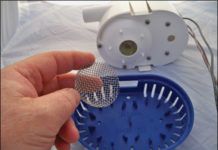
Not only do bilge pumps serve to clear incidental water, but they can also give the crew extra time when a boat is taking on water-time that can be spent repairing a leak, donning life jackets, or making a distress call. Practical Sailor tested more than a dozen centrifugal pumps from Attwood Marine Products, Rule/ITT Corp., Shurflo, and Johnson Pump. In this report, we look at the eight higher-capacity electric bilge pumps (output rated at or above 1,600 gallons per hour, or GPH) and see how they fared in exhaustive bench testing. A follow-up report next month will examine pumps rated for 1,500 GPH or less. Testers measured bilge pump flow rates and power ratings at two voltages and tested for compliance with the American Boat and Yacht Councils standards for dry run performance. In the final analysis, we picked the best bilge pump based on performance, warranty, wiring, and price.

The State of the Main: A Look at Sail Materials and Sailmaking Methods
Sails are a fascinating engineering statement, and when all is said and done, whats sought after is the lightest material possible that will neither stretch nor tear as it withstands the ravages of wind-induced pressure, vessel righting moment, and harassment from sunlight, chafe, atmospheric deposition, and other deteriorating effects. Practical Sailor toured sailmaking facilities and talked to several pros in the know to find out what sail materials are best suited for cruising, racing, and passagemaking. While cotton cloth lies well astern as a sail material, Dacron-which has been powering boats for five decades-has yet to be relegated to the junk pile. However, those willing to pay more to optimize performance have a wide range of just-out-of-the-lab, high-modulus material options to choose from, including high-modulus materials like Kevlar, Spectra, carbon, Vectran, North Sailss Cuben Fiber that are strung into high-end sails in much the same way that carbon fiber is used in a hull skin.
The Best Sailing Gear of 2010
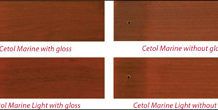
Practical Sailor offers the annual selection of Editors Choice products for the Gear of the Year 2010 lineup. We hope the list will guide you through the dizzying array of gear at the fall boat shows, or at least help you whittle down your wishlist for Santa. The roster covers a broad spectrum of products-from gadgets for measuring speed to a performance multihull built for speed-that have bested their peers in our tests. The lineup includes gear from Spinlock, Brion Toss, Lopolight, Selden Mast, DuBarry, Keen, Standard Horizon, and Mastervolt. It covers LED navigation lights, bosun chairs, footwear for sailors, and marine electronics. Boat maintenance products from Polymarine and Interlux also made the list.
Whirring Wizards of the Bilge
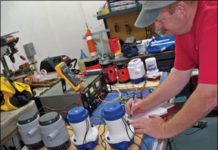
The rhumb line route from Rabaul, New Britain, to Guam is about 1,300 miles. Most of the year, the passage leads you through the doldrums, then puts you hard on a starboard tack, clawing against the prevailing northeasterlies, then creeping northwest through typhoon alley. If youre in a heavily laden, gaff-rigged boat that tacks through 116 degrees and close reaches at the breakneck speed of 4.6 knots, it seems more like 10,000 miles.

Small Boat, Big Keel Why This 27 Footer Works
What makes a small sailboat truly seaworthy? In this video, we take a deep dive into the Pacific Seacraft Orion 27, a rugged, long-keel...



Latest Sailboat Review
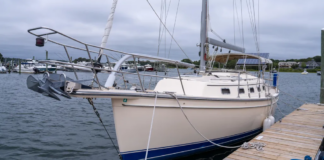
Island Packet Estero Used Boat Review
Florida-based Island Packet targets a relatively narrow niche, so the toughest competitors to its new boats are often older Island Packets. Introduced in 2010, the 36-foot, shoal-draft Estero is the company’s latest attempt to introduce a distinctive model that doesn’t stray too far from the company’s proven formula for success: moderate displacement, full-keel cruisers designed to be lived on, sailed far and in comfort, and endure the bumps, scrapes, and storms that cruising boats inevitably encounter. After sailing the Estero on Florida’s Sarasota Bay and inspecting its interior, construction, and systems, Practical Sailor testers noted that the shoal-water cruiser will appeal strongest to Island Packet fans who’ve been waiting for a shoal-draft, easy-to-sail boat that compares to the IP37 in terms of interior space. These strengths will be most apparent on intracoastal or riverine adventures like the Great Loop.