With over 35 years of bareboat chartering experience, I can honestly say, without any reservations, that when you’re more than one couple, a catamaran is definitely the way to go. Yes, the rental cost is higher, but the cost is also split between all passengers, often making the per couple cost, less than a comparable monohull for one couple.
For example, on our last bareboat charter trip, my wife and I were about to book a Jeanneau 38 monohull for $4,200 per week during the high season in March. But when our good friends asks if they join us and learn all about bareboat chartering, we opted for the Lagoon 380 instead, which was $6,800 per week, or $3,400 per couple. Not to mention the comfort and privacy with each couple having their very own hull including head.
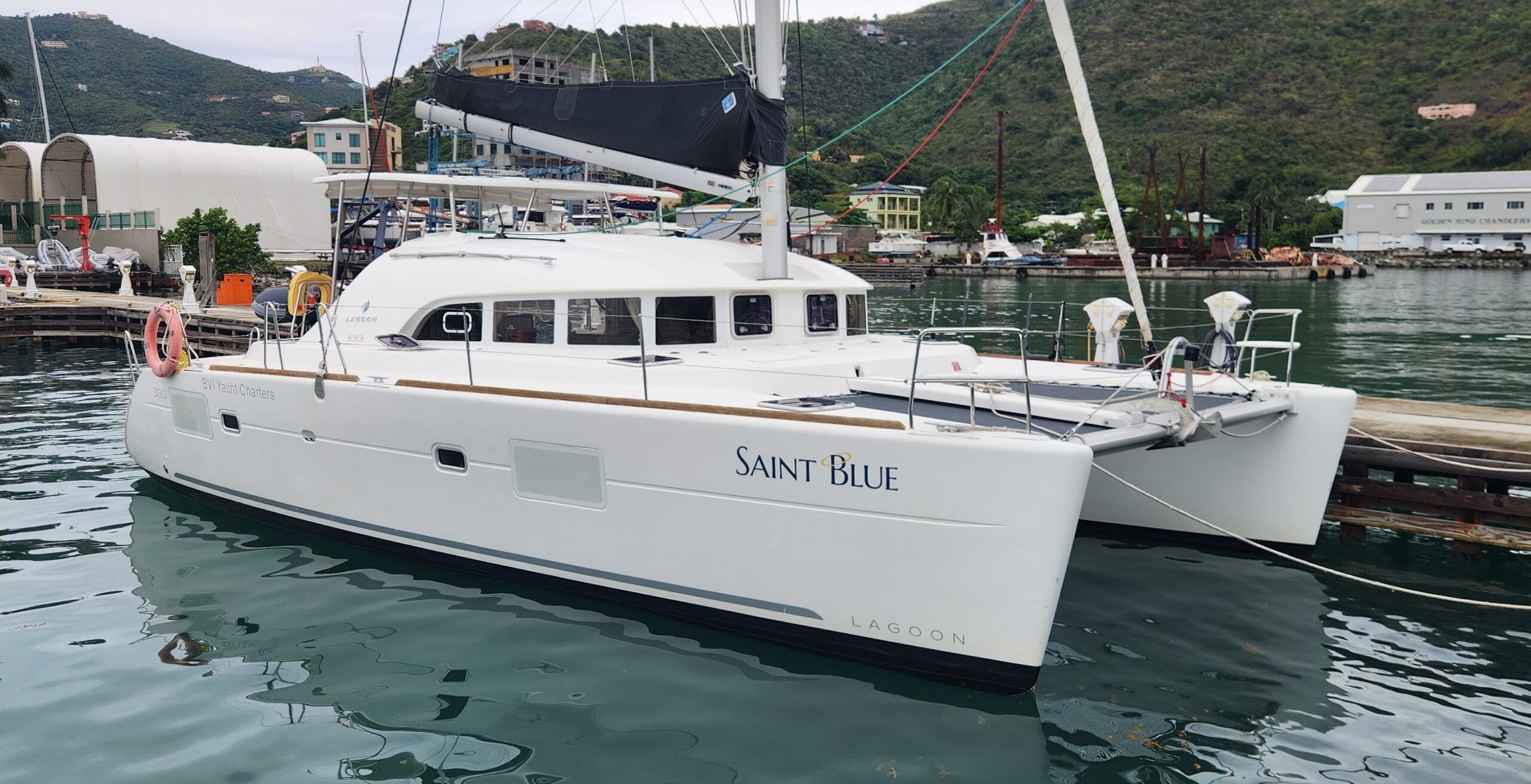
Through out my bareboat chartering history, I’ve had the opportunity to charter many catamarans makes and models, all with their own pros and cons. However, albeit an old design, the Lagoon 380 remains one of my favorite cats. And here’s why.
Why a Catamaran?
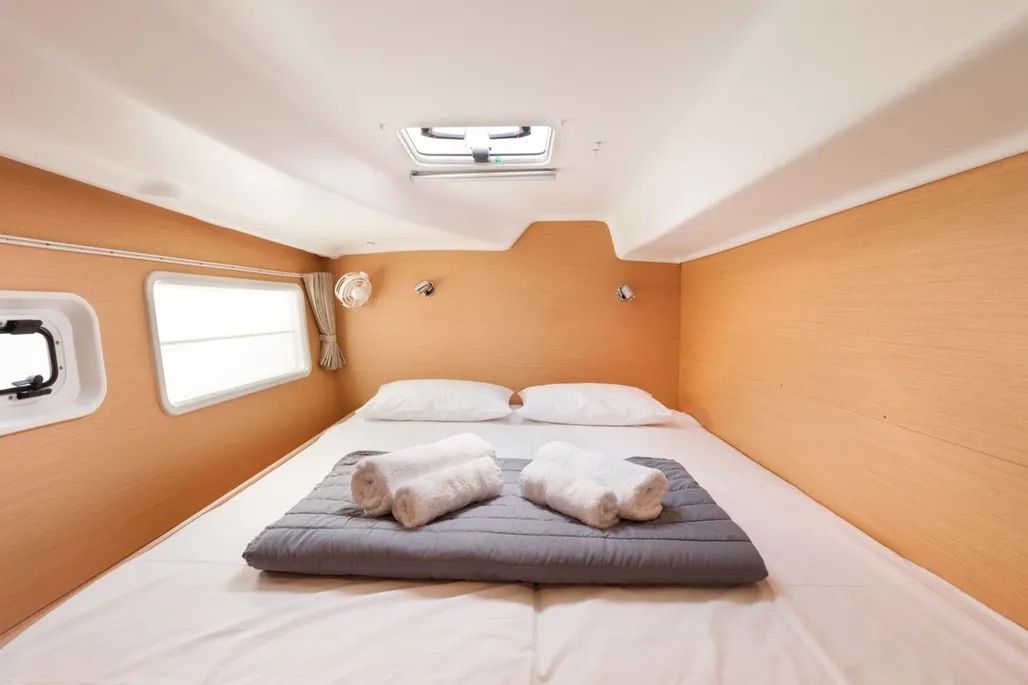
First, when sailing with two couples, having a catamaran is much more comfortable as each couple has their own hull including large queen berth and head/shower. It may sound weird, but not having to share heads is a big one for us. Everyone can settle in to their own space, set their toiletries without having to remove them after using the head, for the duration of the trip.
Secondly, a catamaran offers much more deck space to suit everyone’s taste onboard. From the wide trampoline up front to expansive common areas, like the main cabin and cockpit—as well as large helm area—there’s enough space for everyone.
Third, the very small draft makes getting closer to shore, beaches and anchorages much easier.
When planning a bareboat charter and want a catamaran, I tend to migrate toward the Lagoon 380 if available. I like this size and model mostly for its convenient and very manageable size and for the cockpit/helm configuration, which keeps the helmsperson station within the cockpit area rather than being located on a upper level away from our friends and guests.
Accommodations: Owner’s or Captain’s Version
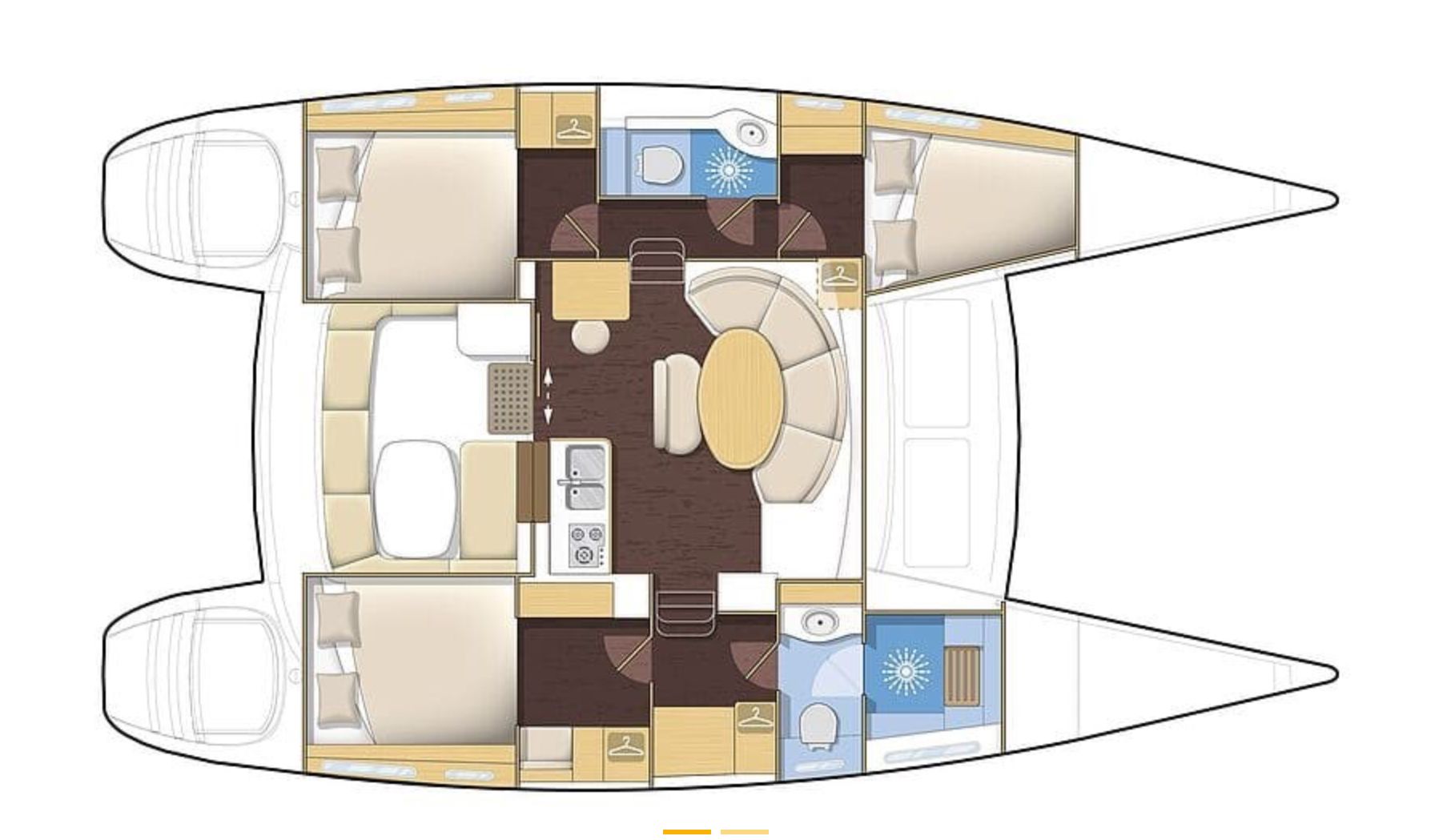
Like many Lagoon cats, the 380 comes in two configurations, a four room/four head version and a captain’s or owner’s version with three rooms and two heads.
The owner’s version transforms the starboard hull into a mini suite, including a queen-size berth astern, more storage space, seating, shelves and a small chart table. The forward area, where a berth would normally be on a four-cabin version, offers up a head with a large separate shower area.
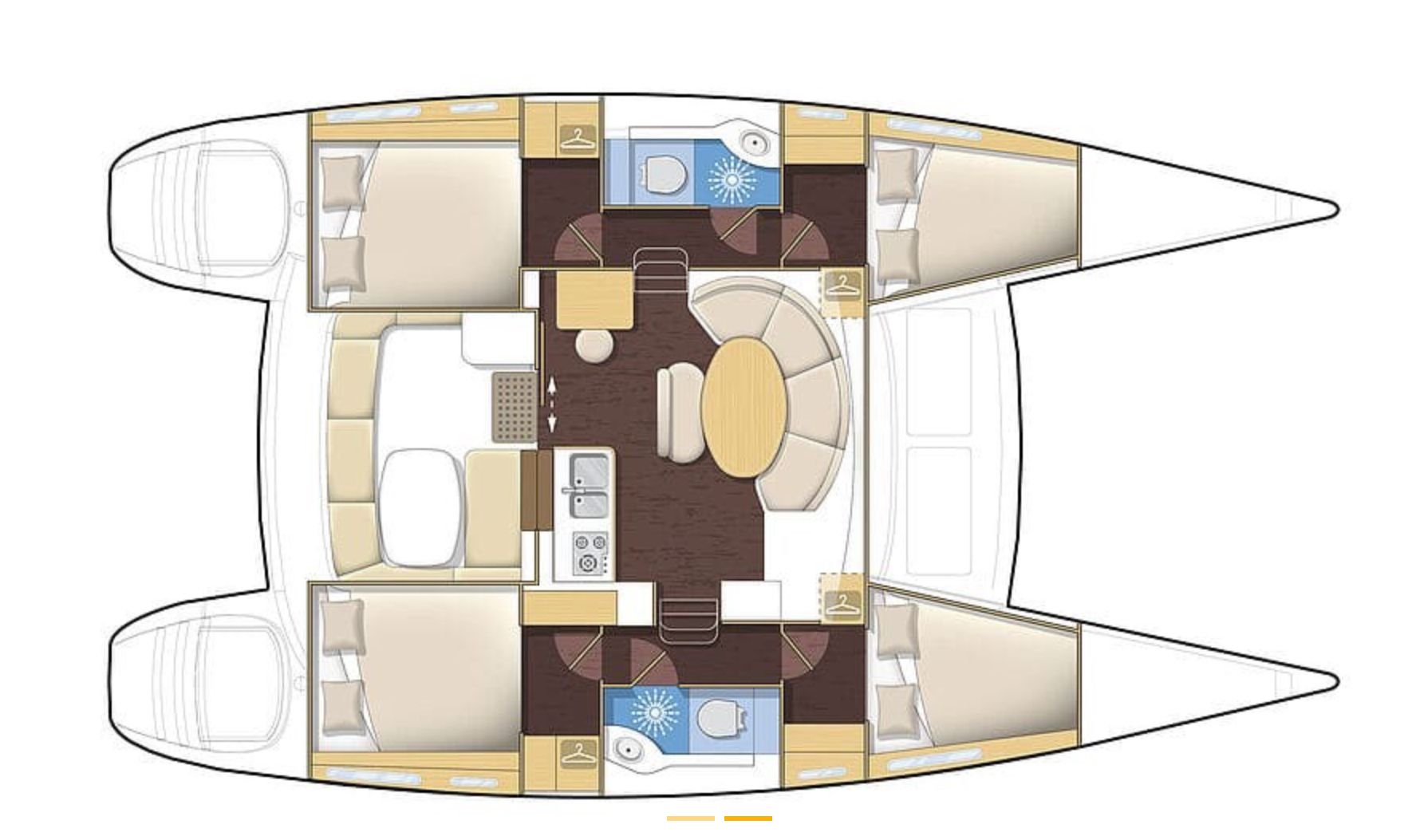
The port hull is made up of a queen size berth astern, a large combination head/shower, and a double berth forward, with ample storage lockers in each berth area.
On the owner’s version, the starboard hull access can also be closed off by a cleverly designed sliding door. Since we travel with only one other couple when booking a catamaran, the port side forward third bedroom on the Owner’s version becomes a common storage area for luggage and food supplies.
Cabin, Interior and Amenities
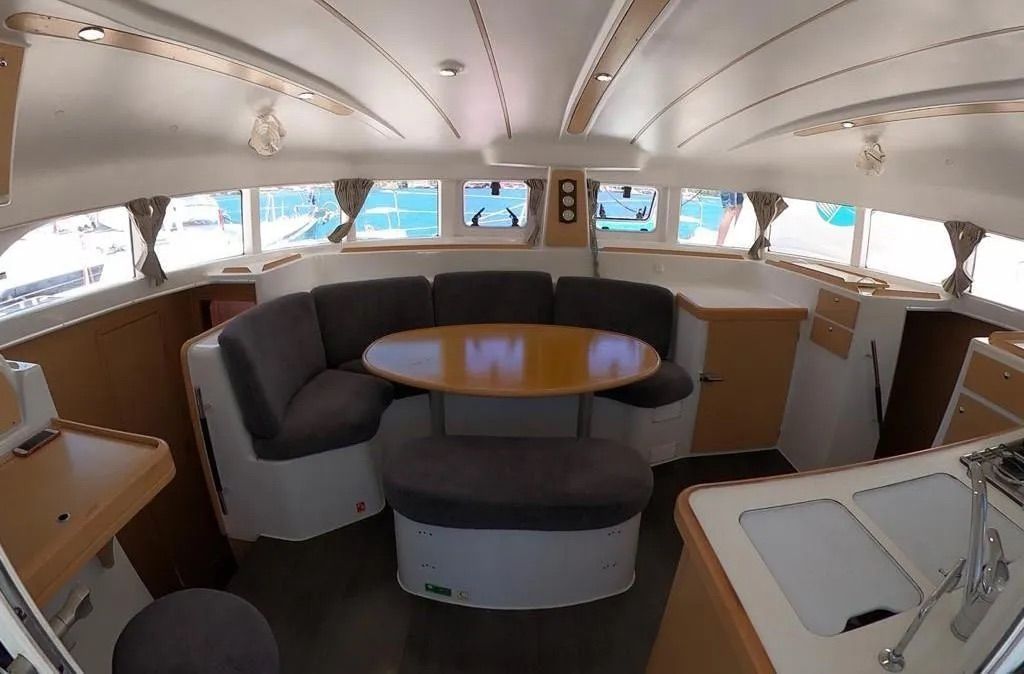
The very well-appointed galley, large saloon and chart table area is roomy with lots of storage and amenities, such as front load fridge/freezer combo, and three-burner gas stove and oven. Depending on the specific boat, it may have many more appliances such as microwave, power converter and shore powered air conditioning system, etc. Like all Lagoon’s cat designs, you have a 360-degree view from anywhere inside the main cabin with plenty of light and air flow from two opening ports and plenty of electric fans thorough out the boat.
All materials are easy to clean fabric, which we enjoy very much as the surfaces are not hot like leather or vinyl, especially when we spend most of our days in bathing suits or shorts. The interior ceiling, walls and floors are all smooth fiberglass with rounded corners for super easy cleaning. Furnishings such like cabinets, interior doors, chart table and stateroom areas are all beautiful teak.
Two 300 liter fresh water tanks, along with proper water management by all passengers, is more than enough for a basic seven-day charter.
For our last trip to the British Virgin Island (March 2025), our Lagoon 380 was a 2019 model equipped with shore powered air conditioning, a 360-watt solar power array and gas BBQ grill. Thankfully, most charter companies have done away with charcoal BBQs where ashes were always thrown overboard.
The cockpit area includes a large dining table with ample room for four adults to dine comfortably. Many people don’t know that the table inside the main saloon and the table in the cockpit can be easily interchanged depending on your needs.
Cockpit
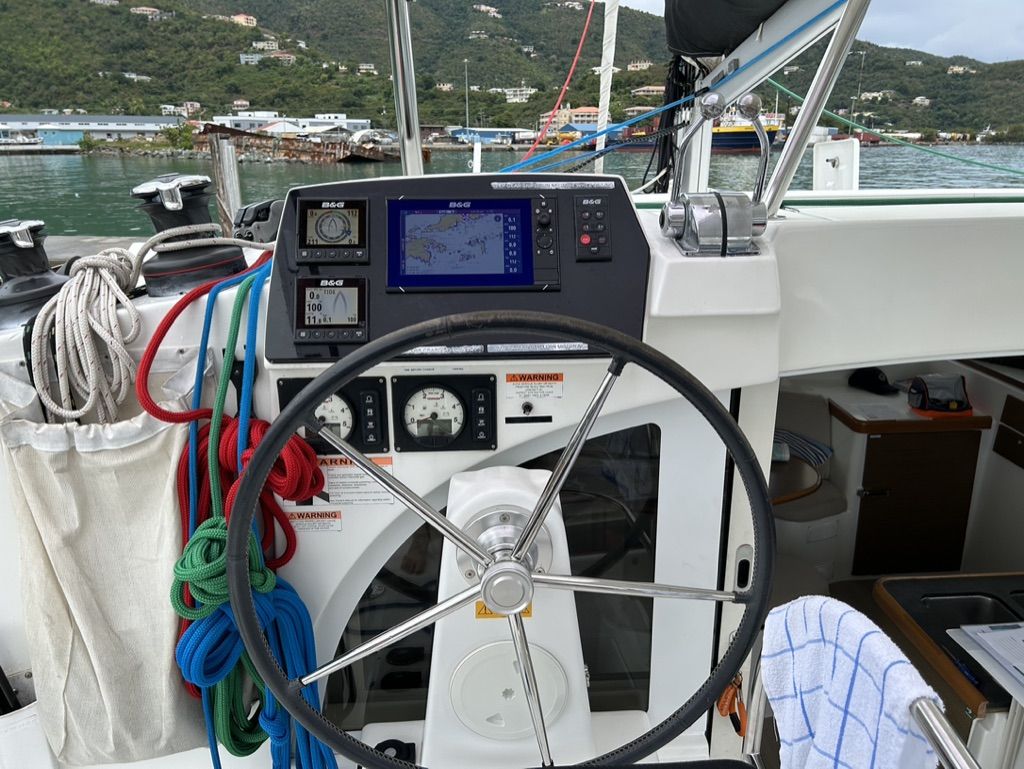
The helm or pilot station is on the port side of the cockpit, which offers excellent 360-degree visibility above the cabin and you can still be with your passengers in the cockpit. This is an important feature that I look for. I’ve had larger Lagoon catamarans with the helm station up on top of the cockpit roof. Although the view is good, I find getting down quickly in an urgent situation very impractical. Plus, being away from everyone wasn’t my cup of tea. I find these larger cats are better suited for charterers that hire a captain.
Construction
Built between 1999 and 2008, the Lagoon 380 was built from GRP (glass reinforced polyester) sandwich fiberglass polyester, a very strong and durable construction process. With over 760 built, the Lagoon 380 is one the best-selling catamaran in this size.
Comfortable and safe, both inland and offshore, her strength, stability, reliability and simple design makes her one the most popular catamaran models in the charter industry as well as for many live aboard sailors.

Sailboat Specifications Courtesy of Sailboatdata.com
Hull Type: Catamaran Twin Keel
Rigging Type: Fractional Sloop
LOA: 37.89 ft / 11.55 m
LWL: 36.08 ft / 11.00 m
S.A. (reported): 829.00 ft² / 77.02 m²
Beam: 21.42 ft / 6.53 m
Displacement: 16,005.00 lb / 7,260 kg
Max Draft: 3.77 ft / 1.15 m
Construction: FG
First Built: 2000
# Built: 760
Builder: Jeanneau (FRA)
Designer: Van Peteghem/Lauriot-Prevost
Make: Yanmar or Volvo
Type: Diesel X2
Fuel: 53 gals / 200 L
Water: 79 gals / 300 L
S.A. / Displ.: 20.96
Disp: / Len: 152.13
KSP: 0.68
Mast Height from DWL: 56.83 ft / 17.32 m
Deck and Rigging: Designed for Easy Single or Short-Handed Handling
The Lagoon 380 helm station offers all the navigation screens, engine and sail controls within easy reach. A large electric winch with foot controls makes raising the mainsail easy and efficient. Thanks to roller bearing cars, lazy jack and bag, dowsing the mainsail is equally easy.
At the bow, is windlass hidden within a large locker with plenty of chain and a great plow style anchor. Like any catamaran, once your anchor is set, a snubber must be added in order to remove any stress from the windlass and ensure the boat, while at anchor will pivot or rotate properly.
Sails
Her sails include a very large full batten mainsail set in lazy jacks and bag. Thanks to her roller bearing sail slides, she is easy to raise (using the two speed electric winches) and dowses in seconds, unless someone leaves a kink in the halyard!
Her 100% jib is set in a Harken roller furler with port and starboard jib sheets brought all the way to the helm station as are both mainsail single line reefing lines. Genoa cars on the coach roof and offer great adjustment range.
Although the deck hardware is there, she did not come with a light air sail. But I have seen Lagoon 380s with light air gennakers and they are great. Especially since you can the set the tack to center or offset it to the bow of either hull, giving you much more flexibility, especially downwind.
Many say catamarans do not point as high as a monohull, which is true, but in my experience, depending on wind and wave conditions, the 380 can point very well for a cat. Tacking is also not as difficult as many have complained. In my mind, preparation is the key. Before tacking, especially on a cat, I will reset the traveller to the exact position on the opposite side. Then proceed with tacking having only the jib to deal with. I found this process simple and very efficient with very little loss of speed.
Like on any other boat, monohulls and catamarans alike, jibing requires more careful thought and attention. I absolutely hate it when the boom comes flying over the cabin, essentially out of control for a moment, and with high risk of damage to the rig and possibly injury to the crew. So, I prefer a controlled jibe, slowly bringing the boom to midship as the boat turns into its new heading and slowing releasing the mainsheet to boom out. When singlehanded, I use the autopilot to change the heading while I focus on the main and jib sheets.
Anchoring
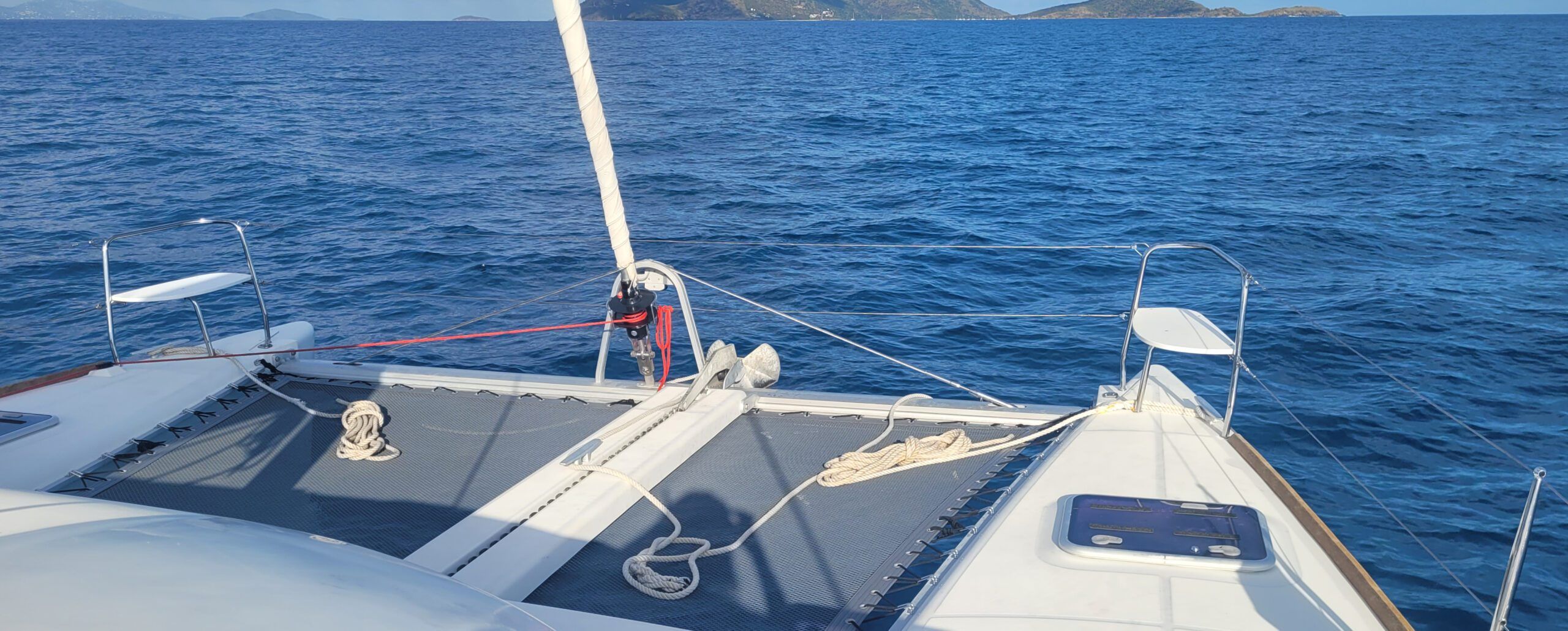
Although many catamaran manufacturers are opting for the anchor roller aft of the trampoline, I remain a big fan of catamarans, like the Lagoon 380, with the anchor roller up front, below the furler, providing an easy view from the helm station and makes setting the snubber line a much easier task.
The only improvement I would like on these setups, is to add a cover over chain guide structure or rail. I think that would make it safer.
Mechanical
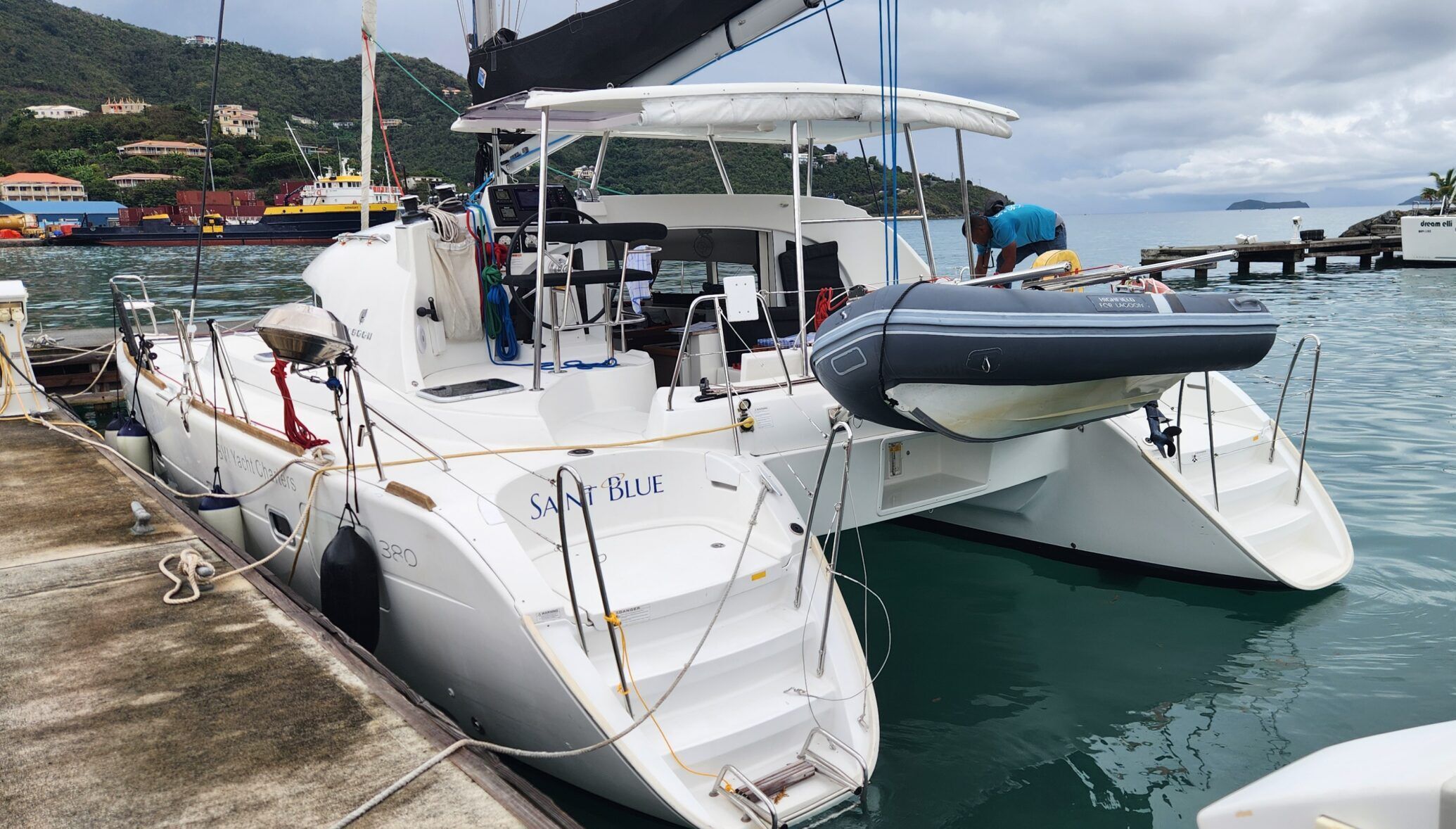
Powered by two very fuel efficient Yanmar 29 HP diesels, the Lagoon 380 can easily cruise at 6.5 knots at only 2,000 RPM. In close quarter, locking the wheel in center, she is extremely maneuverable using only engine controls like a tracked vehicle, she can literally turn on a dime and get into very tight spots.
As with most catamarans, the Lagoon 380 has built in davits, which are able to accommodate a large dinghy and outboard with ease. If planning to cross oceans, she has easily accessible cavity at her stern to store and deploy a safety raft.
Performance Under Sail
Under sail, the Lagoon 380 does not disappoint. While it’s true that a catamaran cannot point as high as a monohull, all the sail controls, jib cars, mainsheet and mainsail traveller are easily set and adjusted, so any sailor will quickly find the sweet spot for any sail angle.
On our last trip to the BVIs, we had winds between 10 and 17 knots and were able to easily maintains 7 to 10 knots of speed up on close haul trim. Because she is a cat, even at higher speeds, her heeling was very little and comfortable for everyone aboard. So, great performance for the sailors and lots of comfort and safety for the less experienced passengers.
Even in lighter breezes, she wants to move. But she is also quite capable of motor sailing with easy and low RPM.
Conclusion
The Lagoon 380 is a proper and seaworthy boat and is at home in coastal waters as much as at sea. Passengers will quickly appreciate the space, comfort and feel very safe.
It is no wonder that Lagoons are very popular boats for the often harsh and abusive charter businesses, and the Lagoon 380 is no exception.
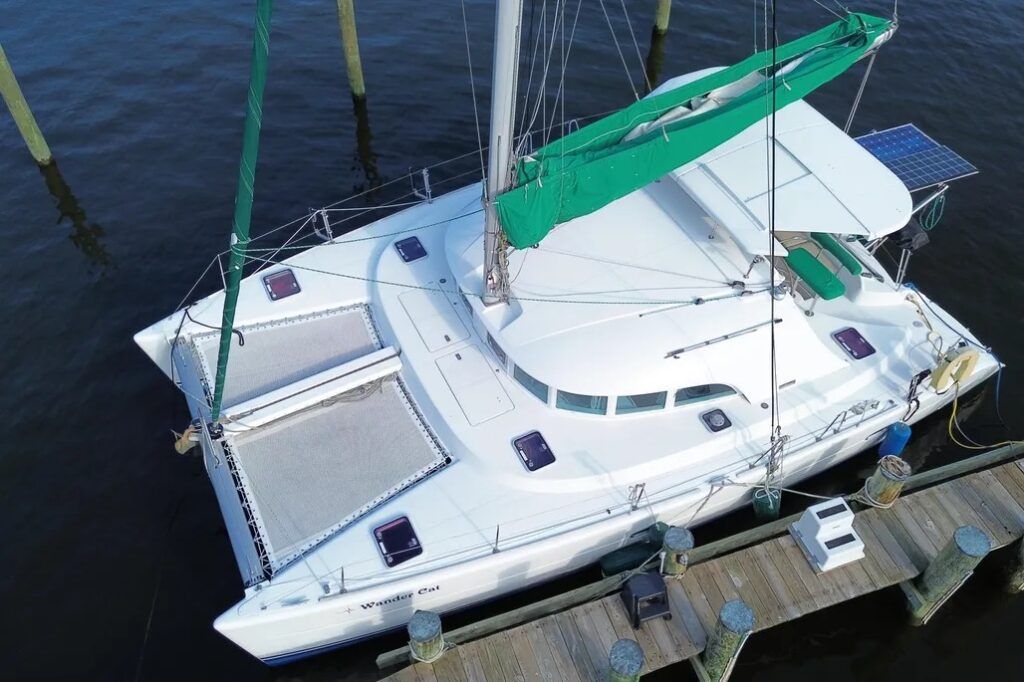
Market Scan Contact
2011 Lagoon 380 Oceancat
$250,655 USD +34 959377853
Huelva, Spain Yacht World
2011 Lagoon 380 MG Yachts Ltd.
$244,958 USD (tax not paid) +30 2109830153
Paleros, Greece Yacht World
2008 Lagoon 380 Four Seasons Yachting GmbH
$260,909 USD (tax not paid) +49(0) 5605–926152
Tenerife, Spain Yacht World
2004 Lagoon 380 Dean Yacht Company
$210,000 USD 410-709-7511
Orchard Beach, Maryland Yacht World
2008 Lagoon 380 Catamaran Guru
$275,000 USD 954-280-6519
Merritt Island, Florida Yacht World