
By the late 1970s, the old Tartan 34 had become dated. The boat had been in production for a decade, and hundreds of families had cut their racing and cruising teeth on the S&S keel/centerboarder. But the market was changing. Boats were faster and lighter, keels and rigs more efficient, interiors roomier and more functional.
In 1978, Tartan brought out the Tartan Ten, a 33-ft., fairly light, fractionally-rigged “offshore one design.” The boat was a huge success—fast, easy to sail, and unencumbered by the design limitations of a rating rule.
But the Tartan Ten had one big problem: limited accommodations with stooping headroom, and an interior most kindly described as spartan. A hardy crew could take the Tartan Ten on a multi-day race such as the Mackinac, and you might even coax your family aboard for a weekend of camping out. But cruising or extended racing in comfort? Forget it!
If, however, you could combine the size and performance of the Tartan Ten with a boat having decent accommodations, you had a good shot at a winning combination, particularly in a time when interest in sailing was growing at an astounding rate. As a bonus, the venerable Tartan 34 could be retired with the dignity she deserved.
History
The answer to all these prayers was the Tartan 33. Introduced as a 1979 model, the Tartan 33 bore a strong resemblance to the Tartan Ten, with a big fractional rig, flattish sheer and wide stern. But unlike the Tartan Ten, the new 33 had good accommodations.
The Tartan 33 was a moderate success, with about 220 boats built over a five-year period. The fractional rig, touted as being easier to handle due to smaller headsails, may have turned off some customers who associated that type of rig with high performance boats such as J/24s and 12 meters. The slotted aluminum toe-rail of the 33 was more reminiscent of Tartan’s racing boats, such as the 41 and the Ten, than it was of a high-quality cruiser/racer.
In 1984, the Tartan 33 went out of production. In its place came the “new” Tartan 34, or 34-2, a boat that could directly cash in on the reputation of the famous old Tartan 34. Interestingly, the Tartan 34-2 is the Tartan 33, with the stern drawn out 9-in. to a more pleasing termination, the interior redesigned to meet market needs, and the 33’s fractional rig replaced by the masthead rig of the Tartan 33R.
Compared to the Tartan 33, the 34-2 is more finely finished, with teak toerails and nicer interior detailing.
When first introduced, the Tartan 33 had a base price of just over $46,000. By the time production ceased, the base price had increased to $66,000. Remember, those were the years of double-digit inflation. Used models are now for sale between $14,500 and $34,900.
Sailing Performance
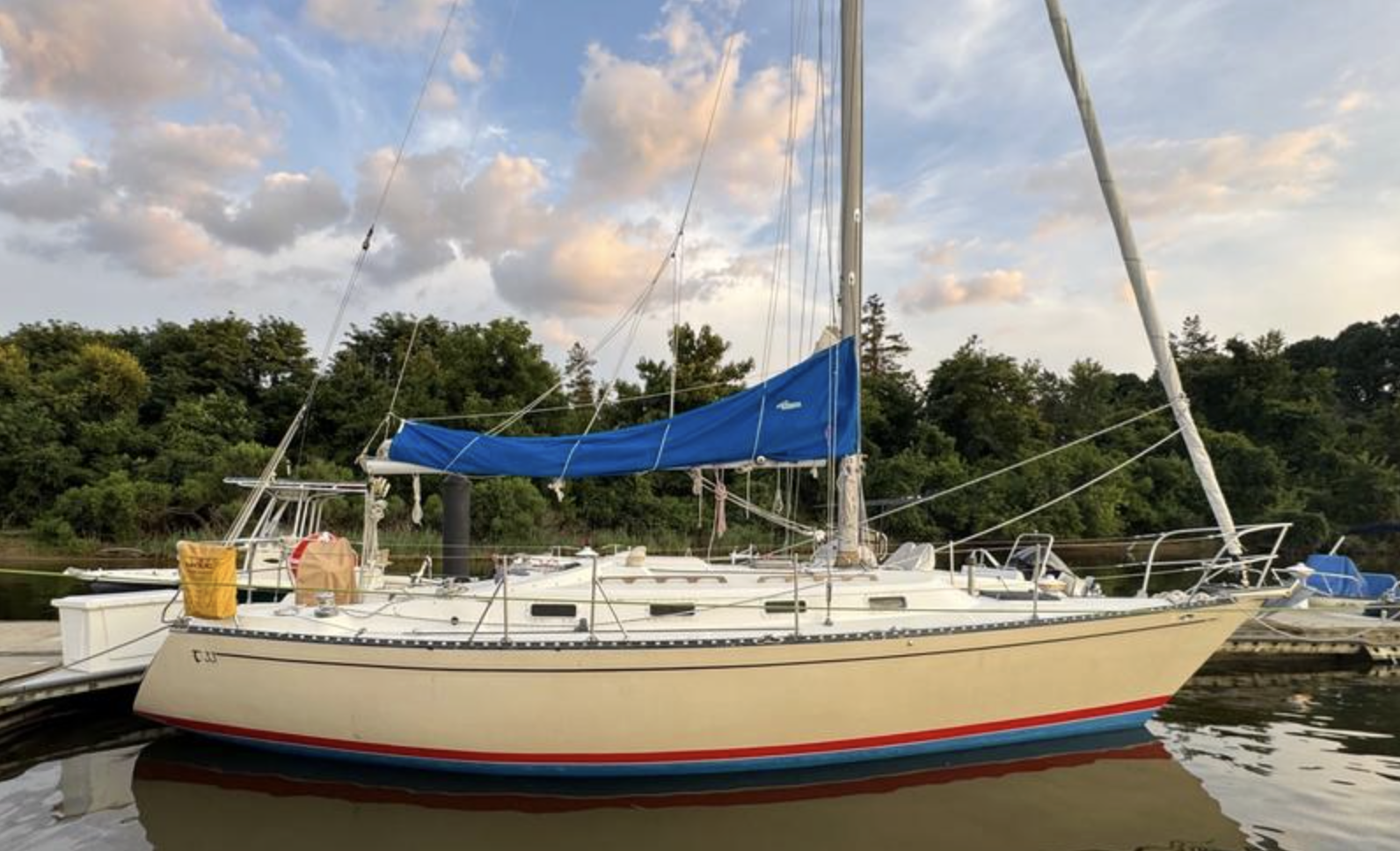
As originally configured—Scheel keel and fractional rig—performance of the Tartan 33 might be a little disappointing for someone coming from a Tartan Ten, but is certainly on a par with most other boats of the same size, type, and vintage. In absolute terms the Tartan 33 is spritely, but not stunning, with a PHRF rating of about 160. By comparison, the old C&C 34—a good all-around cruiser/racer from the same period—rates 144, 16 seconds per mile faster. The C&C 34 and Tartan 33 are almost identical in length, sail area and displacement.
Light Wind Performance
In lighter winds, the fractionally-rigged Tartan 33 is at its biggest disadvantage, particularly off the wind. The big mainsail allows you to sail fairly low, but you go pretty slow. By comparison, a boat with a big masthead spinnaker will be sailing a little higher and quite a bit faster for optimum off-wind VMG in the same conditions.
IMS (International Measurement System) velocity predictions show that the Scheel keel Tartan 33 must in general be sailed a little lower and flatter than a comparable fin keel boat, although the 33’s righting moment is very similar to that of a fin keel boat of the same size and type, as is her range of positive stability.
Racing
The Tartan 33 was not designed to any rating rule, but a number have been rated under the IMS. In some areas, there are enough of the boats to allow them to sail together as a one-design class, but the boat is not fast enough in absolute terms to stir the blood of most sailors interested in one-design racing. In addition, Tartan 33 sailors disagree on the proper amount of headsail overlap for the boat, making level racing more difficult.
33 vs. 33R
To offset the rather average performance of the Tartan 33, the 33R was introduced in 1982. The 33—“R” for “Racing”—has a deep fin keel and a double-spreader masthead rig. The difference in performance between the 33 and the 33R is pretty amazing: the 33R is almost 30 seconds per mile faster than the stock 33, even though the sail area is almost identical.
Righting moment of the fin keel and Scheel keel boats is virtually the same, so the extra performance isn’t the result of increased stability. The combination of the fin keel and the masthead rig is simply faster in most conditions.
It’s interesting to compare the performance with the 34-2, which combines the Scheel keel of the 33 with the masthead rig of the 33R. Although the specifications for the 33 say the boat is a thousand pounds lighter than the 34, the 33 was never as light as that. The typical 33, in IMS measurement trim, weighs pretty much the same as the 34-2, 11,000 lb.
Typically, the 34 has a PHRF rating of about 141 with the optional deep keel, 147 with the standard Scheel keel. This places the 34 pretty squarely between the 33 and the 33R in the performance spectrum, suggesting that the masthead rig accounts for about half the performance difference between the 33 and the 33R.
Rig
In order to keep the rig simple, the 33 was designed without running backstays. Instead, forestay tension is maintained by carrying a lot of load on the swept-back upper shrouds. Some 33s that have been actively raced have added running backstays, but they are not necessary if the boat is used strictly for cruising. Our experience with fractional rigs of larger boats is that it is very difficult to maintain adequate headstay tension without runners or jumpers, even though runners are a pain for shorthanded sailing.
If you want the best performance in a Tartan 33, there’s no question that you should look for a 33R. It may be a long look, as relatively few of the higher-performance boats were built. The 33R’s draft of over 6 ft. 3 in. could be a disadvantage in areas of shoal water.
One advantage of the fractionally-rigged boat’s large mainsail—it’s just over 300 square feet, about what you’d find on most masthead-rigged 37-footers—is that the boat balances and sails reasonably well under mainsail alone. This is a useful feature for shorthanded cruising, when you may find yourself circling a harbor under sail looking for a place to anchor. With the Tartan 33, you can drop the jib and clear the foredeck for anchoring while still maintaining good sailing ability under mainsail.
Shrouds are set well inboard, and you’ll almost always find inboard genoa tracks just outboard of the cabin trunk, even though it was an option.
Steering
Wheel steering was standard on the boat, and the 32-in. wheel provides plenty of power as well as good feedback. The rudder is partially protected by a vestigial skeg, and is a deep, high-aspect-ratio appendage—practically parallel-sided in profile—rather than the more efficient elliptical shape seen in more modern racing boats and performance cruisers.
Cockpit
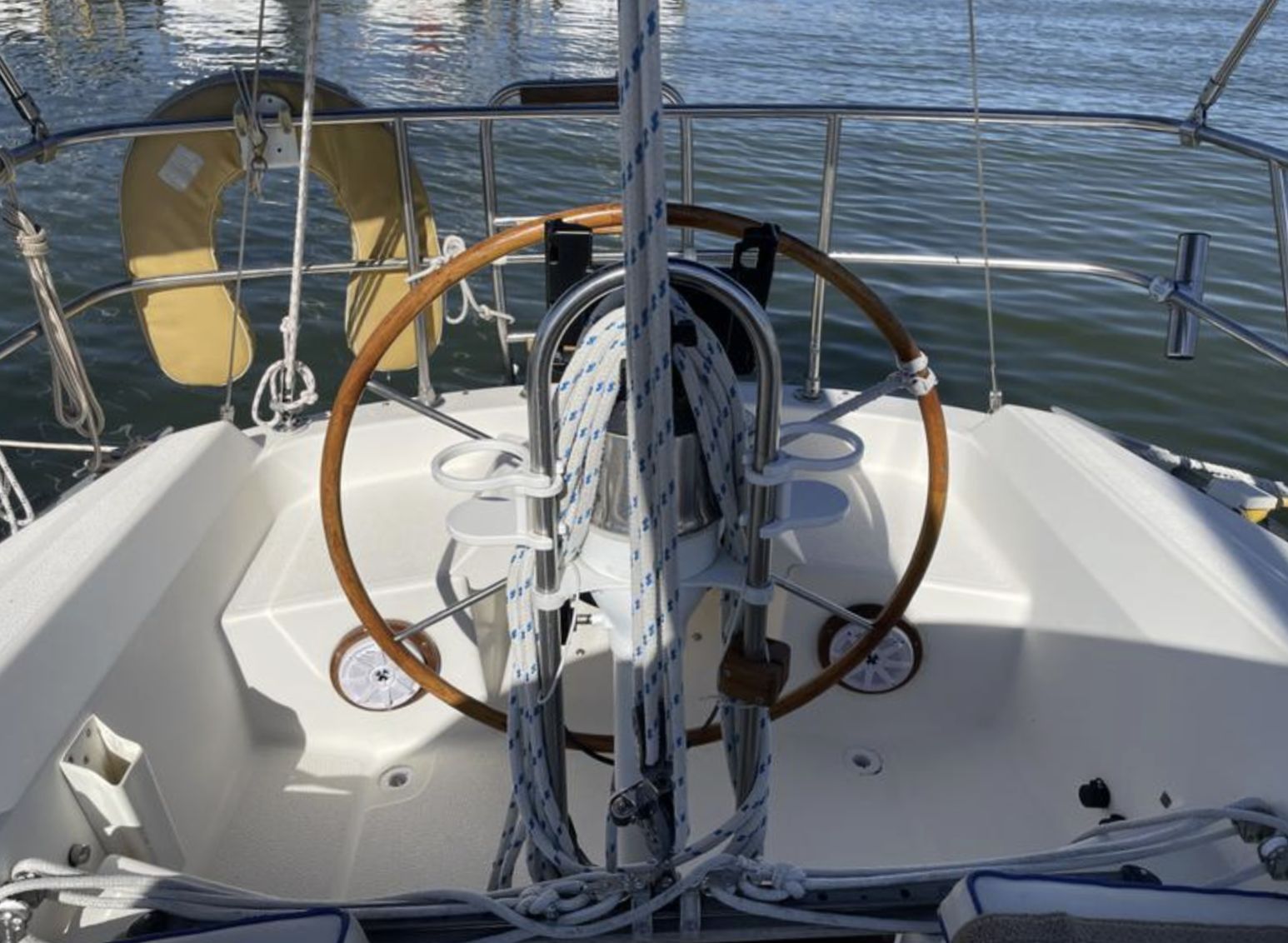
Cockpit layout is efficient for sailing, but is somewhat better for cruising than for racing. A mainsheet traveler spans the cockpit well, just forward of the wheel, and genoa sheet winches are outboard of the main coamings, just forward of the traveler. For racing, it would be better to have the genoa winches further forward, so that trimmers would be well clear of the helmsperson, and their weight would be further forward. For shorthanded cruising, however, the location is good.
Unfortunately, self-tailing winches were not standard equipment. The stock Lewmar 40s are about the right size for the fractional foretriangle, but would be a little small on a masthead rig with a 150% genoa. Sparkman & Stephens is one firm that can always be counted on to design in a molded dodger breakwater, and Tartan has faithfully put them on their cruiser/racers over the years. Other builders should take note of the simple, functional breakwater on the Tartan 33, which has openings molded in to allow halyards to be led aft if you want to set the boat up for singlehanding.
Construction
Tartan has always had the reputation of being one of the country’s higher-quality production builders, and they deserve it. In general, owners report very few construction shortcomings, and very few warranty claims.
Four owners in our survey had gelcoat blistering problems. That does not constitute an unusually large percentage, but interestingly, the boats reporting blistering were two pairs that were sequential in the production series. That may be a coincidence, but it’s an unusual one.
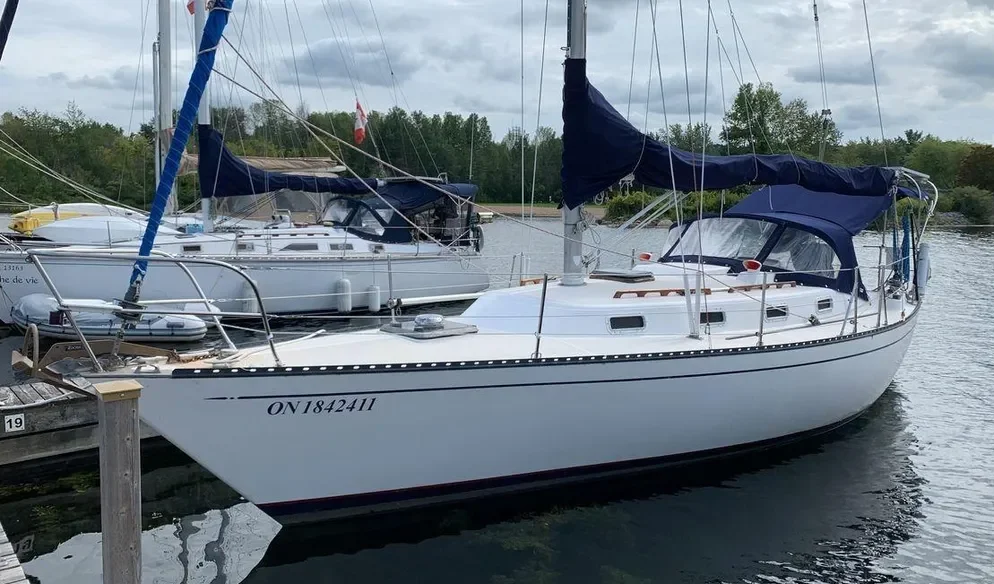
Balsa coring is used in both the hull and deck of the Tartan 33. If you replace or move any deck or hull fittings, be sure to seal any exposed balsa with epoxy resin before installing new hardware.
The hull-to-deck joint is made with a standard inward-turning hull flange, overlapped by the deck molding, which is bolted to the hull through an anodized aluminum toerail. The joint is bedded with both butyl and polysulfide. Builders like to use butyl as a bedding compound, since it’s cleaner to use than most gunned compounds such as polysulfide or polyurethane. Butyl has no adhesive properties, however, and in our experience it can be squeezed out of a joint over time if you continue to tighten down bolts to cure a leak. Since only one owner in our survey reported any deck leaks, Tartan’s combination seems to work well.
Anchor
Several owners complain about the lack of a foredeck anchor well. Wells can be a nuisance when racing, since they frequently hold a fair amount of water. For cruising, however, an anchor well lets you clear the foredeck without making a soaking mess of a cockpit locker.
Easy-Care Exterior Wood
There is an absolute minimum of exterior wood on the Tartan 33: handrails atop the cabin, trim around the companionway. The boat is much more austere than you think of when Tartan comes to mind, but the racing Tartans have always been pretty basic.
Deck
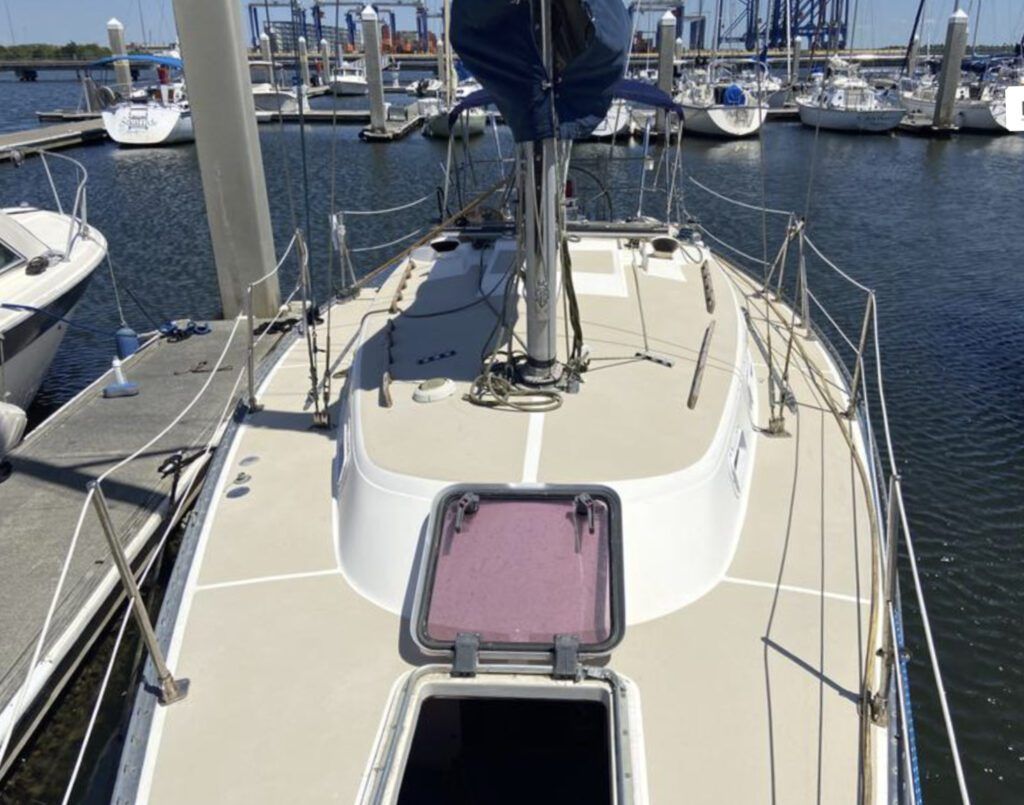
Two-tone decks were an option, although the standard monotone deck was available either in white or a light buff. With the two-tone deck package, non-skid areas on the deck, coaming tops, cockpit seats and deckhouse were a nice buff color, contrasting with the stark white of the rest of the deck molding. If you buy a monotone boat, the areas could be painted a contrasting color. A white Tartan 33 with white monotone decks is a plain vanilla boat, indeed.
Engine
You’ll find a three-cylinder, 24-hp Universal diesel in every Tartan 33. Owners report that the engine has been smooth-running and reliable, and that it’s adequate power for the boat. An aluminum fuel tank holds 26 gallons, giving a range of about 200 miles under power.
All in all, there’s little to quibble with in the design and construction of the Tartan 33: it’s simple, straightforward, and well executed.
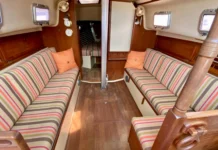
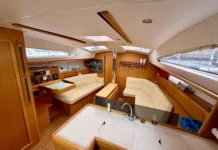
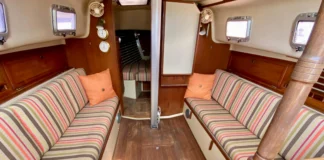
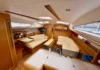
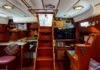
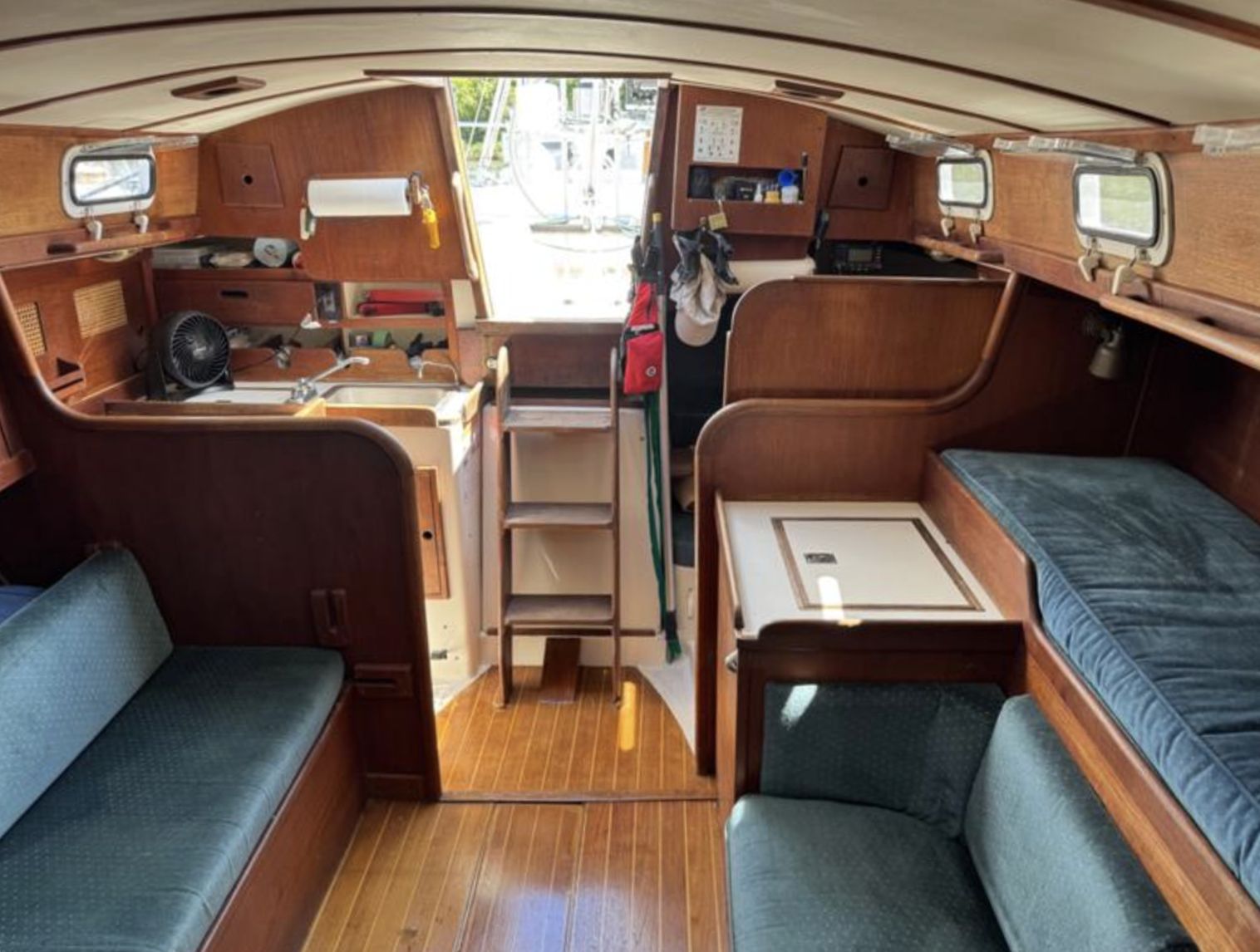
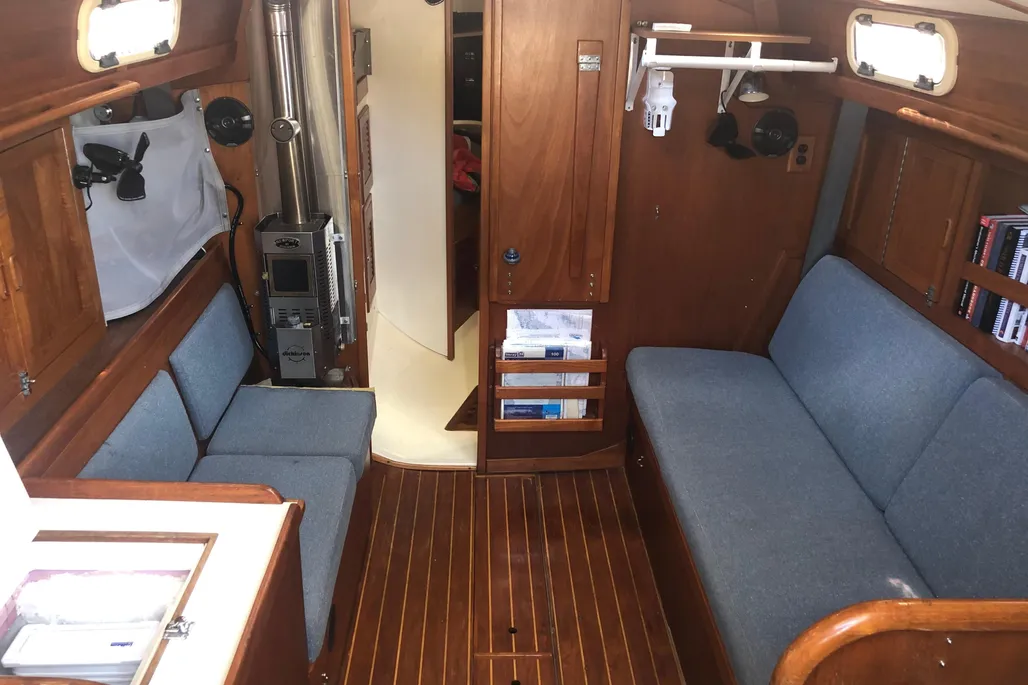
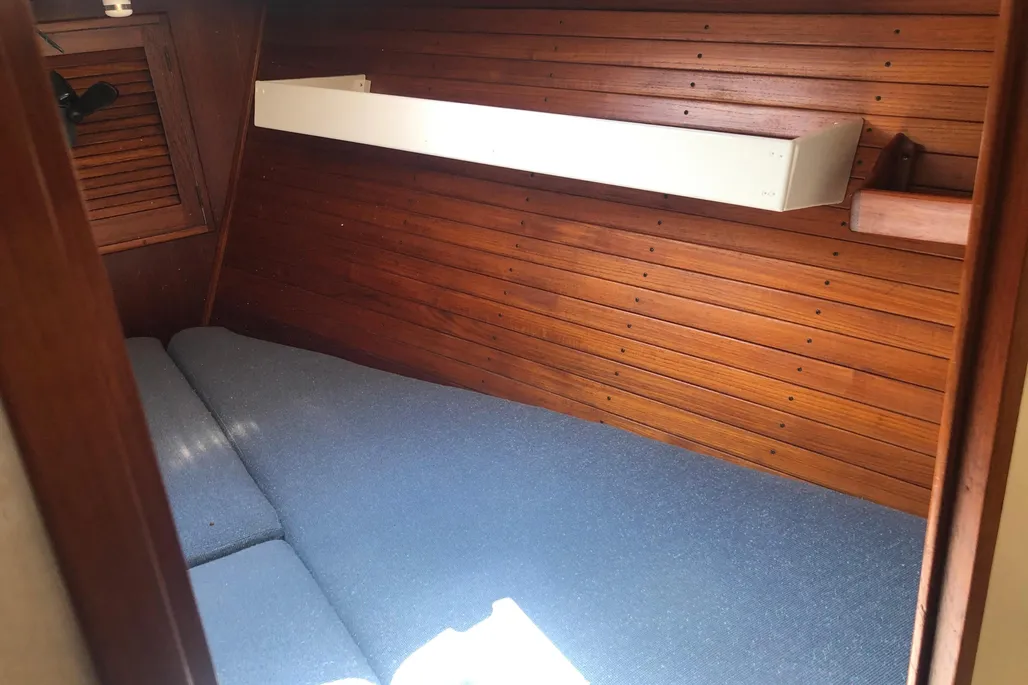
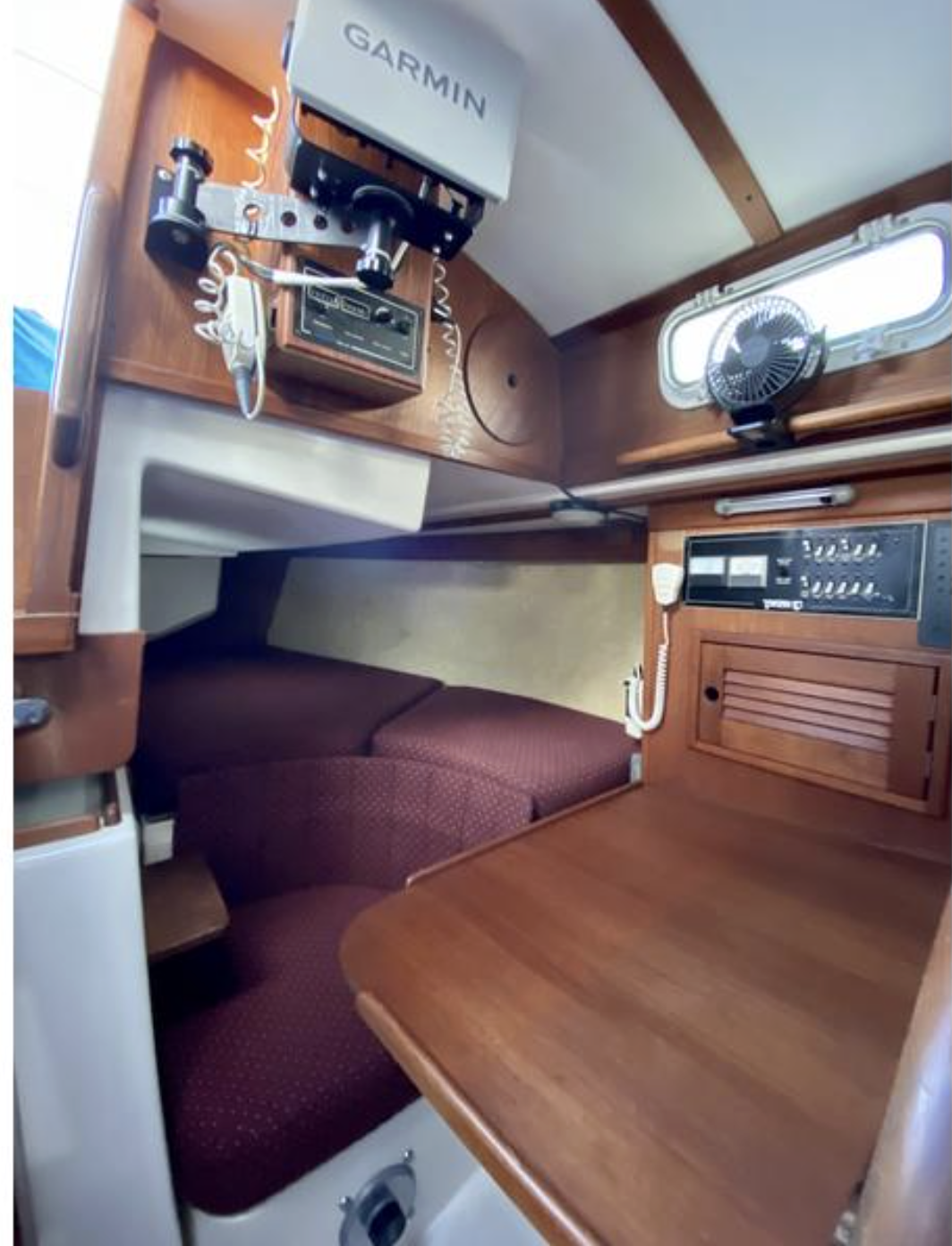
The interior layout of the Tartan 33 has both fans and detractors. The head configuration, for example, is something you either love or hate. To give more room, particularly for showering, the head compartment runs the full width of the boat. A bi-fold door shuts off the head from the forward cabin, and another bi-fold door closes the head to the main cabin. Two opening ports provide ventilation in fair weather. The difficulty with this arrangement is that you cannot get either into or out of the forward cabin if someone is using the head. This wouldn’t be a problem for cruising with a couple, but it could be a nuisance with a lot of people aboard. Closing the door to the forward cabin also cuts off ventilation forward, unless the weather is good enough to have the foredeck hatch open. The problem is made even worse when the insert is used in the V-berth to form a double. This completely eliminates any standing room in the cabin, so that you climb into the berth directly from the head compartment. It works, but there’s a fair amount of psychological resistance to the arrangement, since it is one usually seen on smaller boats. Ironically, the full-width head is a really good one, with plenty of elbow room for showering and dressing. Even without the berth insert in place, standing room in the forward cabin is marginal, and headroom is very limited. While the forward berths are quite long, they are extremely narrow at the foot, so that two tall people will be tangling feet if they use the berths as two singles. As a double, sleeping parallel to the centerline, this is less of a problem. The main cabin layout is also unusual. To starboard, there is a fairly standard settee that extends to form a reasonably-sized double, with a shelf outboard. A dining table folds up against the starboard forward bulkhead. On the port side, the arrangement is less standard. Instead of a normal settee berth, there is a short settee—less than 5-ft. long—with the icebox occupying a high counter at what would normally be the head of the berth. This short settee could function as a berth for a child, but obviously not for an adult. Outboard of the settee, there is a narrow pilot berth, which is comfortable and secure, and fortunately isn’t jammed as high under the side decks as they frequently are. Main cabin ventilation is provided by six opening ports, two cowl vents in dorade boxes, and an aluminum-framed centerline hatch, which was an option, but a common one. The galley—aft on the starboard side—is not the most efficient in the world, since you have to turn around and step across the main cabin to reach the icebox. In addition, the icebox top is the only usable food preparation counter space, which puts the cook in the middle of the main cabin, smack in the traffic flow. A two-burner alcohol stove was standard equipment, but a large percentage of boats have the optional three-burner gimbaled alcohol stove with oven. A deep single sink is just aft of the stove, but it’s a bit of a reach to use, since the flat of the cabin sole doesn’t extend very far outboard in this part of the hull. Aft of the icebox is a sit-down chart table. The working surface is a reasonable size, and the outboard locker could be sacrificed for the installation of electronics. While there is a contoured, upholstered seat for the nav station, it does not exactly face the chart table, and it is offset from the center of the table. The navigator has to twist at an awkward angle to reach the outboard part of the table, or to use any electronics mounted outboard. Aft of the nav station is a big double quarterberth. A drop-in insert which covers the nav station seat forms the head of the inboard portion of the quarterberth, although the berth can be used as a single without disturbing the navigator. This is basically the same quarterberth layout used in the Tartan 37. We thought it a bit awkward on the bigger boat, but it’s a bit more acceptable on a smaller boat where space is at even more of a premium. Most owners who have lived with the interior for some time find it quite workable. A top Tartan dealer told us, however, that he has definitely seen buyer resistance to it. Certainly the redesigned interior of the Tartan 34 is substantially better. If you’re looking for a fairly fast, high-quality, late model cruiser/racer, the Tartan 33 is a good choice. In general, prices will be very comparable to those of other quality boats of the same size and vintage, such as the C&C 34 and Sabre 34. Performance of these three boats is also similar.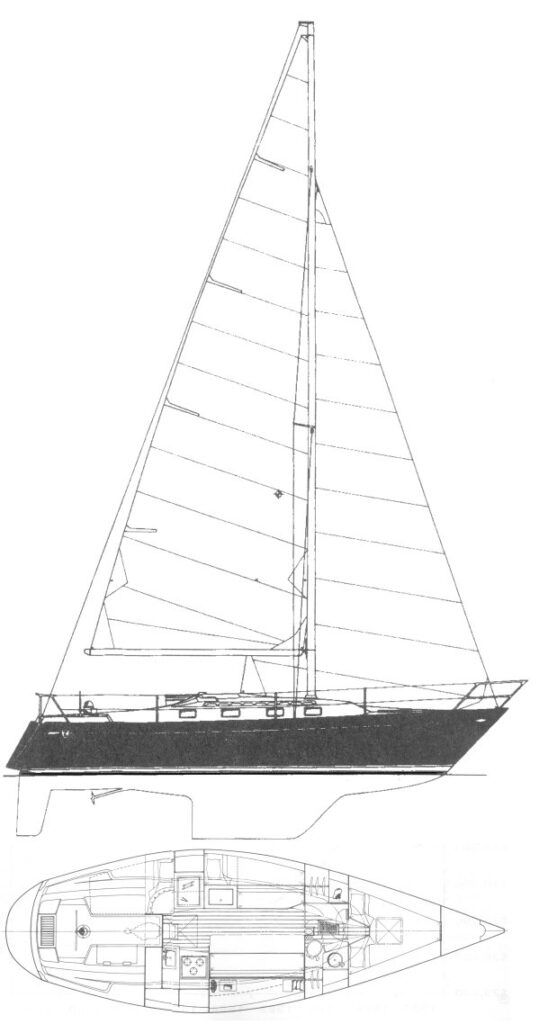
Sailboat Specifications Contact
Hull Type: Sheel Keel
Rigging Type: Fractional Sloop
LOA: 33.67 ft / 10.26 m
LWL: 28.83 ft / 8.79 m
S.A. (reported): 531.00 ft² / 49.33 m²
Beam: 10.96 ft / 3.34 m
Displacement: 10,000.00 lb / 4,536 kg
Ballast: 4,400.00 lb / 1,996 kg
Max Draft: 4.56 ft / 1.39 m
Construction: FG
Ballast Type: Lead
First Built: 1979
Last Built: 1984
# Built: 201
Builder: Tartan Marine (USA)
Designer: Sparkman & Stephens
Make: Universal
Type: Diesel
HP: 24
Fuel: 26 gals / 98 L
Water: 60 gals / 227 L
S.A. / Displ.: 18.37
Bal. / Displ.: 44
Disp: / Len: 186.3
Comfort Ratio: 21.04
Capsize Screening Formula: 2.04
S#: 3.04
Hull Speed: 7.19 kn
Pounds/Inch Immersion: 1,129.02 pounds/inch
I: 39.00 ft / 11.89 m
J: 12.50 ft / 3.81 m
P: 41.75 ft / 12.73 m
E: 13.75 ft / 4.19 m
S.A. Fore: 243.75 ft² / 22.65 m²
S.A. Main: 287.03 ft² / 26.67 m²
S.A. Total (100% Fore + Main Triangles): 530.78 ft² / 49.31 m²
S.A./Displ. (calc.): 18.36
Est. Forestay Length: 40.95 ft / 12.48 m
Interior
Accomodations
Saloon
Galley
Nav Station
Quarterberth
Conclusions
Market Scan Contact
1982 Tartan 33 Veteran Yacht Sales
$34,900 USD (443) 888-2901
Essex, Martland Yacht World
1982 Tartan 33 Ewan Campbell
$36,000 (US$26,327) +12492009820
Midland, Ontario Yacht World
1982 Tartan 33 Riverfront Marine Sales and Service
$20,000 USD +1 (216) 510-9134
Cleveland, Ohio Yacht World