

As my son and I eased my 30-ft. sloop up to the dock at our winter yard in Mamaroneck, NY, a gentleman came racing down the gangplank from the neighboring yacht club and offered us a hand with our lines. “Is this an Albin Ballad?” he asked eagerly, before the boat was even tied off. “Why, yes it is,” I replied with surprise. After several years of ownership I was used to hearing comments like “nice boat” or “beautiful lines,” but never had an admirer come up with the make and model of my aging Swedish beauty.
Indeed, an Albin Ballad is seldom seen in North American waters, unlike her older and more popular sister ship, the 27-ft. Albin Vega, which saw 3,450 built between 1965 and 1979 and sold by the hundreds in the U.S. and Canada. Out of 1,500 Ballads built between 1971 and 1982, more than 1,100 have been accounted for in a detailed and still-active Albin Ballad Survey (AB Survey), but only 31 of those boats (2.5%) are in the U.S. and Canada, suggesting that fewer than 50 Ballads were originally sold in North America. More than 70 percent of boats detailed in the AB Survey, at this writing, are split between Denmark (38.3%) and Sweden (34.1%), distantly followed by the Netherlands (6.3%), Norway (5.3%), Germany (4.7%) and the United Kingdom (3.3%).
Enthusiastic Owners
In whatever country they may reside, Ballad owners are an enthusiastic and adoring crew, as can be discovered on the active Albin Ballad Forum (AB Forum) Facebook group and through still-active Ballad clubs in Denmark, Germany, Sweden and the United Kingdom. Even former Ballad owners, such as Hal Wolkin, the gentleman who helped me with my lines, don’t seem to buy into the “happiest day” maxim associated with selling one’s boat.
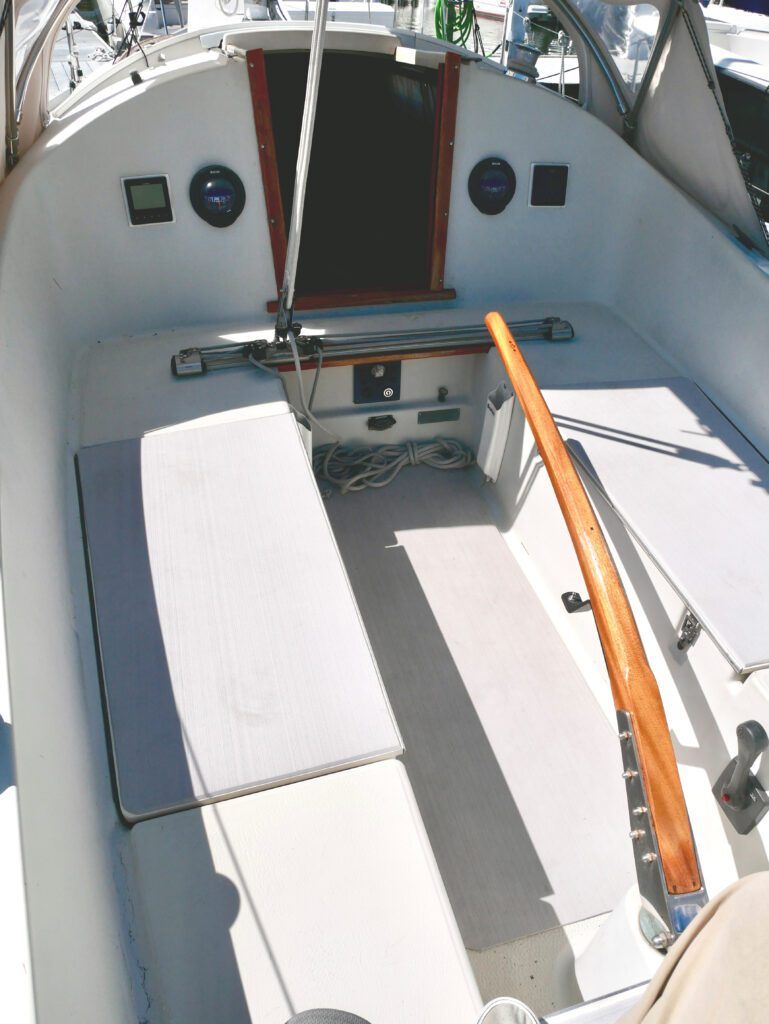
“I always regretted selling my Ballad,” Hal said, eyeing my boat with nostalgia. Hal sold his 1978 Ballad in 1989 because a good friend made a too-good-to-refuse offer to share his very new and luxurious Bristol 35.5. “For a long cruise, the Bristol was definitely more comfortable, but the Ballad has more of a sports car feel‒like you’re engaging in the sport of sailing. The Ballad has lower freeboard, so you’re closer to the water, and it’s very nimble. You steer with a tiller, sitting up near the companionway [compared to steering with a wheel from the back of the far-heavier Bristol]. If you push the tiller an inch, the boat responds.”
Performance and Seaworthiness
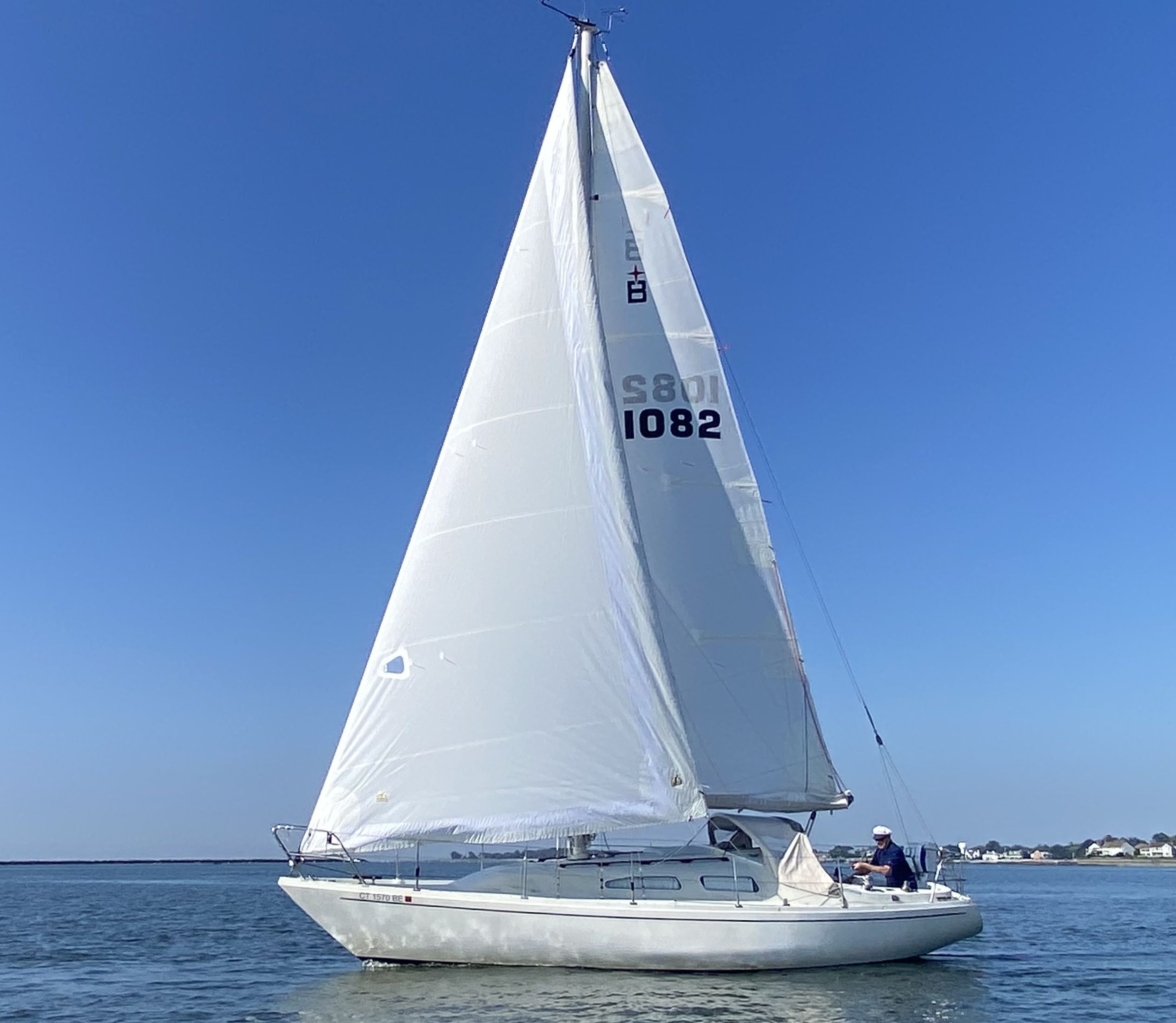
Performance, durability and seaworthiness are the hallmarks of the Ballad. Albin Marin had a reputation for quality construction, and Ballads offer proof in standing up to hard racing in the boat’s early years and demanding coastal cruising over more recent decades. Many European Ballad club members still actively race their boats against other Ballads. The Danish Ballad Club website has fairly recent photos of races with at least a dozen participants while the UK Ballad Association typically draws half a dozen boats to its annual Ballad National Championships.
Ballads also do well against more modern boats. Franz van der Wel, owner of the Ballad Aemilia, posted in the AB Forum that his boat placed first out of 21 boats in its class and first overall out of 40 boats in the 2024 Ronde om Noord-Holland. More often you’ll read AB Forum accounts from Ballad owners documenting ambitious, multi-country European cruises to far-flung ports across the Baltic Sea, North Sea or English Channel.
Ballads in the U.S.
Despite the low odds of finding Ballads in the U.S., my now-friend Hal Wolkin, always on the lookout for his old boat, spotted another Ballad right in our own harbor. Our encounter with the young owners quickly confirmed that they fit the mold of adventurous Ballad sailors.
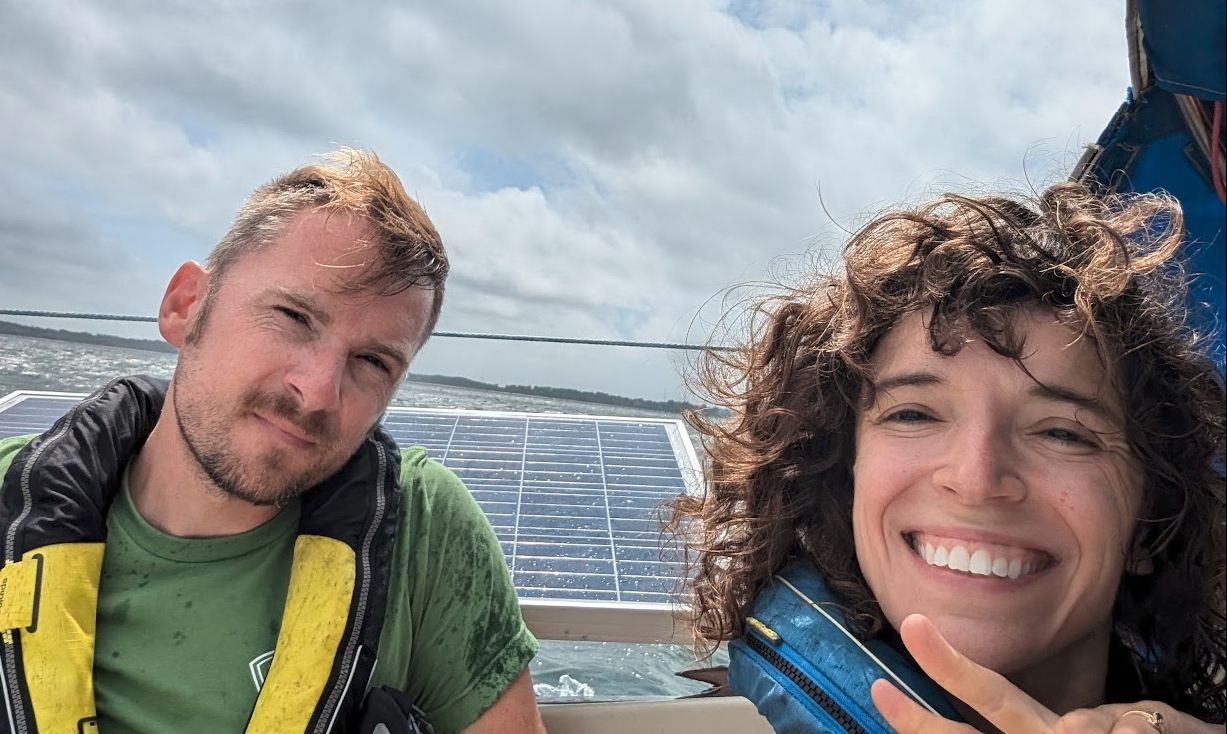
Marius Draeger, 40, and his wife, Talea Cornelius, 36, have sailed their late 1974 Ballad from Mamaroneck, NY, as far north as Maine and as far south as the Delaware Bay. Rather than staying in sight of shore and seeking safe shortcuts, such as the Cape Cod Canal and Cape May Canal, Marius and Talea took the outside routes around these capes. In their coastal cruising exploits they’ve been caught in gnarly storms with steady 30- to 40-knot winds and seas well above their cabin top, but their Ballad has handled it all with aplomb.
“I always feel safe in the Ballad, no matter how windy or wavy the conditions,” says Talea, who had never sailed before boarding Marius’ Ballad in 2019.
Marius says his Ballad quickly accelerates to 5 knots in winds as light as 10 knots, and he reports reaching speeds as fast as 8.5 knots (speed over ground) on a spinnaker run from the mouth of New Jersey’s Manasquan River to New York’s Fire Island Inlet. Given 12- to 14-knot winds and a clean hull, my own Ballad regularly reaches the boat’s hull speed of 6.36 knots in my dashes across and around the Long Island Sound.
Design and Construction
The Ballad was born in 1968 as the Joker S30, a half-ton racing boat designed by Rolf Magnusson, a racing sailor, boat designer and sailmaker. Like many International Offshore Rule (IOR) masthead rig designs of her day, the boat had a small mainsail coupled with a large overlapping genoa. Magnusson campaigned the Joker extensively in 1969 and won a bronze medal in the International Half Ton Cup competition, held that year in Sandhamn, Sweden. That success led to more than 30 orders, in 1970, for the original S30 builder, Arvika Plast, a small builder located near Gothenburg, Sweden.
In 1971 an improved design, renamed Ballad, was acquired by Albin Marin, a large-scale production builder in Kristinehamn, Sweden. At the time, Albin was cranking out the Vega, the 23-foot Viggen and several other models by the hundreds per year. Magnusson would go on to design at least 18 other boats, including two smaller Albin models, but none were as successful or remain as recognized (in Europe, at least) as the Ballad.
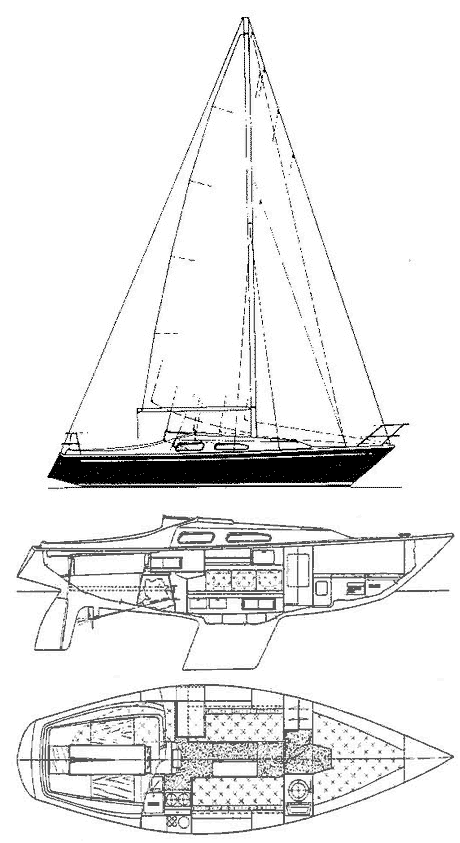
Sailboat Specifications Courtesy of Sailboatdata.com
Hull Type: Fin with rudder on skeg
Rigging Type: Masthead Sloop
LOA: 29.99 ft / 9.14 m
LWL: 22.64 ft / 6.90 m
S.A. (reported): 472.54 ft² / 43.90 m²
Beam: 9.71 ft / 2.96 m
Displacement: 7,275.25 lb / 3,300 kg
Ballast: 3,417.17 lb / 1,550 kg
Max Draft: 5.09 ft / 1.55 m
Construction: FG
Ballast Type: Lead
First Built: 1971
Last Built: 1982
# Built: 1500
Builder: Albin Marine/Shipman Marine (SWE)
Designer: Rolf Magnusson
Make: Volvo
Model: MD 6A
Type: Diesel
HP: 10
Fuel: 9 gals / 33 L
Water: 17 gals / 65 L
S.A. / Displ.: 20.20
Bal. / Displ.: 46.97
Disp: / Len: 279.88
Comfort Ratio: 21.91
Capsize Screening Formula: 2.01
S#: 1.83
Hull Speed: 6.38 kn
Pounds/Inch Immersion: 785.49 pounds/inch
I: 37.07 ft / 11.30 m
J: 12.24 ft / 3.73 m
P: 31.99 ft / 9.75 m
E: 9.32 ft / 2.84 m
S.A. Fore: 226.87 ft² / 21.08 m²
S.A. Main: 149.07 ft² / 13.85 m²
S.A. Total (100% Fore + Main Triangles): 375.94 ft² / 34.93 m²
S.A./Displ. (calc.): 16.07
Est. Forestay Length: 39.04 ft / 11.90 m
Mast Height from DWL: 40.68 ft / 12.40 m
Hull and Keel Configuration
Below the waterline the Ballad has a broad, swept back fin keel combined with a large, skeg-hung semi-elliptical rudder that contributes to the boat’s responsive, well-balanced helm. Lead ballast weighing 3,417 lb. / 1,550 kg makes the Ballad stand up to the wind. This weight is encapsulated in the fiberglass keel, so there are no keel bolts to loosen, leak or fail, but damage after encounters with rocks or reefs should be carefully inspected and repaired.
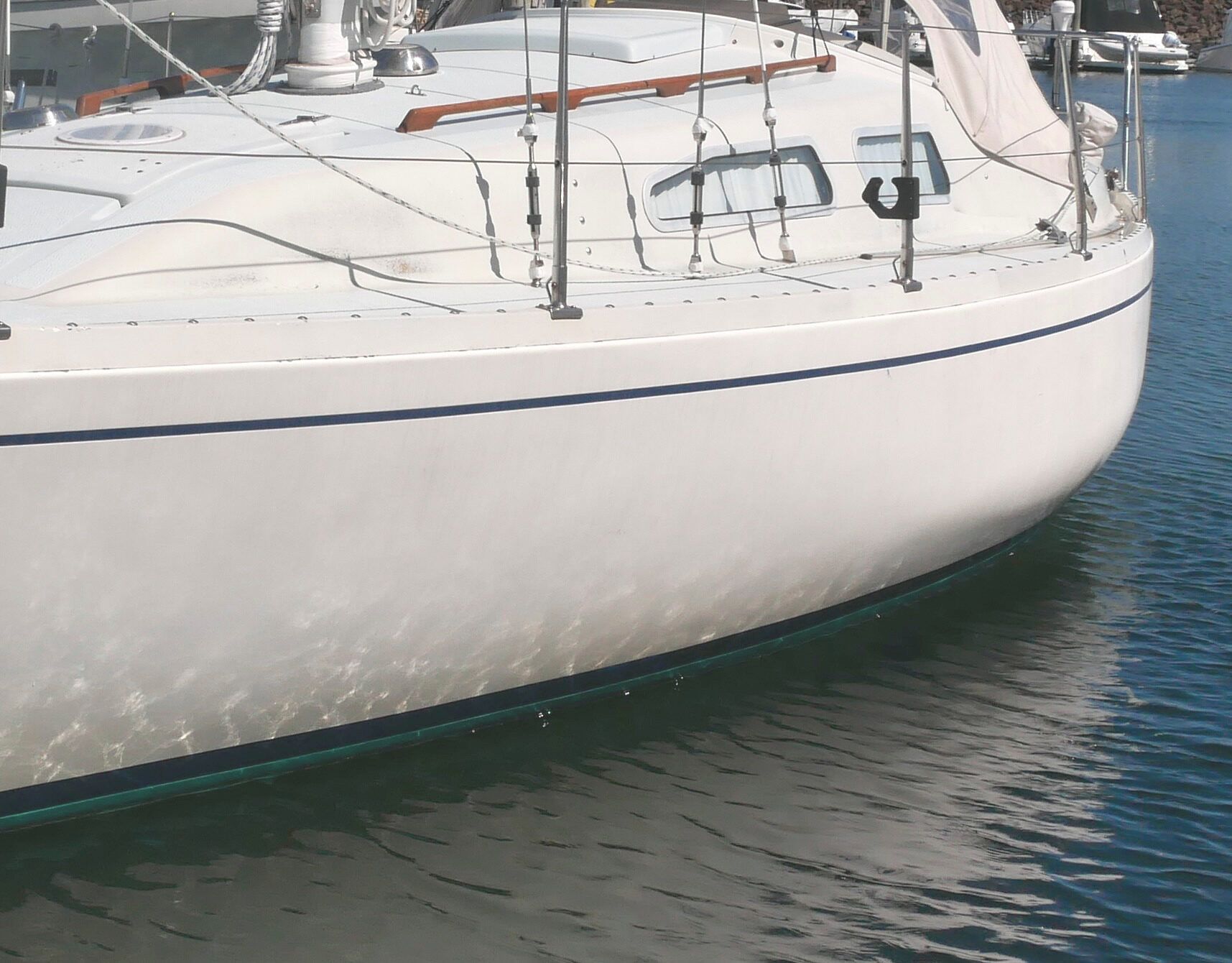
The Ballad is fairly light for her era and class, with a displacement of just 7,275 lb. / 3,300 kg. This compares to 8,320 lb. / 3,774 kg for the Pearson 30, built between 1971 and 1981, and 8,750 lb. / 3,969 kg for the Tartan 30, built between 1970 and 1978. The ballast-to-displacement ratio of 46.97 suggests a stiff boat. Enhancing that stiffness is a slightly flaring knuckle-shaped hull profile amidships, just above the waterline. The hull profile widens the beam to 9.71 ft. / 2.96 m and moves the center of buoyancy farther outboard compared to similarly beamed boats with tender wineglass profiles.
Hull and Deck Construction
Hull construction began with fiberglass mat followed by two layers of woven roving. Thicknesses range from 5/16 in. / 8-9 mm above the waterline to 3/8 in. / 10 mm below the waterline and as thick as 15/16 in. / 25 mm in the lower extremities of the keel.
Ballad decks feature a sandwich core construction combining a topside layer of reinforced plastic/non-skid, a 1/8 in. / 3 mm top skin followed by 9/16 in. / 15 mm of divinycell coring and another 1/8 in. / 3 mm headliner skin on the undersides. The molded-in 2 in. / 50 mm high toe rail as well as the hatch frames, the opening for the keel-stepped mast, and all areas likely to be through bolted (for blocks, hand rails, winches and sail tracks) were solidified with a pressure-resistant filler. The hull and deck are joined at the toe rail with a butyl rubber gasket and more than 130 stainless steel bolts spaced just 5.1 in. / 130 mm apart.
Deck Durability and Maintenance
When venturing far offshore and when in rough seas, many coastal-cruising-oriented Ballad owners will reef early. “In open seas, it just doesn’t feel wise to put the butyl seam under the water,” one owner recently commented on AB Forum. The toe-rail mounted stanchions can also be leaky, after all these years, so better to avoid submersion. In any case, given the hull’s knuckle shape amidships, a buried rail would indicate a boat that is over canvassed and beyond its optimum heel angle.
At nearly an inch thick and with solid glass in areas likely to be through bolted, Ballad decks hold up well. Some owners report a crunchy sound in winter when walking on cored areas. The sound suggests water ingress, freeze/thaw cycles and possible delamination of the skins from the divinycell core. Experienced owners on the AB Forum express little concern, reporting that their decks are still solid even if there’s a touch of noise. Indeed, PVC-based, closed-cell divinycell won’t rot and get mushy, like balsa core. Nonetheless, owners should find and fix points of water ingress, keep the boat covered and dry in winter, and dehumidify the interior as best as possible.
The IOR-Influenced Rig
The Ballad’s 40.68 ft. / 12.40 m aluminum mast is keel stepped and robustly supported by eight ¼ in. / 6 mm, 19-strand stainless steel stays (fore, aft, and three stays each on the port and starboard sides). The spars were supplied by Ambau of Germany or Proctor of England through 1978 and by Selden of Sweden thereafter. The 472.54 ft2 / 43.90 m2 sail area combines a massive 346.5 ft2 / 32.2 m2 150% overlapping genoa with a tiny 149.07 ft2 / 13.85 m2 main. Many owners on the AB Forum write that they favor a 135% or 130% genoa for easier handling.
Marius Draeger, the other Ballad owner in my harbor (and the only other current owner I’ve met), says he sticks with a 100% working jib at most times, in part because it improves upwind performance, allowing sheeting to within 30 percent of the wind direction. I get signs of pinching when sailing tighter than 35 percent into the wind with my 135% genoa. The smaller head sail enables you to move the sheet lead cars all the way forward and further inboard on the boat’s curved T-tracks. The smaller sail also affords better forward visibility.
As for the Ballad’s tiny standard mainsail, the sail’s foot (E dimension) of 9.32 ft. / 2.84 m is half a foot shorter than that of a J/24‒such were the design contortions promoted by IOR ratings. The main rolled up on a round, roller-reefing boom. Reefing and stowage was accomplished using a crank that fit into the end of the boom. Marius, like many other owners on the AB Forum, doesn’t use the roller reefing feature, having switched to conventional slab reefing with two reef points.
Modern Upgrades
Some owners, including the previous owner of my boat, upgrade to a more modern boom with internal reefing and outhaul lines. After consulting with a naval architect (or so I was told), my previous owner also raised the boom by 8 in. / 0.2 m (shortening the luff by a corresponding amount), extended the boom’s length by eighteen inches to 11.10 ft. / 3.38 m (in part to gain reefing line leverage) and lengthened the mainsail’s foot by eight inches to 10.00 ft. / 3.04 m. At 156.65 ft2 / 14.55 m2, my mainsail is about five percent larger than a standard Ballad mainsail. As a result, my boat likes to be reefed (to maintain optimum heel angle, gain speed and improve balance) when the wind gets above 14 knots. Owners with the smaller, standard mainsail say they reef above 16 to 18 knots.
Marius’ reefing practices are a special case because, in 2021, he replaced all six stainless cable side stays as well as the backstay with a Dyneema setup from Colligo Marine. The switch reduced weight by more than 30 pounds, he says, with more than half of that weight formerly being well aloft and contributing to heeling. As a result, Marius says his Ballad is even stiffer, and he can delay reefing until winds reach 20 knots (noting, too, that Marius’ default headsail is a working jib).
Early Boats to Avoid
Early iterations of the Ballad, namely those built from 1972 through early 1974, may have an Achilles heel in the form of a mild steel mast truss. The truss is under the mast step hidden below the cabin sole and sitting on top of the keel ballast. The truss bears the weight of the anodized aluminum mast, plus the tension of eight stays. The truss is mostly encased in polyester resin (this was before the days of modern epoxies), but being in the bilge, nearly a score of early mild steel trusses are known to have rusted and failed, in some cases causing masts to go loose. In rare cases the failing truss caused a split in the leading edge of the keel beneath the foot of the mast.
Albin Marin eventually addressed the truss problem by switching to galvanized steel trusses. Judging by reports in the AB Survey, the switch to galvanized happened sometime in early 1974 and it all but eliminated the problem. Almost all problems reported in the AB Survey are associated with 1972 and 1973 (sub hull #200) boats.
Fixes for Early Models
More than a few owners of boats with failed or suspect mild steel trusses have cut out a portion of the cabin sole around the mast step in order to extract and replace the truss. Some owners had replacements built out of G10 composite while others opted for stainless, epoxy-coated steel or anodized aluminum. Repair options and procedures are well documented online, but it’s a major project (and testament to the love that Ballad owner have for their boats) to say the least. I would personally avoid buying a sub-hull-#200 boat unless I had documented and visible evidence that the truss had been replaced.
Inspect Before You Buy
When considering later models, inspect the bilge compartment directly behind the mast step for signs of rust. Before I purchased my boat, I went to the trouble of drilling small holes at the top and to each side of this bilge compartment (being super careful not to hit the truss with a drill bit) in order to use an endoscopic camera for inspection. It was hard to see much, honestly, so I took faith in the boat’s high hull number (1082) and trust that it was built with a galvanized truss. In addition to rotating dry desiccant packs in the forward bilge, I try not to stress the truss by going out in rough, pounding seas or over-tightening the stays.
Propulsion
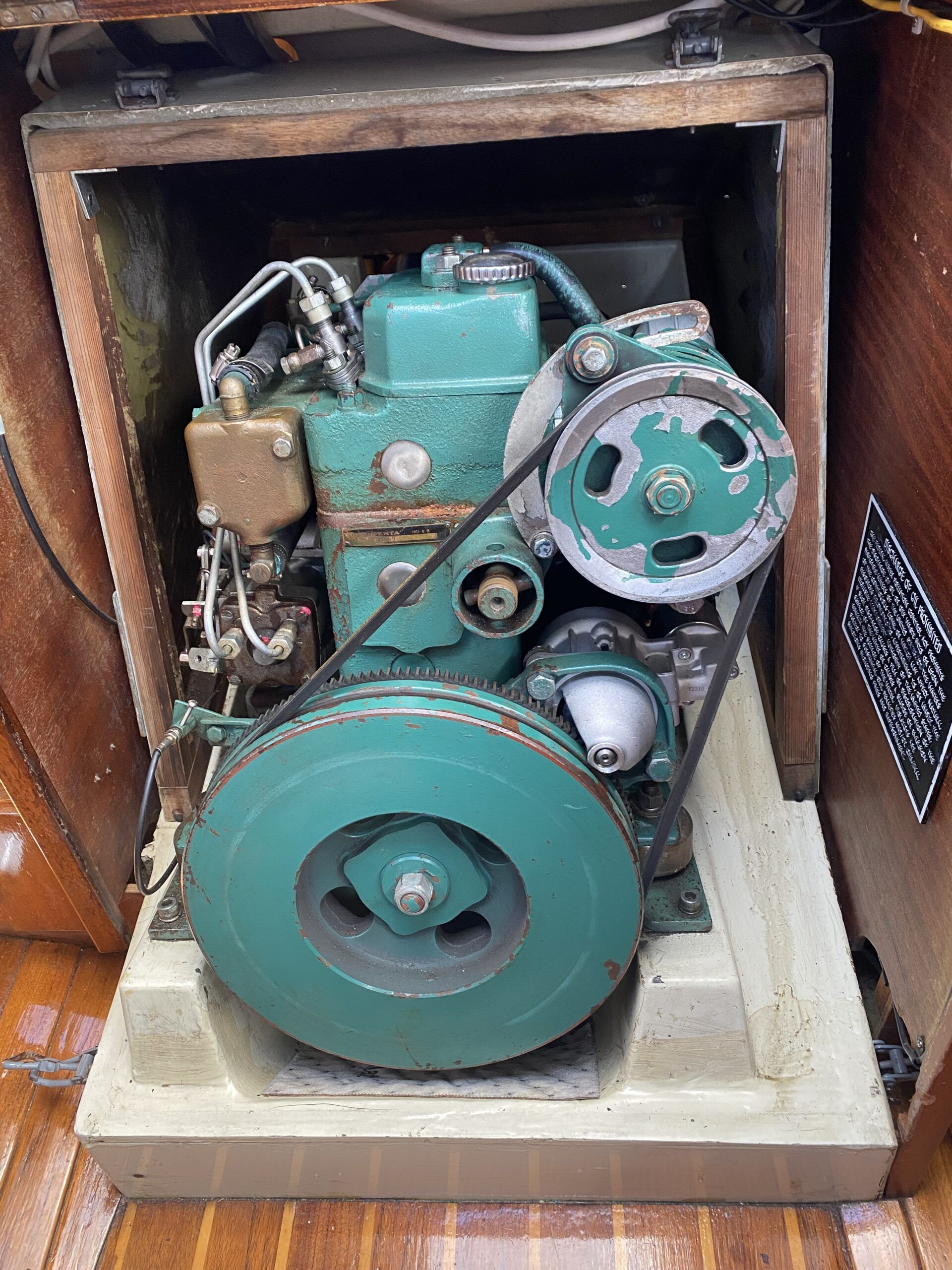
Ballads between 1971 and 1975 were powered (most would say underpowered) by the 10-hp Volvo Penta MD6A while 1976 and 1977 boats got the MD6B of the same horsepower. Power was later increased, successively, to the 13-hp MD7A from 1977 to 1978 and to the 17-hp MD7B from 1979 to 1982. As many as 25 boats were built after Albin Marin’s bankruptcy in 1982, with the molds having been acquired by the Ballad One Design Association. These later boats were built under contract, mostly in Denmark, and were usually powered by the 18-hp Volvo Penta 2002.
Backing under power can be problematic in the Ballad, as with many auxiliary inboards, but with practice, one gains confidence. The trick is getting going quickly with an initial burst of power so the big rudder can provide directional control. Strong cross winds and timidity with the throttle can spell trouble. Neophytes should have fenders and a boat hook at the ready.
To Repower or Not
The AB Survey reveals that hundreds of owners have repowered their Ballads, mostly with diesel inboards in the 16-hp to 21-hp range. Leading choices over the years have included the Volvo Penta 2002, 2020 and D1-20; the Yanmar 2GM20F, 3GM20 and 3YM20; the Beta 16 and 20; the Sole Mini 17; and the Nanni M3.21s. The leading repower choices here in 2025 are the 20-hp Beta 20, 21-hp Yanmar 3YM20, and 19.6-hp Nanni M3.21.
Like many owners, I’m still nursing my boat’s original, raw-water-cooled 10-hp Volvo Penta powerplant. The MD6A/B can get the boat going above 5 knots in flat water (in my case with a two-blade folding prop), but I keep it to 4-4.5 knots to avoid taxing the old engine. Owners with newer engines comment on the AB Forum that they couldn’t imagine fighting head winds and rough seas with less than 16 hp. I don’t have to imagine: it’s slow going motoring against big winds, waves and currents, so I try to stay under sail or just pray that the engine won’t conk out.
Owners and would-be owners will find many comments on the AB Forum about repower choices, folding versus feathering props, three blades versus two, and the impact of various choices on prop walk. The conventional wisdom seems to be that you might as well go for a bigger motor and a three-blade feathering prop if you can afford them. You can also expect to have to replace the prop shaft, shaft seal, cutless bearing and, if upgrading to 19-21 hp, exhaust system as part of a repower project.
Engine Noise
Marius laments that the previous owner of his Ballad removed the back portion of the original two-piece fiberglass motor cover to make room for a 1990s vintage Yanmar 2GM20F. (The front half of the cover is integral with the companionway steps while the back half is hidden under the cockpit sole.) As a result, Marius’ engine is louder than he would like, so he’s planning to take measurements of the rear cover on my boat to try to construct a replacement.
Repowering Options
Today’s engines are said to be much more compact than older models, so if my boat ever needs a repower, I’d hope to stay within the envelop of the original motor cover. If I have to settle for a two-cylinder Beta, Yanmar or Volvo Penta engine with only 14 hp to 16 hp, I figure I’ll have 40 percent to 60 percent more power than I’m used to and won’t have to be cautious about running at wide open throttle. If a repower can wait for five years, perhaps the cost, weight, and range of electric repower options will meet my expectations for multi-day coastal cruises (though I have my doubts about the range part).
The Interior
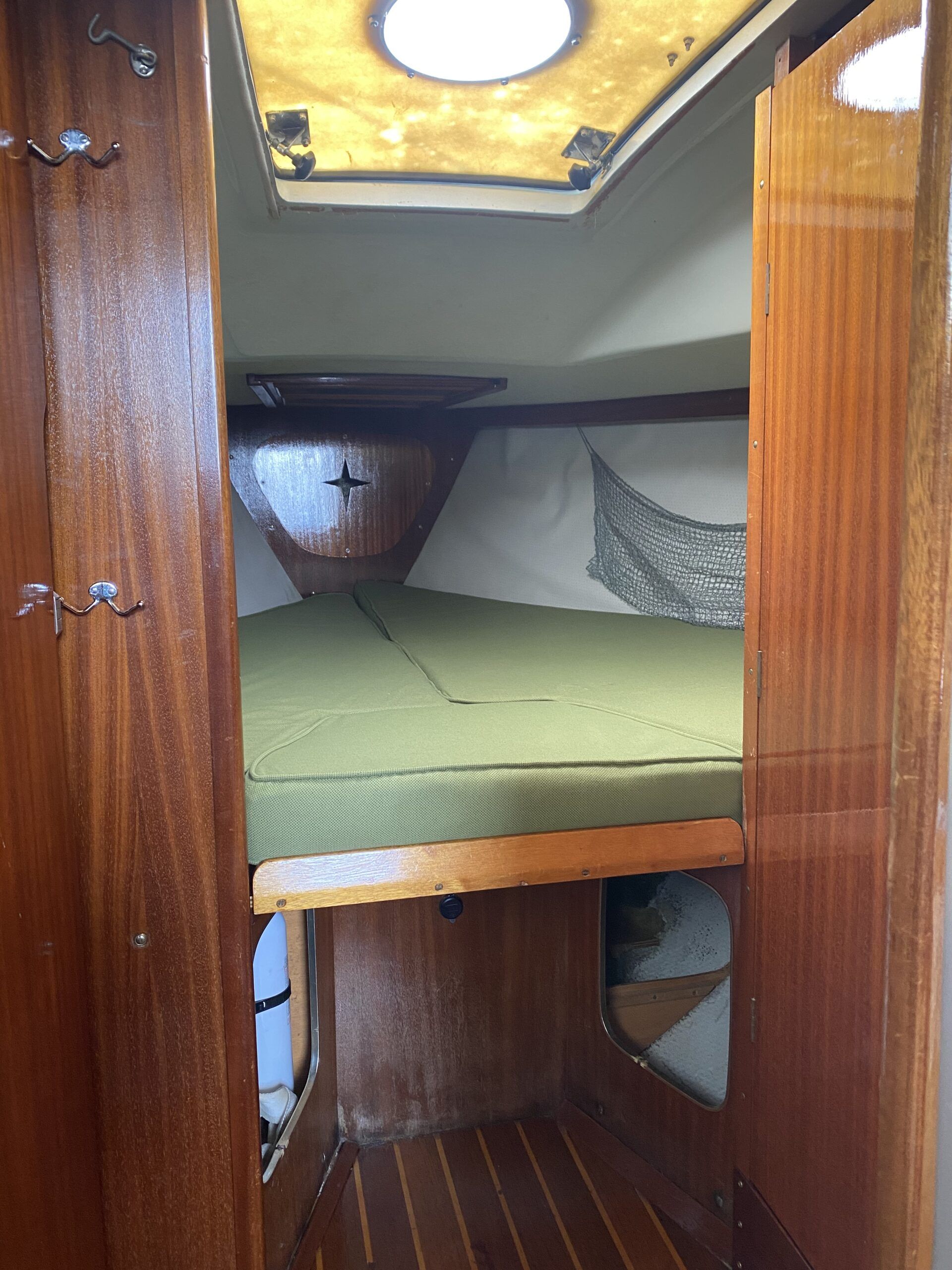
The Ballad’s sleek lines on deck sacrifice head room below. At 6 ft 2 in. /1.87 m, I do have stand-up headroom at the companionway, but headroom diminishes to 5 ft. 6 in/1.67 m at the front of the salon and just 4 ft. 10 in /1.47 m in the forward compartment. The salon’s four big, fixed windows offer plenty of light, but ventilation was originally limited to the forward hatch, companionway and passive vents over the salon and head compartment. Like many owners, I have replaced the passive vent over the head compartment with a solar-powered model.
The forward hatch size and shape is unique to the Ballad, and the original offered only the dim illumination of sunlight passing through a yellowed fiberglass panel without gel coat. I added a 9-in., round fixed port light to my now-painted hatch. Marius has installed a beautiful, tinted-acrylic, Ballad-specific replacement hatch from Plexifix, a Danish supplier. He also found and has installed Ballad-specific opening rear cabin windows, available from Ertec, another aftermarket supplier based in Denmark (the capital of Ballad ownership).
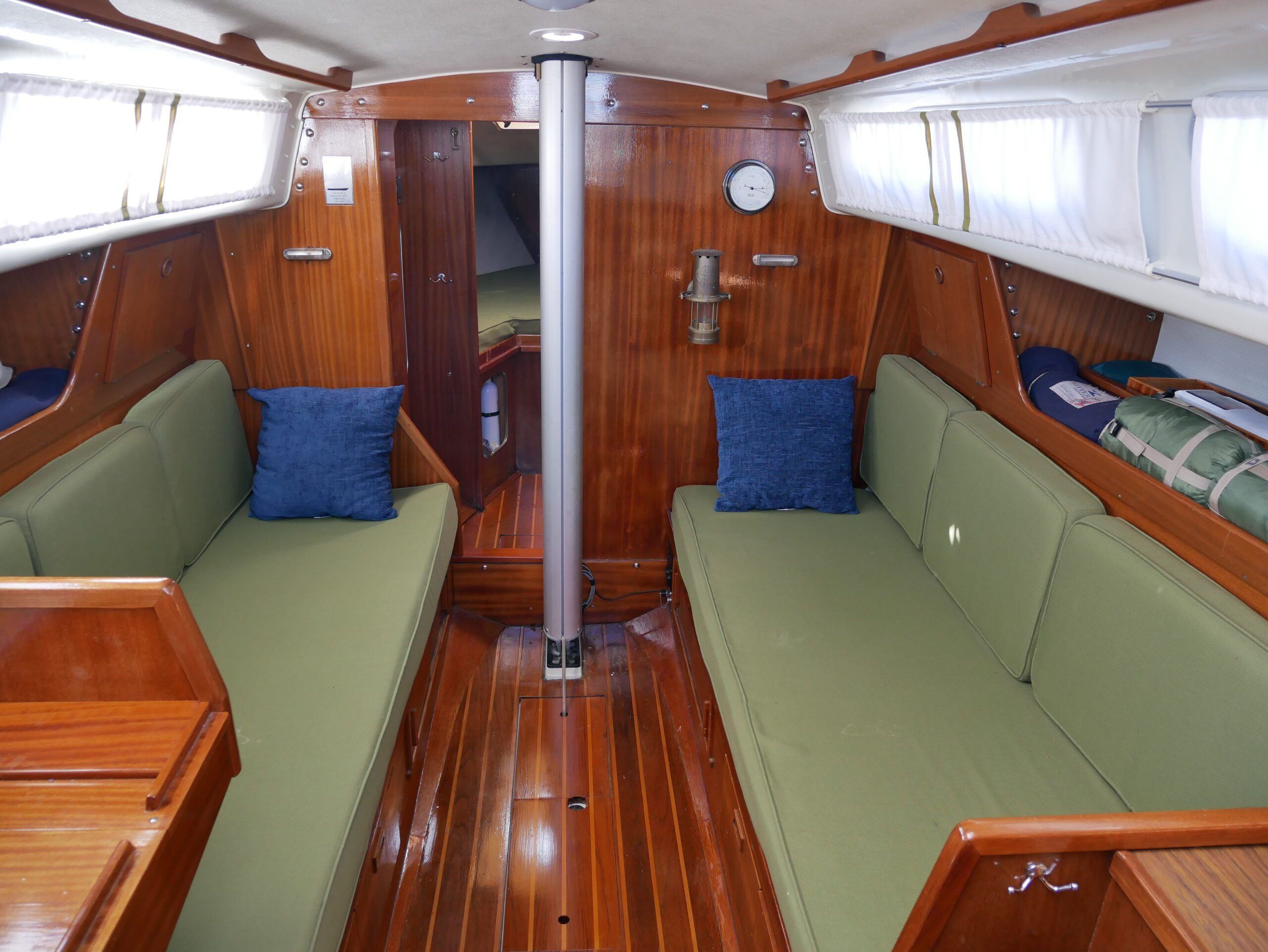
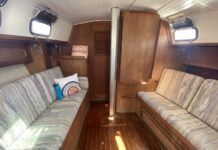
Ballad interiors are basic by today’s standards. Standard models had fiberglass cabin soles while some boats, including my own, were dressed up with teak and holly soles. Either way, the bulkheads, settee/quarter berths, nav table, cabinetry, storage compartments, head compartment, and hanging locker were all constructed of nicely finished mahogany plywood with selected solid-wood structural beams and components.
Nav Station and Sleeping Accommodations
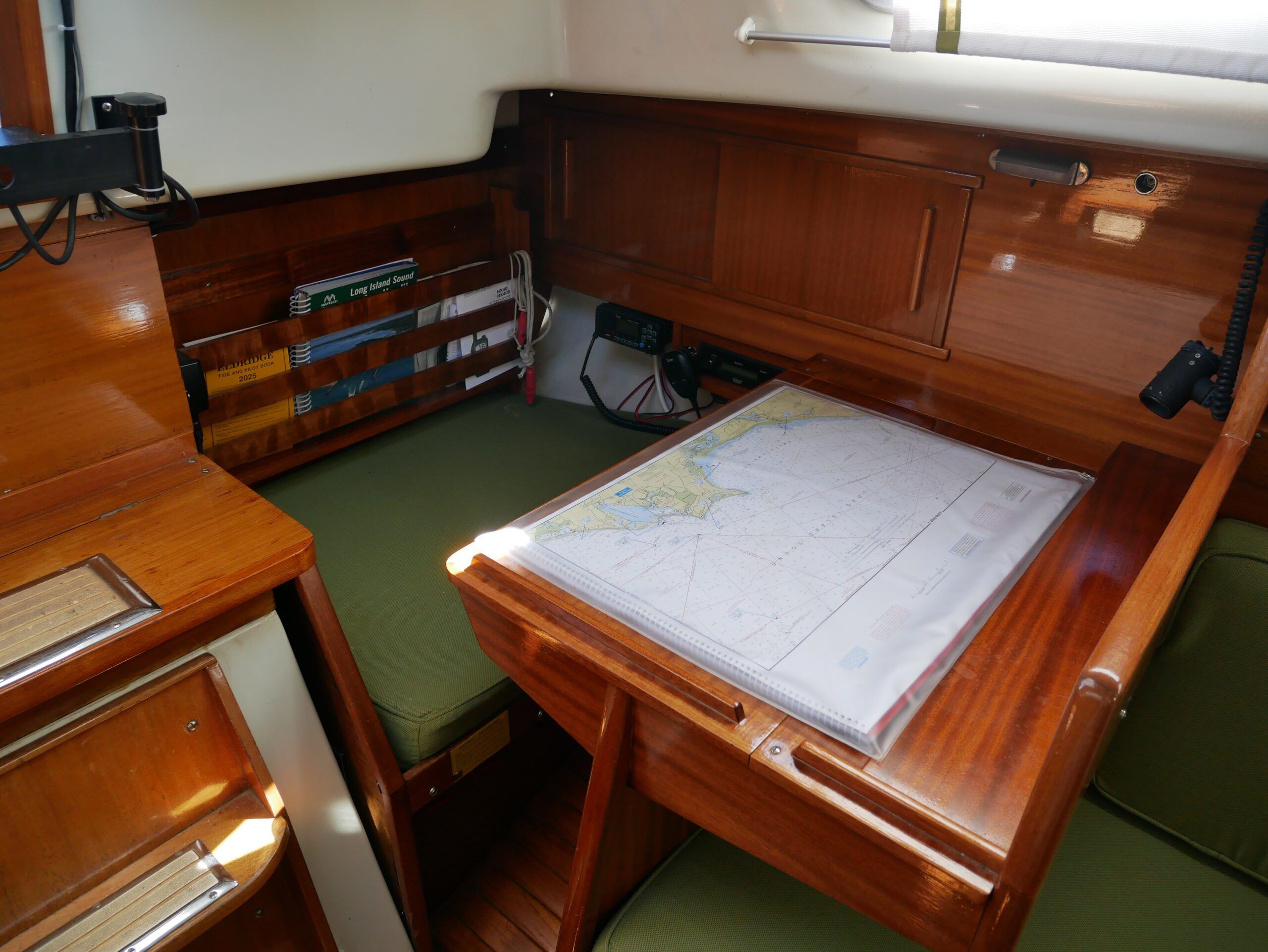
One of the solid-wood components is the generously sized navigation table, a feature often sacrificed on 30-ft. boats. It’s a tight fit getting into the seat, with just a 6.5 in. / 165 mm passage between the top companionway step and the corner of the table, but there’s plenty of room once seated.
The nav table seat was originally the head of a quarter berth cushion that extended under the starboard cockpit seat. Most owners have put in a bulkhead to do away with this fifth sleeping position, creating a dedicated locker on the cockpit side and a generous nav station seat on the salon side of the bulkhead. That leaves four sleeping positions, counting the port and starboard settees, which double as berths when the seat back cushions are removed, and the two-person V-berth in the bow. The port berth is 6 ft. 6 in./1.98 m long, with plenty of room for feet under the back of the nav table. The starboard berth is slightly shorter at 6 ft. 2 in./1.87 m.
Galley
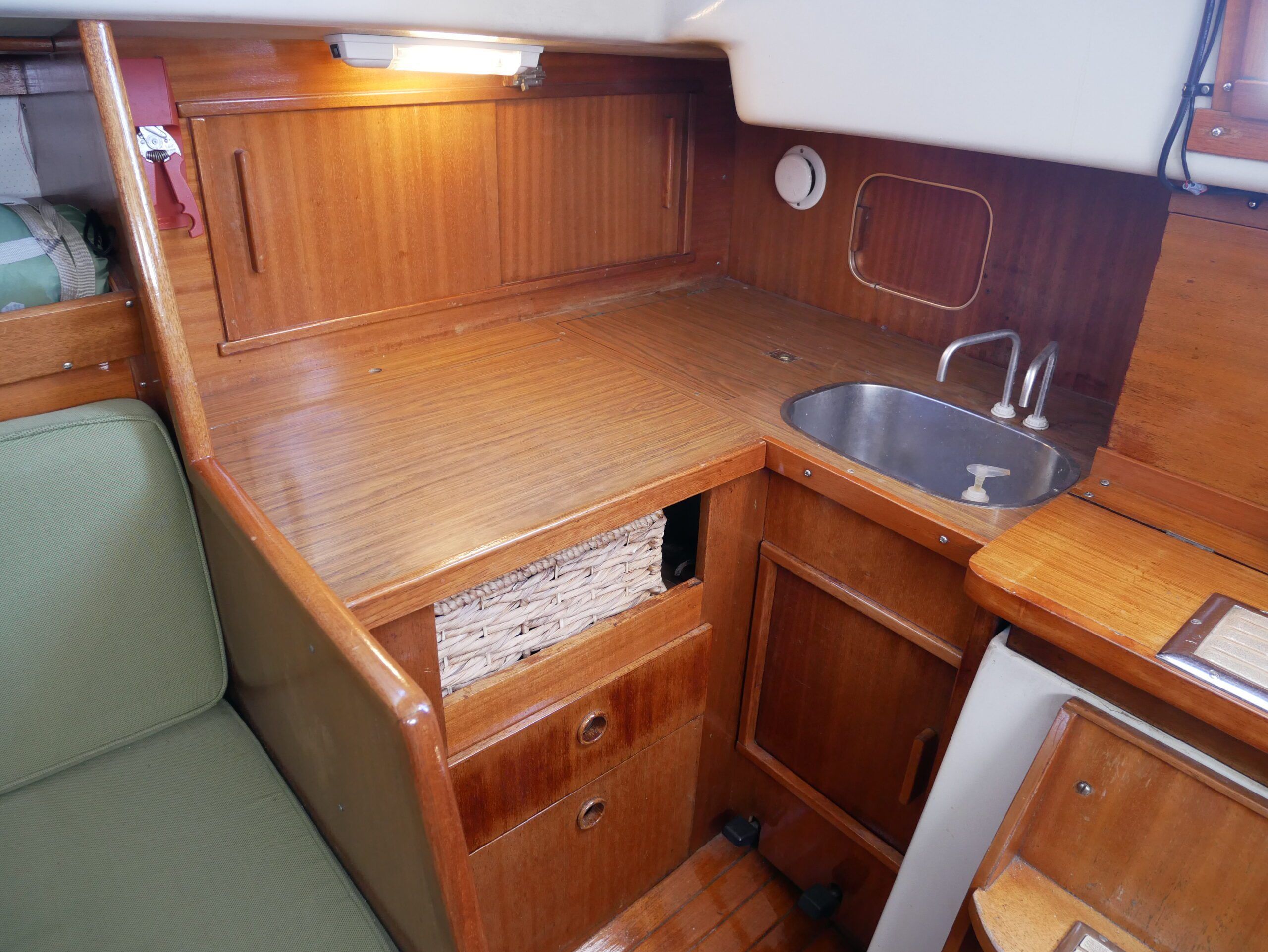
Standard Ballad galleys combined an ice box, a small sink with fresh water and sea water foot pumps, and a two-burner stove top. Some later models were fitted with a gimbaled combination stove/oven. There was no provision for a propane locker or refrigeration, but you’ll find lots of DIY design ideas and pictures of such improvements on the AB Forum. The galley countertop is a Formica-finished marine ply with a faux wood-grain finish (that some owners have painted with epoxy or replaced).
The original, two-leg split-fold dining table that bisected the salon was heavy, impossible to stow and took up a lot of space. Like most owners, Marius and I have both done away with this table and opted for more modern, easily stowed alternatives. Marius has installed a Swedish-made Lagun table (kudos for sticking with a supplier from the boat’s country of origin) while I have opted for a lightweight molded plastic table top mated with just one of the removable legs from the original table. Both the leg and table top are easily stowed at the back of the hanging locker.
The (Tight) Head Compartment
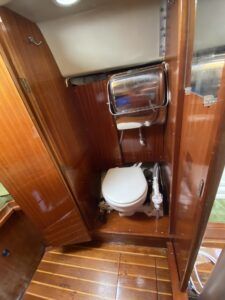
Just beyond the salon bulkhead there’s a hanging locker to port and a tight, two-foot-wide head closet to starboard that was originally fitted with a manual-pump toilet and a slide-out sink. Holding tanks were not standard equipment back in those days, so many owners (myself included) have placed a holding tank above and behind the head with a wastewater deck plate directly above and a vent line connected to a through-hull just below the hull/deck joint. I made room for the tank by doing away with the sliding sink, replacing it with a folding sink.
Albin provided nicely finished mahogany bi-fold doors for the head closet and hanging locker. The locker door swings into place and closes with a magnet catch to conceal the head compartment from the salon. The head door swings open and latches with a hook to give the head compartment a modicum of privacy from the V-berth. The design is ingenious, but the head space is cramped, lacks a shower, and is akin to “glamping” when it comes to privacy.
Conclusions
If you’re looking for a fast, well-built 30-ft. coastal cruiser from the 1970s, the Ballad is a great candidate (if you can find one in North America). You would buy a Ballad for its performance, seaworthiness, and graceful lines. Interior room and creature comforts are not exceptional, but they’re not out of line with many boats of her size and era. The boat is well suited to cruising couples. Marius and Talea have recently extended their crew to include a dog named Neo, a Nova Scotia Duck Tolling Retriever (a breed that grows to 18 to 20 in./46 to 51 cm high and 40 to 50 lb./18 to 23 kg). Many owners also comfortably squeeze in small children. You could also try one or two very close adult friends, but the cramped fore cabin and primitive, showerless head would likely limit such trips to day sails or weekend cruises.
Market Scan Contact
1979 Albin Ballad 30 via Boat Point
£12,500 GBP Contact via Boat Point
Sunderland, UK Boat Point
1979 Albin Ballad 30 Ralf Stuhlemmer (private seller)
€22,000 EUR Inquire via Boat24
Kiel, Germany Boat24
1976 Albin Ballad 30 Contact via Apollo Duck
€12,000 EUR Contact via Apollo Duck
Vliho, Greece Appolo Duck
While Albin Marin is long gone, the active network of loving owners, nurtured by the AB Forum and active Ballad clubs in Europe, offers a wellspring of how-to sailing, repair and upgrade advice and part and component sourcing tips. Given the boat’s popularity and longevity, there are even aftermarket part sources, including Albin Motor (a distant sister company), and, as mentioned above, hatch supplier, Plexifix, and window supplier, Ertec.
Most Ballads available for sale are in Europe. Listings boasting of recent repowers, fairly new sails and extensive cruising equipment might ask for upwards of $30,000. At the other end of the spectrum, Marius found his boat “in rough shape” in Massachusetts and paid only $6,000 back in 2016. I found my Ballad in Connecticut in 2022 and gladly paid $16,000 because it was in very good shape (though it had not been repowered). Listings found online at this writing were in places other than the U.S. and ranged in price from $16,915 to $22,000.
Sources
A Brief Presentation of Albin Ballad, Barbro Eriksson, Swedish Ballad Club




One detail I forgot to mention in this review: The Ballad does not have an anchor locker up at the bow, but the forepeak locker afforded room for a hawse pipe to be added while stainless hooks on the bow pulpit stow a Danforth. Read the article “Handling Anchors on Boats Without Anchor Lockers,” here in Practical Sailor, for more details on these modifications and other options.
I’ve logged many hours on Albin Ballad trips from Holland, Mi to Lake Superior. On one trip off of Door County, our anemometer pegged at 60 mph and we were quite comfortable.
The author mentioned not over tightening the shrouds. Please realize that loose or tight, the shrouds take the entire loading when you “wash the spreaders” due to a roundup.
I don’t recall where that boat ended up, but it is not on Lake Superior.
Good memories.
While never a Ballad owner, an Albin Vega was our first boat and the sweetest sailing boat I’ve ever helmed. The Vega & Ballad share many similar traits and finishings, and the simple functionality of the layouts, cockpit and cabin, are two of their best features…along with that wonderful tiller steering.