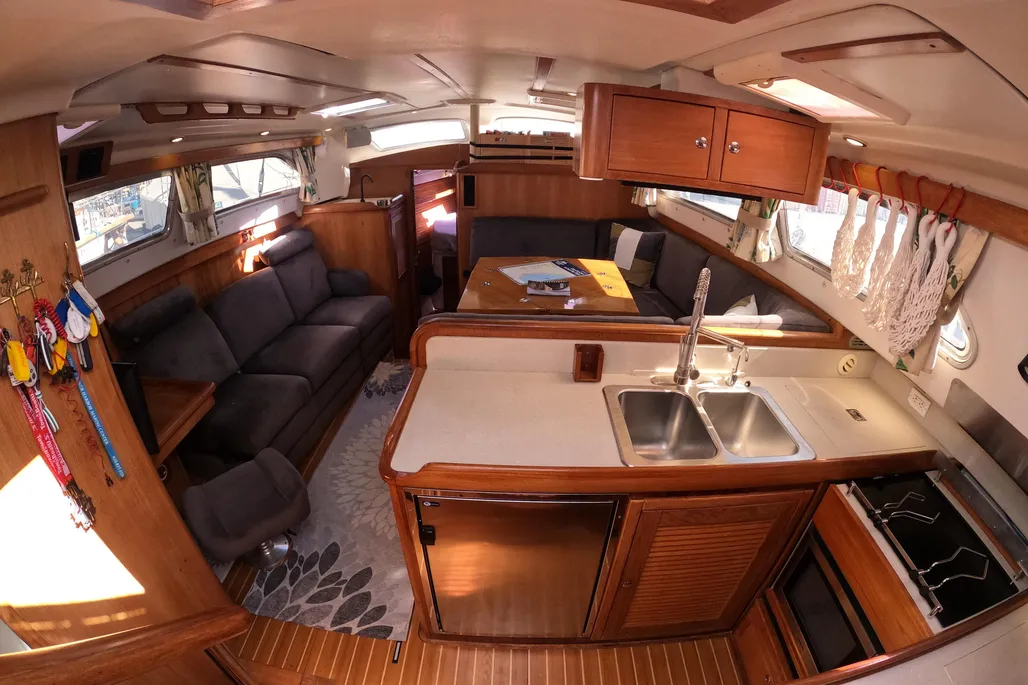
The Catalina Morgan 440 is a massive ocean-capable design from the drafting board of Gerry Douglas, a prolific designer for Catalina Yachts for over 40 years. Constructed from 2004 to 2012, the boat is a departure from the usual Catalina design that dominated the North American sailboat market for the past few decades. In this review we will examine Snowbored, currently owned by Lucas in Toronto, Canada. Commissioned in 2008, this Catalina Morgan 440 has been upgraded and improved by a fastidious owner—cool boat, cool guy.
First Impressions
At dockside, the oversized 85 lb. (38 kg) stainless steel Mantus anchor dominates the bow. Cradled in a stainless-steel double roller, Lucas calls it the “sleeping pill.” With 300 ft. of chain attached to an additional 180 ft. of nylon rode, this combination has allowed for secure nights at anchor. A rode counter in the cockpit assists in setting an appropriate scope. With the use of “marriage savers” (headsets) when setting or raising the anchor, there have never been any issues with dragging. The anchor can be deployed and retrieved from the bow as well as the cockpit.
In addition to this formidable bow anchor there is also a 15 lb. (7 kg) collapsible aluminum Fortress Danforth-style stern anchor that is normally hand-deployed off a bracket out of the cockpit. When not in use it is stored below.
To keep the decks clean, Lucas has gone as far as to install a pressure washer system with a hose at the bow that will reach the length of the deck, allowing for easy clean-up when the chain clangs up from the mud.
The coach house is tall with a pair of unusual bow-facing windows on the leading edge of the tallest portion, complemented by a large deck hatch positioned on the forward edge of the lower cabin trunk. With tall top sides and such a large cabin trunk there is a likelihood of windage causing a problem in tight quarters. Lucas, however, reports no real difficulties. A recently replaced bow thruster and a bit of practice have made it a non-issue.
Stats
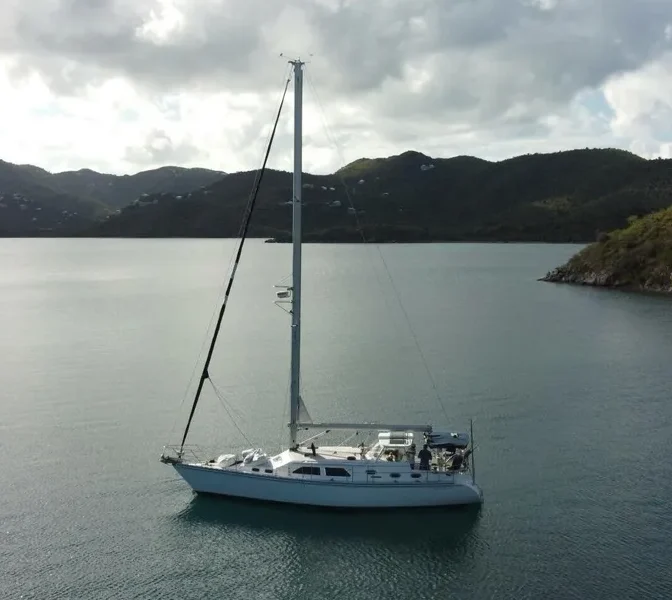
With an overall length of almost 46 ft. (14 m) on a 40 ft. (12.37 m) waterline, a 14 ft. (4.27 m) beam and displacing 25,528 lb. (11,579 kg), the Morgan 440 is a big boat. But she carries the large cabin trunk gracefully. Mast height is 63 ft. 6 in. (19.3 m) including all the masthead instruments, allowing passage along the 65 ft. (19.8 m) minimal clearance of the ICW (Intracoastal Waterway). The in-mast furling main and furling genoa, replaced in 2018, have a total of 932 sq. ft. (86.59 sq. m). A spinnaker is stored below along with a storm jib.
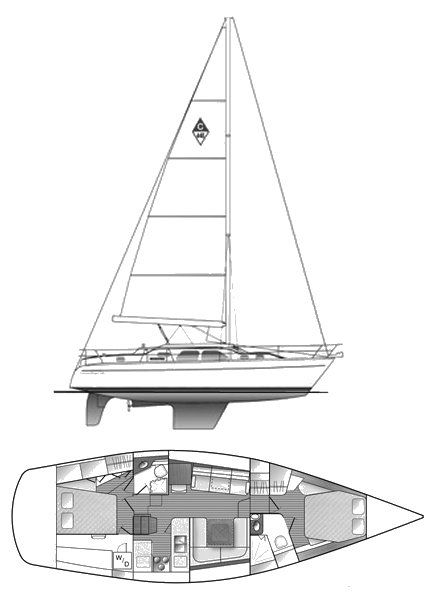
Sailboat Specifications Courtesy of Sailboatdata.com
Hull Type: Wing Keel
Rigging Type: Masthead Sloop
LOA: 45.92 ft / 14.00 m
LOD: 44.33 ft / 13.51 m
LWL: 40.58 ft / 12.37 m
S.A. (reported): 931.00 ft² / 86.49 m²
Beam: 14.00 ft / 4.27 m
Displacement: 25,528.00 lb / 11,579 kg
Ballast: 8,600.00 lb / 3,901 kg
Max Draft: 4.92 ft / 1.50 m
Construction: FG
Ballast Type: lead
First Built: 2004
Last Built: 2012
Builder: Catalina Yachts (USA)
Designer: Gerry Douglas
Make: Yanmar
Model: 4JH3-TE
Type: Diesel
HP: 75
Fuel: 117 gals / 443 L
Water: 176 gals / 666 L
Headroom: 6.17 ft / 1.88 m
S.A. / Displ.: 17.25
Bal. / Displ.: 33.69
Disp: / Len: 170.54
Comfort Ratio: 27.84
Capsize Screening Formula: 1.91
S#: 3.11
Hull Speed: 8.54 kn
Pounds/Inch Immersion: 2,029.96 pounds/inch
I: 57.83 ft / 17.63 m
J: 16.67 ft / 5.08 m
P: 50.00 ft / 15.24 m
E: 18.00 ft / 5.49 m
S.A. Fore: 482.01 ft² / 44.78 m²
S.A. Main: 450.00 ft² / 41.81 m²
S.A. Total (100% Fore + Main Triangles): 932.01 ft² / 86.59 m²
S.A./Displ. (calc.): 17.27
Est. Forestay Length: 60.18 ft / 18.34 m
Mast Height from DWL: 62.33 ft / 19.00 m
Mechanical
The Morgan is equipped with a 75-hp 4JH3-TE Yanmar mounted under the galley sole. There is somewhat limited access through a removable panel just ahead of the companionway steps. These steps can be removed to allow access through a larger panel with better access to the aft part of the engine and transmission. Unfortunately, the raw water pump is mounted low on the Yanmar and is somewhat difficult to access for impeller changes. Fuel capacity of 100 U.S. gallons (379 liters) in a single tank.
There is a dual Racor fuel filter system located in a separate bilge compartment with access just forward in the main cabin. A large removable floor hatch allows excellent access. The raw water intake strainer for the water-maker is also readily available here.
Water Capacity
The Morgan has two water tanks, one forward holding 50 U.S. gallons (189 liters) and the other on the starboard side of the main cabin holding 125 U.S. gallons (473 liters). To supplement water capacity for liveaboard sailors, Lucas has a Cruz Ro water maker mounted behind the starboard side settee in the main cabin. Able to provide 30 U.S. gallons (113 liters) per hour, fresh water is not an issue for long distance cruising.
Electrical
Snowbored has both a 30- and 50-amp Smart Plug system for shore power. The house battery includes twelve 100-amp Battle Born lithium batteries, providing plenty of power for off-grid sailing. A separate cranking battery is located in the engine compartment. Battery monitoring is accomplished with a Victron modular system that allows for remote supervision of the battery system along with water and black water tanks.
For power generation afloat there is an Eclectic D400 wind generator mounted on the stern quarter, producing about 8 to 10 amps in 15 knots of wind. Indispensable in the trade winds of the Caribbean, this system is not really effective in their home port of Lake Ontario.
A 350-watt rigid solar panel is mounted on the dinghy davits with an additional pair of flexible 150-watt solar panels atop the bimini for extra power. Was that sufficient for live-aboard status in the Caribbean? With hindsight, he would have added another rigid panel to a modified dinghy davits over the stern of the boat. An aftermarket Balmar 100-amp alternator keeps the batteries topped up when under power and, located at the forward end of the cavernous bilge compartment, is an 8 kw Panda generator for additional electrical capacity should the air conditioner be needed.
The Cockpit
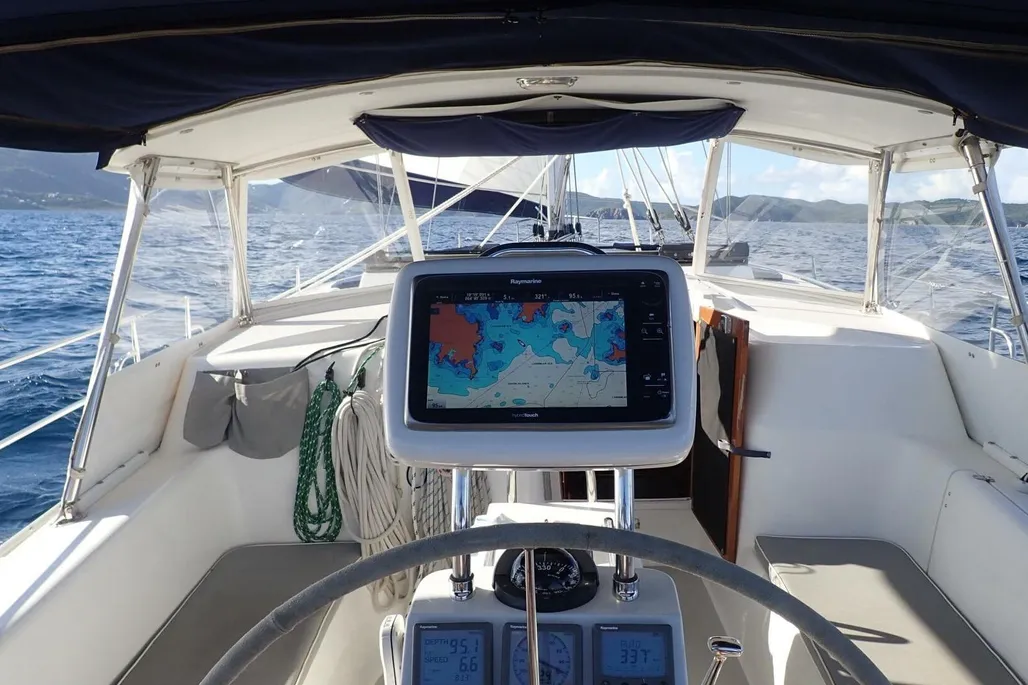
Climbing aboard is a big step up onto a relatively narrow side deck, and then another big step over the cockpit coaming into a spacious seating area. Aboard Snowbored the cockpit is enclosed with a full dodger/bimini combination with removable side panels, all added in 2019. The canvas is maintained as needed to keep the like-new appearance. The traditional Catalina dolphin seats adorn the rear quarters of the cockpit, the perfect place to watch ahead while the autopilot keeps the boat on course.
An interesting side note: during a vicious Florida windstorm, blades of the Eclectic D400 wind generator separated from the hub. One blade punctured the inflatable dinghy on the stern davits, and a second blade entered through the open stern panel of the enclosure, launching the dolphin seat cushion overboard. Fortunately, no one was in the way, and the seat cushion was replaceable.
A large folding table dominates the cockpit with good back supports provided by the tall coamings. Recently re-surfaced self-tailing two-speed winches are mounted on the coamings within reach of the helmsperson. There are no additional winches for controlling a spinnaker separately, although there is room for such. There is a single two-speed self-tailing powered winch on the coach roof for halyard work. This winch can also be tasked for other lines as all sail control lines lead back from the base of the mast (or genoa furler) to this area on the coach roof.
Access and Storage
Access through the stern pulpit is behind the single wheel. A gate that incorporates a boarding ladder leads down to a narrow swim grid. It is not large by any standard, but it does allow for easy boarding from the dinghy.
There is a cavernous cockpit locker under the starboard side seat. With shelves against the hull for sailing gear, the bottom is kept clear for feet. This shelf has the capacity to be transformed into a sleeping berth should the need arise. However, with only a pair of small opening portlights, the need would have to be dire. From this locker there is a door forward leading to the aft cabin. A hatch aft leads to the lazarette locker. This locker is large enough to house a combination washer/dryer with access through the door to the aft cabin.
The aft lazarette has the steering quadrant protected by cabinetry and usually holds fenders and sundry sailing gear.
On Deck
Moving forward the side decks are narrow, squeezed between the tall cabin trunk and high lifelines. Stainless steel handrails are mounted on the top edge of the cabin. Between the high double lifelines and handrails, moving forward feels very secure. The mast stays are mounted inboard against the cabin trunk with room to move past outboard. Amongst all the other additions/modifications aboard Snowbored, Lucas has positioned a stainless steel rail between two stanchions just forward of the high cabin trunk. This allows for securing additional water/fuel jugs. It offers a more professional appearance than the usual 2 x 6 lumber strapped into place.
The cabin trunk drops substantially forward of the mast with a large opening hatch on the forward slope where it tapers down to the foredeck. Unfortunately, the cabin top handrail is not continued onto this lower section. This may cause some concern going forward in rough conditions.
The foredeck is unobstructed with a windlass placed just aft of the split anchor locker hatch. The locker itself is also split, appropriate for two ground tackle chains from the double anchor platform. The washdown pump is located here as well.
As mentioned, sail controls are all led back into the cockpit. The mid-boom mainsheet leads forward from the traveler to turning blocks on the cabin trunk, then aft to stoppers just in front of the power winch. Genoa sheets lead to tracks just inboard of the slotted aluminum toe rail, then back to the winches on the cockpit coaming.
The Interior
With no substantial bridge deck to climb over, going below is simply over a low lip and down three steps, a feature of many Catalina designs. A proper well-supported handrail provides for secure entry, even in a seaway. To port, behind this handrail, is a step down to the aft head compartment and aft cabin. This will be a potential tripping hazard until familiarity becomes the norm.
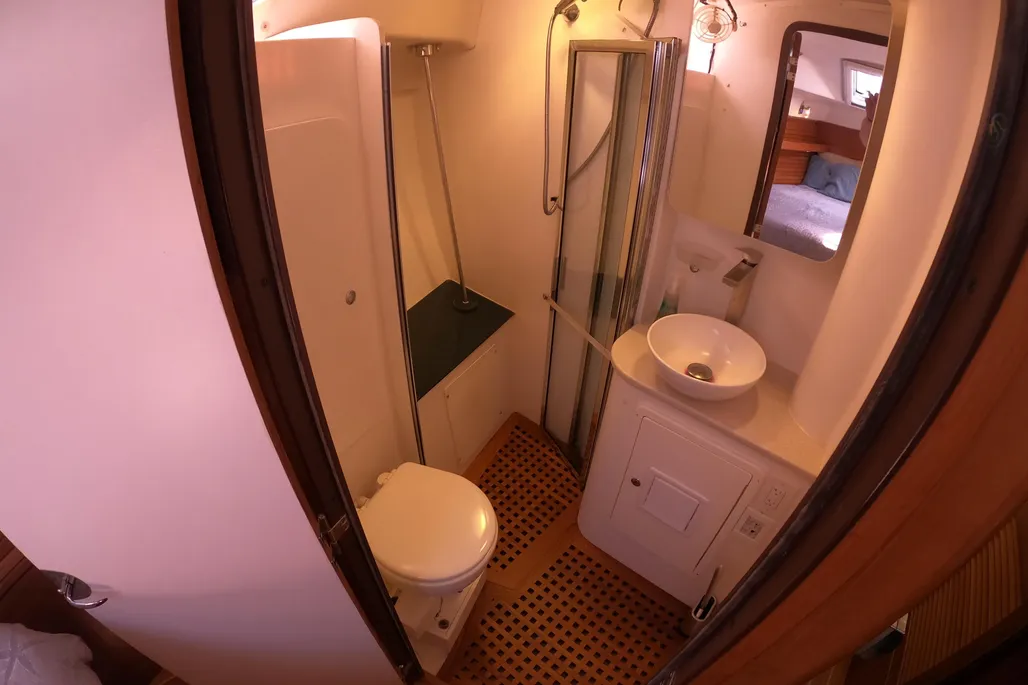
The relatively spacious head compartment comes complete with shower. All white gelcoat and melamine, the area is easy to keep clean. An opening deck hatch and portlight provide adequate ventilation.
Aft Cabin and Nav Station
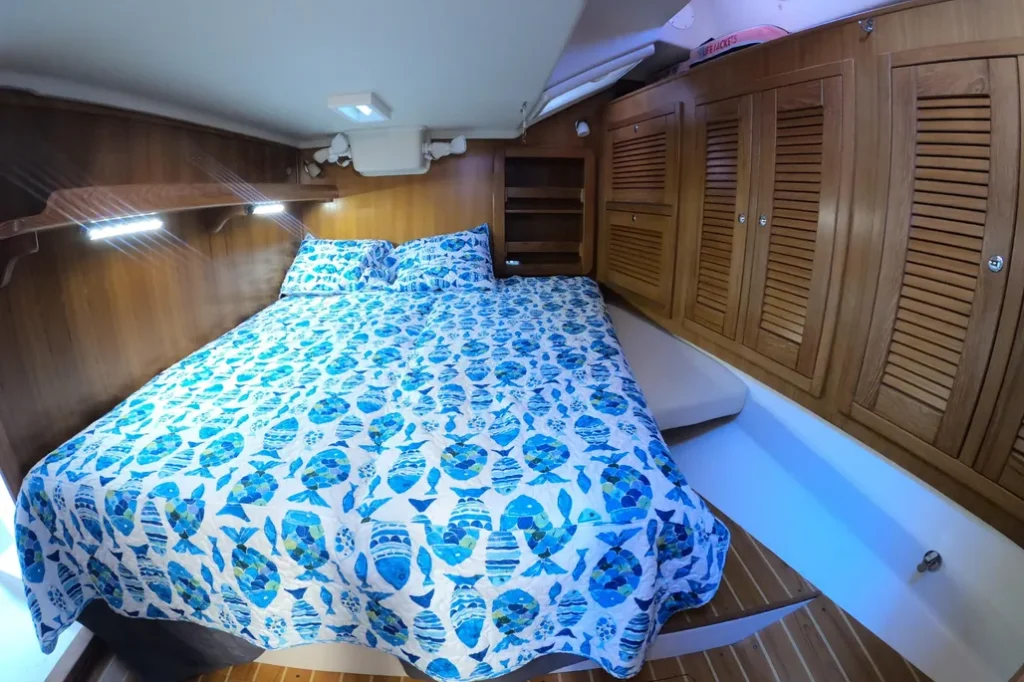
Aft of the head is the stern cabin with a generous fore and aft double berth with access at the forward end and outboard side. There is plenty of storage/locker space available behind beautiful teak louvered cabinetry. Two outboard opening ports provide ventilation. Access to the washing/drying machine is through a door leading to the cockpit locker. A “bookshelf” at the aft end of this cabin can be swung aside to gain access to the lazarette locker—a well thought-out feature.
Forward of the head, still on the port side, is a relatively small aft-facing navigation station with electrical control panel. There is a small port-facing stool for seating. Far too small for traditional paper charts, this table is adequate as a writing desk with storage. There is plenty of bulkhead space for today’s navigational equipment.
Galley
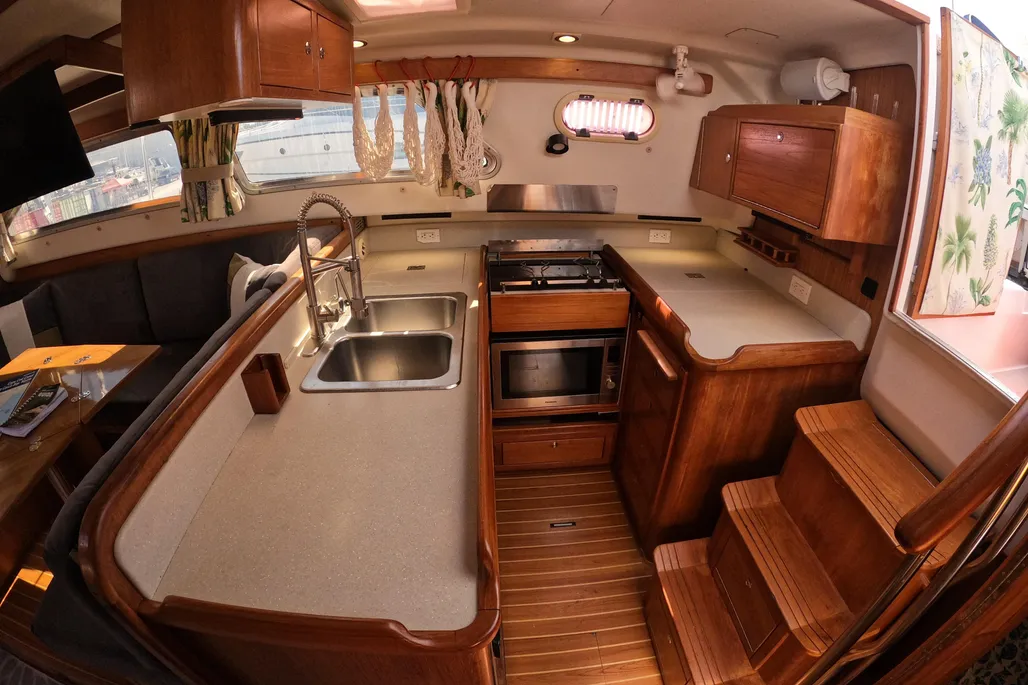
To starboard is the galley that is complete with a front opening fridge under the plentiful counter space, a top loading freezer in the corner, and a recently upgraded three-burner Force 10 propane stove/oven. There is also a top-loading storage compartment for cooking gear. A small microwave is located in an eye-height cabinet against the aft bulkhead. A cabinet over the sink is mounted against the overhead for additional storage. A single opening portlight and deck hatch provide ventilation although being this close to the large companionway airflow isn’t really an issue. Since disposal of galley garbage is always problematic, Catalina provided a trash can under the top step of the companionway steps—ingenious!
Salon
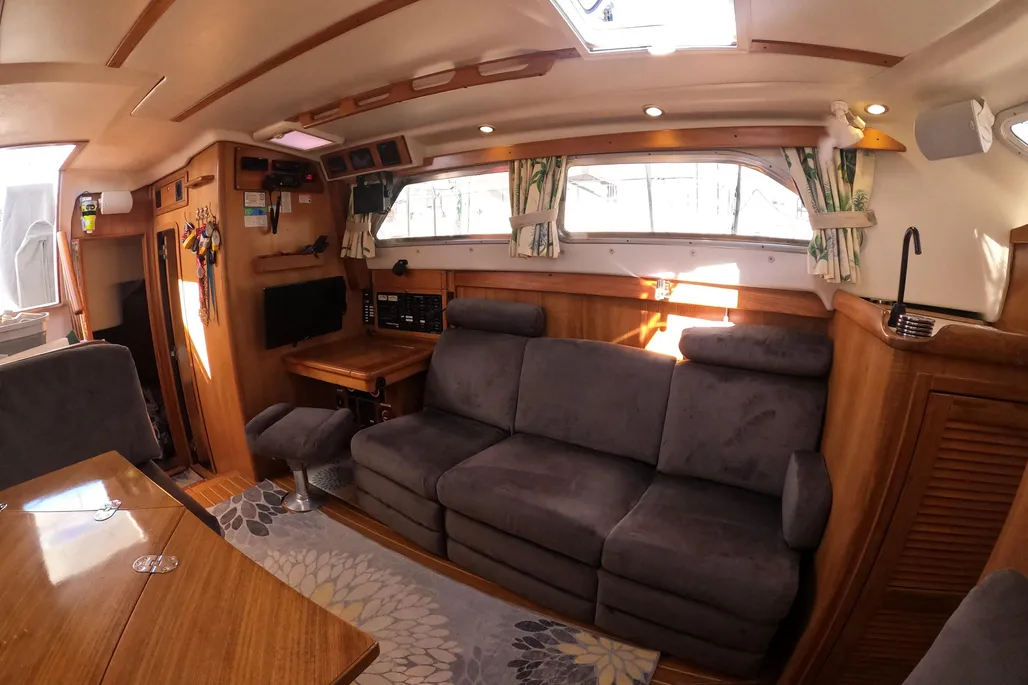
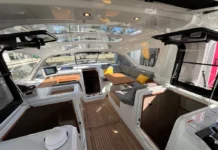
With copious amounts of light entering from large cabin trunk windows, as well as the two forward facing window and deck hatches, the salon is a spacious display of golden teak and white upholstery. The U-shaped seating area is on a raised platform to starboard. An electrically raised or lowered folding pedestal table that can easily seat six guests is the centerpiece. In the raised position and folded open, this area allows for comfortable seating with a view through the large windows cabin windows. This is ideal for keeping an eye on what’s going on outside. With the table lowered, this area can become additional berthing space. Behind the aft end of the settee is the water maker and a 3,000-watt inverter.
To port is a bench seat. The center seat folding down to become an armrest/drink holder. There is storage behind. The two outlying seats can be folded out in the Lazyboy style.
Forward Cabin and Head
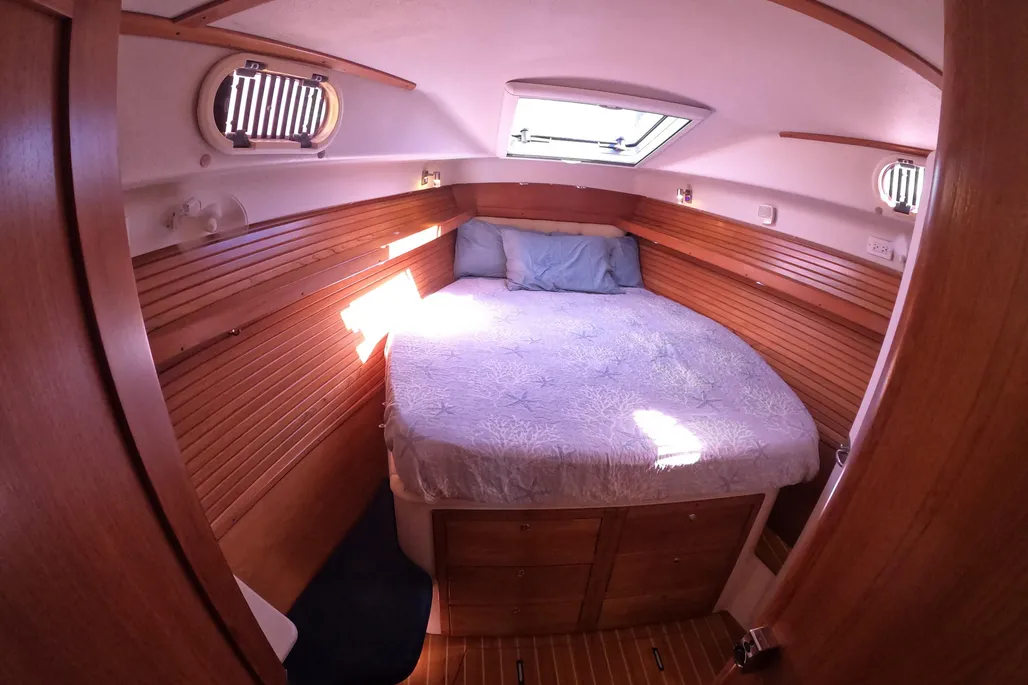
Just ahead of the port settee is a substantial hanging locker with a countertop set up with high fiddles to keep items in place. While it is not really a hallway, this area still seems to be part of the main salon with the forward windows directly overhead. Moving forward as you step down to the V-berth, the generous pedestal bed is under the large opening deck hatch and two opening portlights. There is plenty of ventilation, necessary for those warm days. The pedestal has drawer storage underneath. A small vanity mirror and stool is set to port with a substantial hanging locker. To starboard is the large ensuite head compartment complete with separate shower stall and proper ventilation.
Conclusion
Although Lucas and the family love the boat and have enjoyed the cruising life, the lure of the space available on catamarans has him entertaining the sale of this Catalina Morgan 440. Should that happen, what a great boat to head south on. It is already equipped with a massive battery bank and has the ability to keep it charged with wind, solar and a genset. In addition to the oversized anchor and water maker, this setup allows you to remain off the grid for days or weeks. A lucky buyer will be getting a great boat for long-distance adventures.
Market Scan Contact
2005 Catalina Morgan 440 North Point Yacht Sales
$259,900 USD +1 (401) 535-7357
Annapolis, Maryland Yacht World
2007 Catalina Morgan 440 Seattle Yachts - San Diego
$187,000 USD 619-523-1745
San Diego, California Yacht World
2008 Catalina Morgan 440 BVI Yacht Sales LTD
$139,500 USD 941-344-3916
St John, U.S. Virgin Islands Yacht World