So, you’re in the market for your first boat. Having just purchased my own vessel, the thrill and anxiety of the process are both fresh in my mind. Let’s run through some of the essential considerations to help you find the right boat, at the right price, at the right time. Note: This article is geared towards buying your first keelboat. As such, it excludes any discussion of motorboats and sailing dinghies.
What Kind of Sailor Are You?
Buying your first boat starts with understanding what you want—and what you need. While this may seem straightforward, there are a few important questions you should ask yourself. After all, it’s dangerously easy to be seduced by the amenities of a luxury cruiser when you really intend to race, or by a sturdy bluewater boat when there’s only coastal daytripping in your future.
Define the type of sailor you intend to be (or not be) with the following questions:
1. Where will I sail?
Largely constrained by your geographical location, consider whether you’ll spend more time on lakes, coastal waters, or ocean/bluewater. While there are no hard and fast rules here (sailors have crossed oceans in 18 footers), in general, the further offshore you go, the bigger and tougher boat you’ll need. Heavily tidal areas also influence keel shape—hence the ever-popular bilge keels of the English Channel and UK Isles, which are almost never seen in the Great Lakes where fin keels predominate.
2. How often will I sail (and for how long)?
The reasoning here is simple—longer trips require more tankage (fuel and water) and house power (battery system size). Can you make do without a computer? How about without a shower? The more time you spend in the boat, the more you’ll spend on the boat.
3. Who will I sail with?
Solo sailors need less space and less tankage, allowing for a smaller boat overall, but will also benefit inordinately from amenities like furling sails, electrical or mechanical autopilot, and self-tacking jibs. Sailing families require the most space, tankage, and battery power, while crewed sailing generally needs a little more than a solo sailor does—unless you plan to participate in multi-day races.
4. What type of sailing will I do?
Decide at a minimum whether you plan to race and whether you intend to liveaboard. These two questions will clarify a great deal. Depending on the work you’re willing to put in, you can transform a cruiser into a liveaboard boat. But transforming that same cruiser into a racer might leave you constrained by structural constants such as the keel type, hull shape and displacement.
5. How comfortable am I working on a boat?
There’s an old saying about boats: “Some nail ‘em, some sail ‘em.” Not everyone is cut out to repair fiberglass or install new plumbing. Be realistic and adjust your search accordingly. And even if you have the skills, do you also have the inclination? Without both, skip over the old fixers-uppers (even if they are a really great deal).
Choosing the Right Boat for You
Now that you’ve got some idea of what kind of sailor you’ll be, let’s take a look at the different boat types to suit you. There are several considerations here:
- Type of boat;
- Length of boat;
- Hull material and keel shape; and
- Technical specifications
Boat Types
Cruisers. Racers. Liveaboards. These are the basic three categories, the trifecta, of sailing vessels. Cruisers prioritize comfort and are equipped for longer journeys. Racers favor performance over luxury. And liveaboards will feature all the conveniences of home, meaning larger tanks, larger batteries, and amenities like showers and large living spaces. Note that some boats are considered hybrids (racer-cruisers) and most larger cruisers can be adapted to a liveaboard boat without too much hassle.
We could get even more granular here and discuss subcategories like island hoppers, daysailers, and bluewater boats, but to keep things simple, we’ll limit our discussion to just these three types. Having identified above the type of sailing you want to do, keep it in mind as we go along: A bit of Googling will allow you to source the wisdom of the crowd and reveal which of these three types identifies a given boat, helping to refine your shortlist of potential boats.
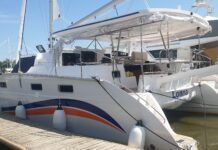
Catamarans are stable, spacious, and great for families or liveaboards. They’re often referred to, adoringly or contemptuously, as floating condos. There’s no doubt that catamarans offer less motion compared to monohulls, but for that same reason many purists often regard their actual sailing experience as somewhat flat (no pun intended). Catamarans are faster, sometimes much faster, than a monohull. But heavy weather or extreme latitudes is out of the question. They’re also generally more expensive. In my experience, I’ve noticed that some monohull owners will eventually transition to a catamaran if they intend to island hop, accommodate a family, or live aboard full time, but few start out on a cat as their first boat. Ultimately, it’s best to spend time on both, through sailing schools or charters, to decide for yourself. That’s all I’ll say about that.
Boat Length
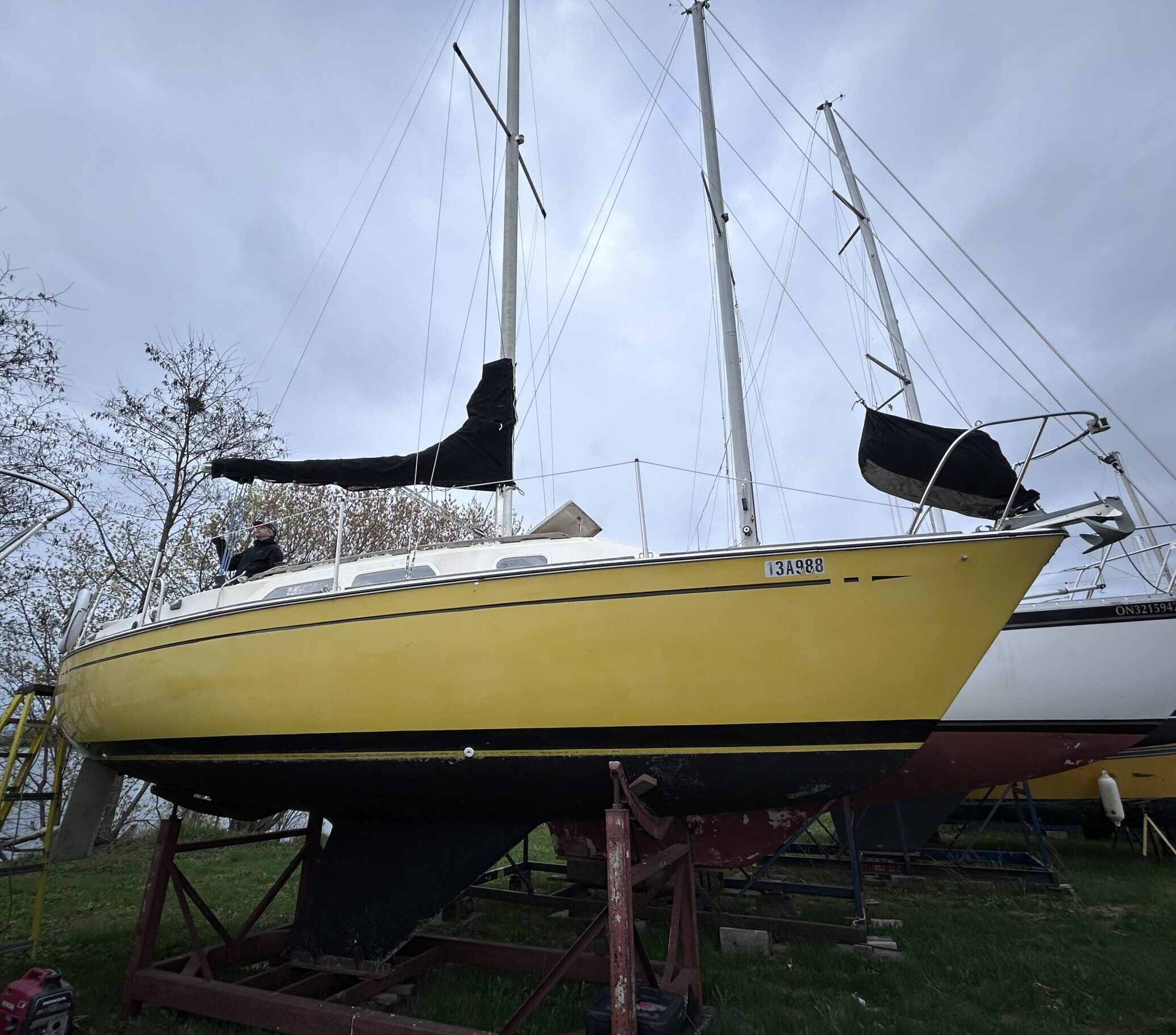
There are certain “milestones” on the scale of boat length. While the exact inflection points are the subject of some debate, in general:
- Up to 24 feet LOA (length overall) most boats are trailerable, so keep that limit in mind if towing the boat is an important concern for you. However, with some notable exceptions, taller sailors will find the lack of interior headroom a drawback here.
- Around 30 feet in length, you enter into territory where bluewater and liveaboard cruising start becoming feasible for modern sailors (sailors of the past accommodated themselves to much more cramped and narrow boats).
- In the 40-plus feet category, boats really come into their own for couples, families, and longtime liveaboarders. Just keep in mind that past 40 feet, some boats begin to feel unmanageable for a single operator, especially without modern conveniences like electric winches, furling sails, and bow thrusters.
In this sailor’s opinion, 24 to 28 feet is a great size for a starter boat—big enough to bring friends and family aboard or accommodate the occasional weekend overnight trip, but small enough to remain manageable, even singlehanded, for the novice sailor.
Finally, bear in mind that a boat’s interior volume does not scale in linear proportion to its length. A boat that is just a few feet longer can often feel quite a bit roomier, so be sure to actually get inside the boat you want to purchase to accurately assess whether the headroom and the size of the head, galley, and sleeping quarters are sufficient for you.
Hull Materials
Based on sheer production statistics alone, your first boat is likely to be made of fiberglass. Whether the “classic plastic” of mid-late 20th century boats or the modern vacuum-glassed boats of today, fiberglass dominates the boating industry due to its weight, economy and versatility. Steel hulls used to be more common, but are slowly fading out as aluminum, its lighter, flashier, more expensive cousin, eats into the expedition and performance sailboat market. See “Aluminum Cruisers: The Basics for First-Time Buyers.”
On your first boat, you shouldn’t be too concerned with the choice of hull materials, as your personal preference will ultimately be born of experience. Unless you have some extreme sailing in mind (particularly high or low latitudes), you can’t go wrong with any of these materials. Keep in mind that metal boats can become uncomfortably hot in equatorial latitudes without added insulation, so if you plan to sail the Caribbean, a fiberglass boat may be the better choice. Key differences are summarized in the table below:
Hull Material Pros Cons
Fiberglass Lightweight Less impact resistant than metal hulls
Affordable Vulnerable to delamination or saturation
Easy to repair
Naturally good sound and thermal insulation
Steel Extremely durable Heavy
Can be repaired anywhere in the world Prone to rust without regular repainting
Poor sound and thermal insulation
Requires robust electrical isolation
Aluminum Lightweight Expensive
Impact resistant Vulnerable to galvanic corrosion
Does not require paint Poor sound and thermal insulation
Requires robust electrical isolation
A Word on Keel Shapes
Keels are another topic people love to debate (are you seeing a pattern here?). The main types of full keel (or modified full), fin keels and bilge keels. Full keels will point like a freight train with great stability on rough seas. But their turning radius is wide, they’re slower than other boats, and maneuvering at low speeds or in tight places like marinas can be challenging. Fin keels trade some of that stability for speed, efficiency and better upwind sailing performance. They are the most common keel shape today. Finally, bilge keels are rather unique and found mostly in choppy, tidal areas like the English Channel. They provide good lateral stability and also allow for grounding the boat during low tide.
To make it simple—if you plan on serious bluewater sailing, choose a full keel. If you’re in UK waters, consider a bilge keel. For everyone else, a fin keel is the way to go.
Getting Technical
Here is where Sailboatdata.com is your friend. Before you buy, look up your vessel and make note of these key stats. I keep my favorite boats bookmarked for easy reference.
- Comfort Ratio: A value comparing the “motion comfort” for boats of similar size and type. The higher the ratio, the more comfortable the boat will be in heavy seas and winds. This number is less important for lake and coastal sailors, but absolutely essential for bluewater cruisers.
- Capsize Screening Formula: A measure of offshore seaworthiness. This is essentially how hard it is for the boat to tip over. Look for a CSF < 2.0 for ocean passages.
- Displacement: The weight of the boat. A heavier boat will generally be more comfortable in rough weather.
- Tankage: Check both the water and fuel capacity of the boat. Keep in mind that the average person uses 26-40 gallons per day (!) in the residential sector. Since you likely won’t be showering daily and running a washing machine aboard your first boat, you can get away with much less. On passage, 1 gal/person/day is the absolute minimum ration. Between 3 and 6 gal/person/day is comfortable.
- Engine: By comparing the factory specs to the boat you’re looking at, you can tell if the engine has been replaced.
- Sail Area to Displacement (S.A./Displ): A measure of performance roughly corresponding to power-to-weight ratio. Important for racers.
- Hull Speed: Also important for racers, this is the maximum theoretical speed of the boat, limited by the wavelength it creates at its waterline.

Finding Your Boat
Once you’ve decided on the type of boat and size of boat you want, it’s time to start a short list of potential makes and models that fit the bill
If you need help making up your mind or determining what boat might suit you, sailing forums and YouTube channels are also great sources of information and inspiration. In all honesty, I can say that the Practical Sailor YouTube channel has been an invaluable source of advice for me in my own sailing journey. Spend any amount of time in these haunts and you’re sure to pick up on which brands are loved and which are loathed by the community, which boats are legendary, and which boat might be right for your type of sailing. Much of what I’ve learned about boats, and my own taste in them, has been shaped by advice of seasoned sailors on these sites.
One final word of advice—unless you’re absolutely dead set on a particular vessel, try not to get tunnel vision on a particular make, model or year. Good deals can often be had if you’re flexible. Besides, this is your first boat, and chances are you’re still figuring out what you really want—and that’s okay. It might realistically take owning a boat (or even two) to precisely hone in on that dream boat.
YachtWorld
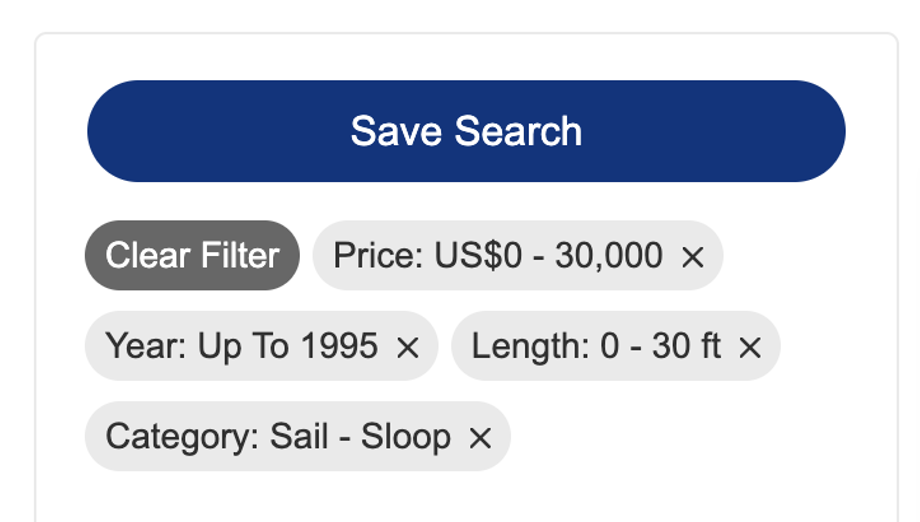
In forming your shortlist, you’re also constrained by availability and location. Here’s where online listings can really come in handy. Use the filters on online listing sites like YachtWorld to see what’s actually available to you. You’ll probably also discover a few boats you hadn’t even considered or didn’t know existed.
Yacht Brokers
It’s also a good idea to look up the yacht brokerages in your area and browse their inventory. Sometimes these boats aren’t listed on the bigger sites. Brokers are often more than happy to chat about your needs and which potential boats might fit, so don’t be shy about making that call. Especially if you are in the market for a newer or more expensive boat, brokers may be the ideal sales channel for an inexperienced buyer and well worth the modest fee.
Facebook Marketplace and Kijiji
In addition to these sources, don’t neglect sailing non-specific sites like Facebook Marketplace and Kijiji—especially if you are in the market for a “budget” boat. If you’re looking to follow the Pardeys’ classic advice, “Go simple, go small, go now,” you’ll definitely want to scan these humbler online listing sites.
Yacht Clubs
Last but not least, if you are a member of a yacht club or marina (or they allow visitors), there’s usually a bulletin board with boats for sale in the main office. While the selection will be limited, there is a certain ease and familiarity that comes from buying offline and local.
Ask Questions
As you search through online listings, consider each vessel’s history. Don’t be afraid to send the seller a list of questions. A freshwater-only boat will likely have standing rigging and metal components in much better condition, and with a longer interval before they need service or replacement. Likewise, boats in temperate climates often age better than boats in particularly hot and humid (cold and icy) climates. Has the boat even run aground or been involved in a collision? How many hours are on the motor? The answers may not be deal breakers, but it’s important to set the record straight so you can accurately forecast the amount of work you’ll need to put in.
With our shortlist in hand, we are now ready to refine our choices by perhaps the most salient factor of all: price.
Budgeting and Important Expenditures
It’s extremely important to factor in all the extraneous costs of owning a boat. There is much more to consider than just the purchase price of the vessel. You have factors like insurance, financing, slip fees, club fees, launch and haul out fees, marine surveys, upgrades, and regular maintenance. Ever heard the old joke that “boat” stands for Bust Out Another Thousand? These myriad little costs, which really add up over time, are the reason why. But fear not, we will factor these costs into our budget to ensure we’re planning for the overall expenditure, not just the vessel.
Insurance
Depending on where you live and the age and length of your vessel, insurance may be legally required to own and operate your boat. Older, smaller craft are often exempt. Still, it’s a prudent idea to protect both your new investment and yourself—especially if you’ll be taking guests or crew aboard. Remember, boat insurance isn’t just for the vessel itself, but for personal injury and liability resulting from any boating activities.
Important: Many marinas and sailing clubs will not launch or haul out your vessel if it is uninsured, so make sure you get an insurance quote and approval before purchasing. The last thing you want is to be denied coverage on your new purchase while it sits in a club that won’t launch uninsured boats. Your new vessel could be left, quite literally, high and dry. Many sailing clubs also require boat insurance to even join the club or moor your boat.
Moreover, be aware that many insurance providers will require multiple photos of the entirety of the vessel—including the keel and hull—before approving a policy, and that’s only possible when the boat is on the hard (parked on land). Buying a boat on the hard also allows you and a certified marine surveyor to thoroughly inspect it, which may also be a requisite for insurance coverage—especially for newer boats.
Insurance premiums will vary based on your geographical location and the value of your boat, but in my experience, it is typically cheaper than car insurance and more than worth the peace of mind. Do yourself a favor and get a quote on any vessel you’re serious about before buying. See “Insurance for Older Sailboats.”
It’s easier to properly inspect a boat when it’s “on the hard.”
Marine Surveys
Even for newer boats, you should strongly consider getting a proper marine survey on your prospective purchase. Think of it like a home inspection, but for a boat. In fact, if you dream of living aboard, this is quite literally the case!
Choose a certified ABYC Master Surveyor for the most thorough inspection and report. Some will even let you observe their work, providing a great opportunity to learn what to look for in a boat. The price of marine surveys can vary wildly, but expect to spend at least $15-25 USD per foot of boat length, plus applicable taxes.
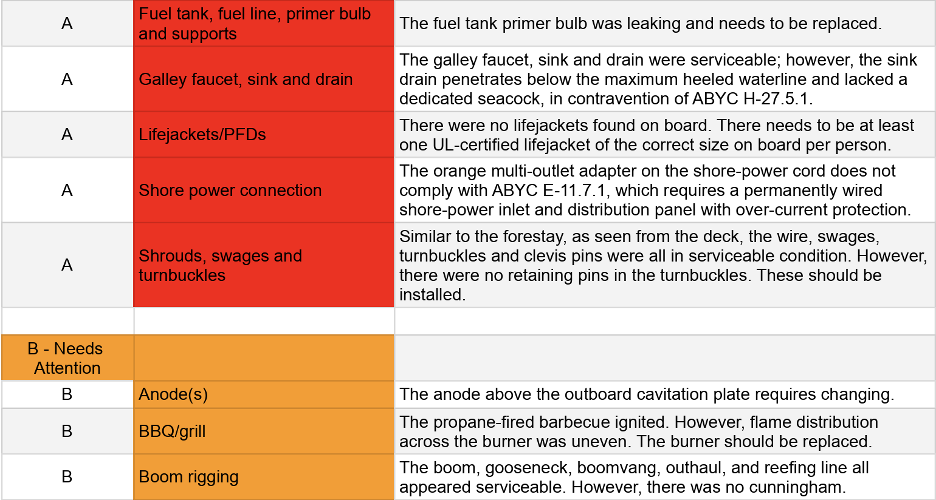
Surveyors will typically also stipulate a fair market value for the boat. This allows you to determine if the boat is a good buy or if you should perhaps bargain the price down. The valuation also comes in handy if and when it comes time for you to sell the boat. Don’t hesitate to walk away from any seller who refuses to allow a marine survey on their vessel. See “Pre-Purchase or Insurance Survey: Which One Do I Need?” and “How To Prepare Your Boat for a Survey.”
Maintenance and Upgrades
A good rule of thumb is to spend 10 to 15 percent of the boat’s value in annual maintenance. Of course, an older $5,000 boat will likely require more maintenance, while a newer $500,000 vessel should require substantially less (should, not will). But 10 to 15 percent remains a good starting point, so adjust this value up or down based on the boat’s vintage, condition, and the results of your marine survey.
It’s also a good idea to use the survey (whether official or unofficial) to start a list of potential upgrades you might want to make. When a furling headsail costs upwards of $4,000 and watermakers regularly fetch $8,000, it’s prudent to be realistic about how any planned upgrades will affect your bottom line.
Safety Gear
This deserves its own category. Few things marine-rated come cheap, but in a life-threatening situation, the right safety equipment is worth every penny. Don’t take a gamble—always sail equipped with the proper safety gear. And it’s not just common sense: The proper safety gear is often a requirement to operate a boat, enforced by the Coast Guard or other local authority. This includes items such as VHF radios, personal flotation devices (PFDs), pyrotechnics (flares), and buoyant heaving lines.
Marina and Club Fees
Joining a marina or sailing club is a great way to make friends, race, and of course, find a home for your boat. The difference between marinas and sailing clubs is that marinas are open to all types of boats, including motorboats and small fishing craft. Sailing clubs (a.k.a. yacht clubs) are sailor-specific, with a strong culture to match. The choice is up to you, and it’s often dictated by what’s in your area. Regardless of your choice, the costs are largely the same:
- Initiation Fee (often for yacht clubs only)
- Annual membership dues
- Spring launch fee
- Boat wet slip fee (often charged by foot of length)
- Fall haul out fee
- Winter storage fee
For yacht clubs in particular, there may also be a minimum spend at the club restaurant or bar, and possibly the expectation that you will dedicate a certain number of volunteer hours per year to club upkeep (“sweat equity”). Be sure to make inquiries before you purchase your boat so you can factor all these costs into your budget. Because of the initiation fee, expect the first year’s cost to be the highest and decrease from there.
Sailing Courses
If you’re purchasing a new boat as part of a journey in learning to sail, you should also factor in the cost of education, as sailing courses can quickly become expensive.
In the United States, the American Sailing Association (ASA) offers introductory courses such as ASA 101. Together with the Royal Yachting Association (RYA), ASA grants certifications that are recognized worldwide and may be required to charter or deliver boats. There is also International Yacht Training (IYT), which offers an International Certificate of Competence and is increasingly recognized abroad, granting the same privileges.
The price of your education should also encompass any radio operator courses, navigation courses, and marine first-aid or offshore survival courses you plan to take. Note that in many jurisdictions, a VHF radio license is required to own and operate this essential piece of equipment, so at a minimum, plan to take that.
Adding It All Up
Now that we’ve set a budget and factored in all the extra costs, you might find that your choice of boat needs to change. That is, you might realize the money you can allocate to the boat itself puts you in a more modest price range. And that’s perfectly okay. It’s better to do your due diligence in regard to all of the above and get a humbler boat than it is to find yourself in a fancier boat without insurance, safety gear, or any slip to call home.
Item Cost (CAD) Cost (USD) Comments
1976 Paceship PY26 CA$3,000.00 $2,198.49 Incredible deal as the surveyor appraised the boat at $7,000 USD fair market value
ABYC Marine Survey @ 21 CAD/ft + tax CA$616.98 $450.01
Boat Insurance (annual premium) CA$434.16 $316.66
Sailing Club (annual dues) CA$62.50 $45.59 Heavily discounted due to military veteran status
Wet slip up to 30' (annual fee) CA$437.50 $319.10
Launch fee @ 16.16 CAD/ft 420.16 $306.45 Technically bundled with purchase of boat, but included here for completeness
License fees 107.35 $78.67 Pleasure Craft Operator Card, Powered Vehicle Operator Permit
Sailing courses CA$1,965.07 $1,440.06 Basic Cruising, Basic Navigation, Radio Restricted Operator Certificate (Marine), Marine Basic First Aid
Safety equipment CA$350.00 $256.49 Flares, Noisemaker, Heaving line, Throw bag, First Aid Kit
Total CA$7,393.72 $5,411.52
Buying Your Boat
Now comes the fun part (just not for your wallet). If you’re purchasing through a reputable dealer or yacht broker, you can assume all the important information will be on your bill of sale. If it’s a private deal, you can use a simple homemade bill of sale to complete the purchase, but at a minimum, ensure the agreement contains:
- Seller Name
- Buyer Name
- Make, Model, and Year of Vessel
- Hull Identification Number (HIN)
The last number is quite important. It’s like a VIN for your boat—a 12-digit unique identifier assigned to the boat for its entire lifetime. In Europe, this is sometimes called the Craft Identification Number (CIN or CID) and clocks in at 14 digits long.
If applicable in your country, once the purchase concludes, you will need to register or transfer the vessel registration into your name. Consult local authorities for information on how to do this properly.
Tip: An often overlooked factor for first-time buyers is which time of year you make your purchase. There are two times when you can snag good deals: In the fall, before haul out and winter storage, and in the spring, before launch and summer storage. Both periods see sellers keen to let their vessels go before billing periods roll over and they’re stuck with another season of mooring or storage fees. In peak summer season, prices will likewise hit their peak as new boaters catch the fever and seek to enter the market.
Whatever vessel you choose, rejoice—you’ve made it to the end and will soon be out on the water! I hope you find everything you’re looking for out there.
Fair winds and following seas.