

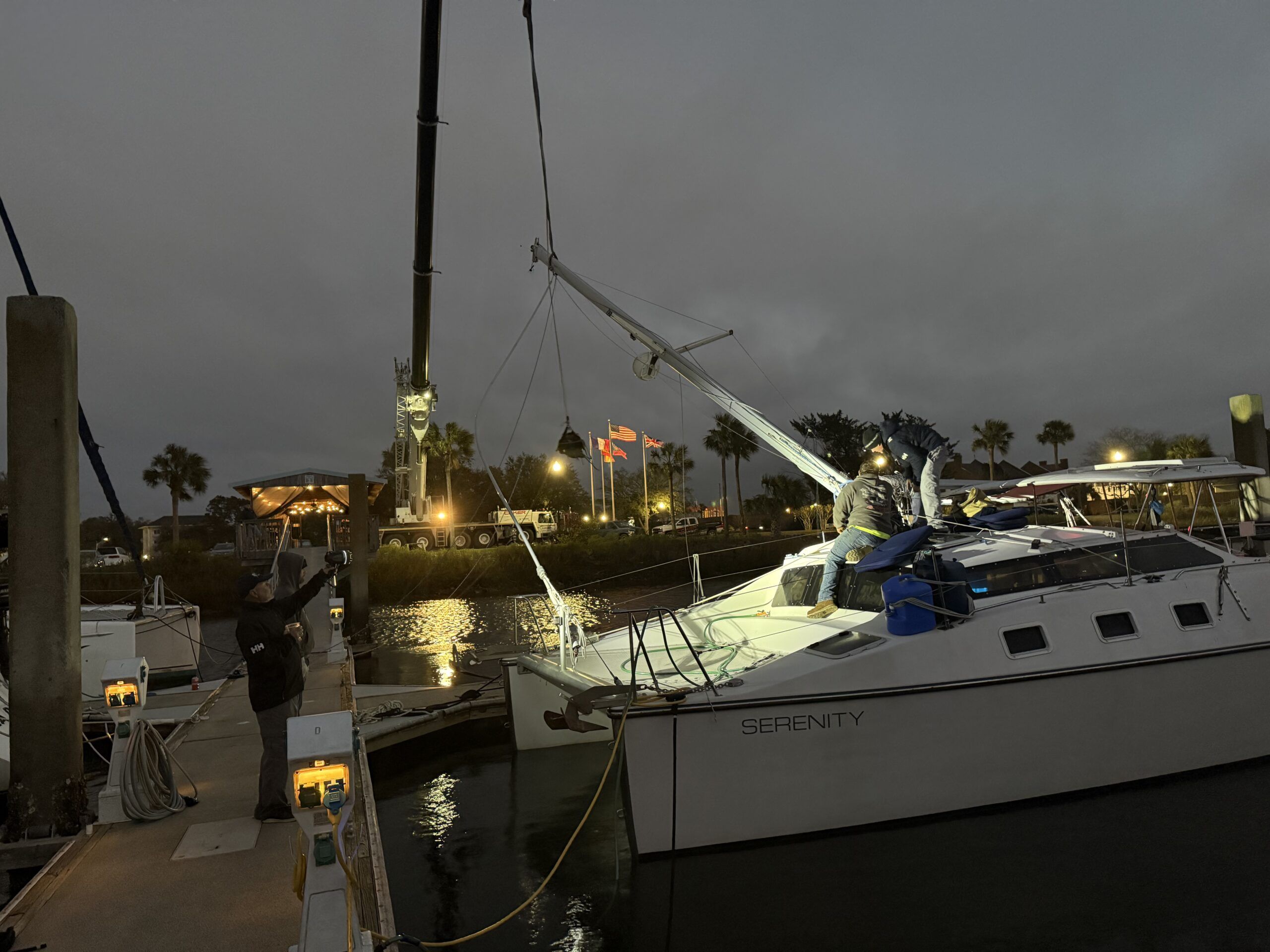
Valentine’s Day is not my favorite holiday. Now it will remain the anniversary of my dismasting rather than the day with romance, roses, chocolates and cards. Although, I did end up with roses and chocolates at the end of the day and even a surprise dinner for two, despite starting the day with no real prospect for that.
My Valentine this year was my boat, Serenity (see “Sailing On After Losing a Sailing Partner”). I went to a Valentine’s Day brunch at the marina that day, solo, and wrote, “Sailboats are better Valentines than some people,” on the heart asking for participants to give love advice.
Before the brunch, I posted this boat Valentine to my sailboat in a sailing Facebook group:
- “So, for this Valentine’s Day, I celebrate my mistress, Serenity. Like any mistress, she demands my time, money and attention. I’ve seriously considered selling her, but after three offers fell through, it seems the universe wants us to stay together.
- I’m getting Serenity new shrouds for Valentine’s Day. They are the most expensive Valentine’s gift I’ve ever given. She didn’t get me anything. Except, she supports my adventures every day. She keeps me warm and safe in my berth at night. She supports my remote work with her solar panels and Starlink. She feeds me from her little galley. And she puts up with my shit, as long as I pump it out periodically.
- She might be the most reliable Valentine I’ve had. I can forgive her for failing to get me chocolates and roses. So, here I am solo on Serenity on Valentine’s Day in Georgia with my mast held up by halyards waiting for new shrouds.”
And then, as I stepped back onto my boat just after noon carrying my first rose of the day from the brunch and a borrowed snapping tool so I could tackle a snapping project, I heard a thunk. And then I felt a weird movement. I learned from losing my anchor (see “Severed Anchor in the Bahamas: Seven Lessons Learned”) to pay close attention to weird sounds and boat movements.
I looked towards the remaining shroud, on my port side, and the shroud was GONE. GONE? Wait. WHAT? I must be looking in the wrong place. And I looked towards my starboard side to see my mast down leaning on the catamaran in the slip next to mine. Oh &$#@…
These Are My Lessons Learned From My Valentine’s Day Dismasting:
1. If you think it might be time to replace your old rigging, it is time to replace your old rigging.
I’ve been considering replacing my standing rigging for two years. I considered replacing it and got a quote before I went down the ICW (see “Tips from a First ‘Sail’ on the ICW”) to the Bahamas last year, but there wasn’t anything obviously wrong with the standing rigging on inspection, my insurance wasn’t requiring replacement, and I decided to wait.
In hindsight, replacing old rigging might be like reefing. The saying goes, if you are considering reefing, it is time to reef. If you are considering replacing old rigging it is probably time to replace the rigging (see “Replacing Wire Rigging”). Now, nobody is going to agree on the precise definition of “old.” But I knew my standing rigging was certainly more than 10 years old, and probably between 15 and 18 years old. I also knew a recent survey identified some chafing on my shrouds where they meet my lifelines.
After getting a few quotes and considering removing the mast and replacing the full standing rigging, I found the cost and logistics and location daunting, given my sailing plans and list of upcoming upgrades. I decided to hire the rigger who would replace just the shrouds with the mast till up while in Georgia. This is not a crazy thing to do—people do it regularly, though at least one of the riggers I contacted refused to do shroud replacement with the mast up and perhaps, their caution was correct. They would later do the repairs to restep my mast and more.
2. Be careful about replacing standing rigging with the mast up.
On the Monday before Valentine’s Day, my rigger removed my starboard shroud so it could be replicated. The plan was to replace both shrouds with newly replicated shrouds on Valentine’s Day. The installation of the new shrouds got delayed because the company replicating my shrouds had to order a special mast attachment fitting from Selden that they did not stock.
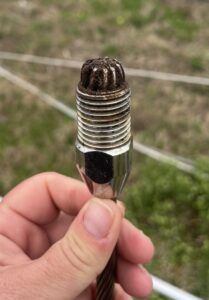
I don’t know if we will ever fully understand what caused the failure that resulted in my mast falling. The halyards holding up my mast on the starboard side with the missing shroud did not fail. The spot with visible chafing on the remaining port side shroud wire did not fail. The remaining port side shroud released at the lower end between the turnbuckle and the wire in a fitting called the Sta-Lok. Riggers and seasoned sailors tell me these rarely fail. It appears it may have been partially unscrewed when the rigger released tension on the port side turnbuckle to remove the starboard shroud.
On a blustery day—gusts around 25 knots from my starboard forward quarter—my port side Sta-Lok let go. And the mast, oddly, fell in the direction of the wind. It was as if when a gust eased, the mast rocked just enough back towards the starboard side to pull the Sta-Lok apart. This motion probably was not possible with both shrouds on and properly tensioned.
3. There are worse places to lose your mast than in a marina.
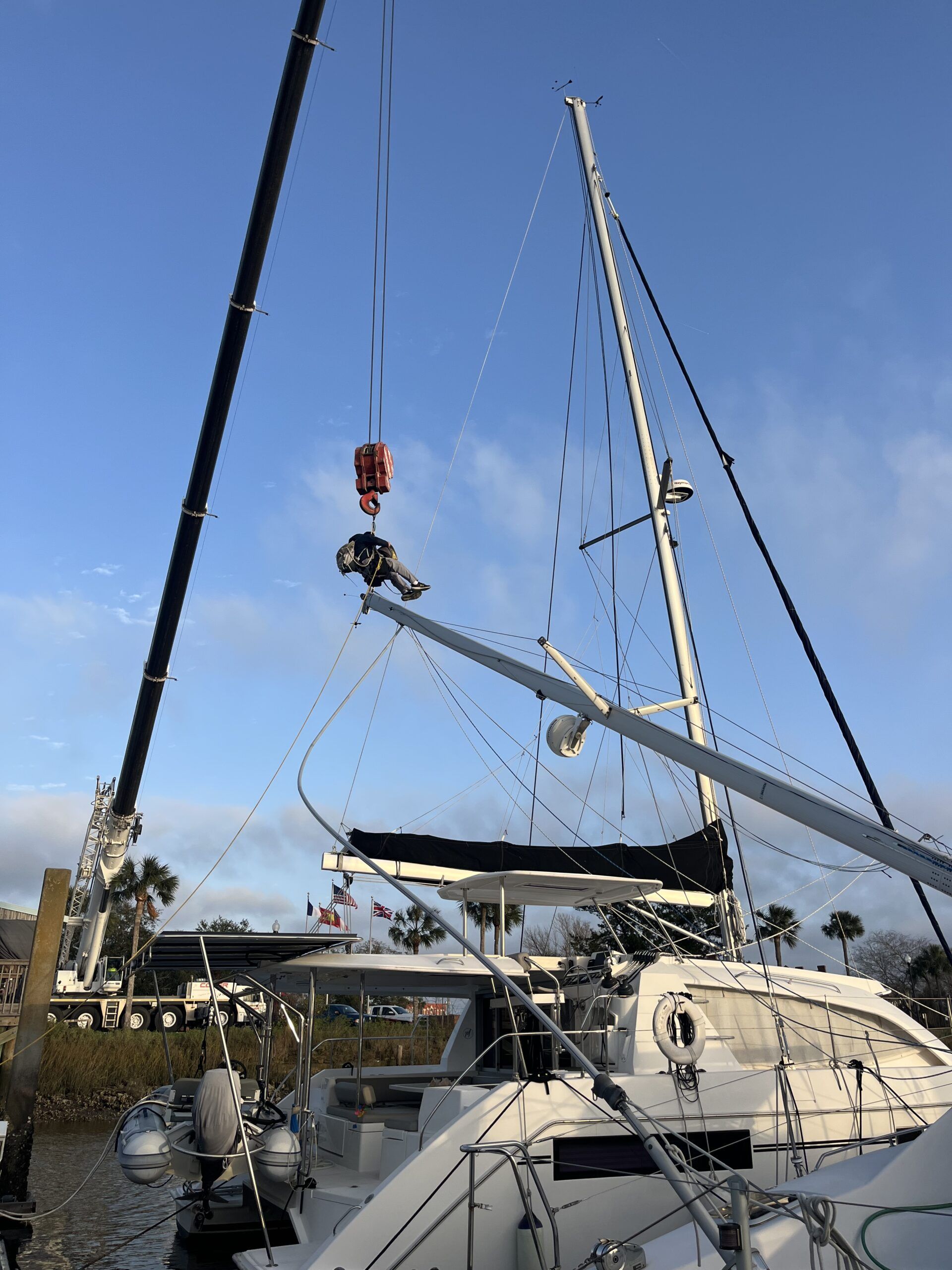
At a marina, it was easy to step off the boat and get to safety. I am so grateful no one got hurt. Help started arriving on foot and by car almost immediately. I called my rigger first and the marina dock office second and the owner of the catamaran under my mast third. Initially, we all stood and stared at my mast caught on the topping lift of the cat in the next slip and defying gravity, despite the wind gusts and two boats moving slightly in their slips.
We had no idea why the mast wasn’t sliding down the line and crashing into my neighbor’s solar panels, but we were all grateful. Maybe it was serendipity, maybe it was luck, maybe it was the hand of God, as one person claimed staring up at the mast paused halfway through falling. We were in the Bible Belt south, after all.
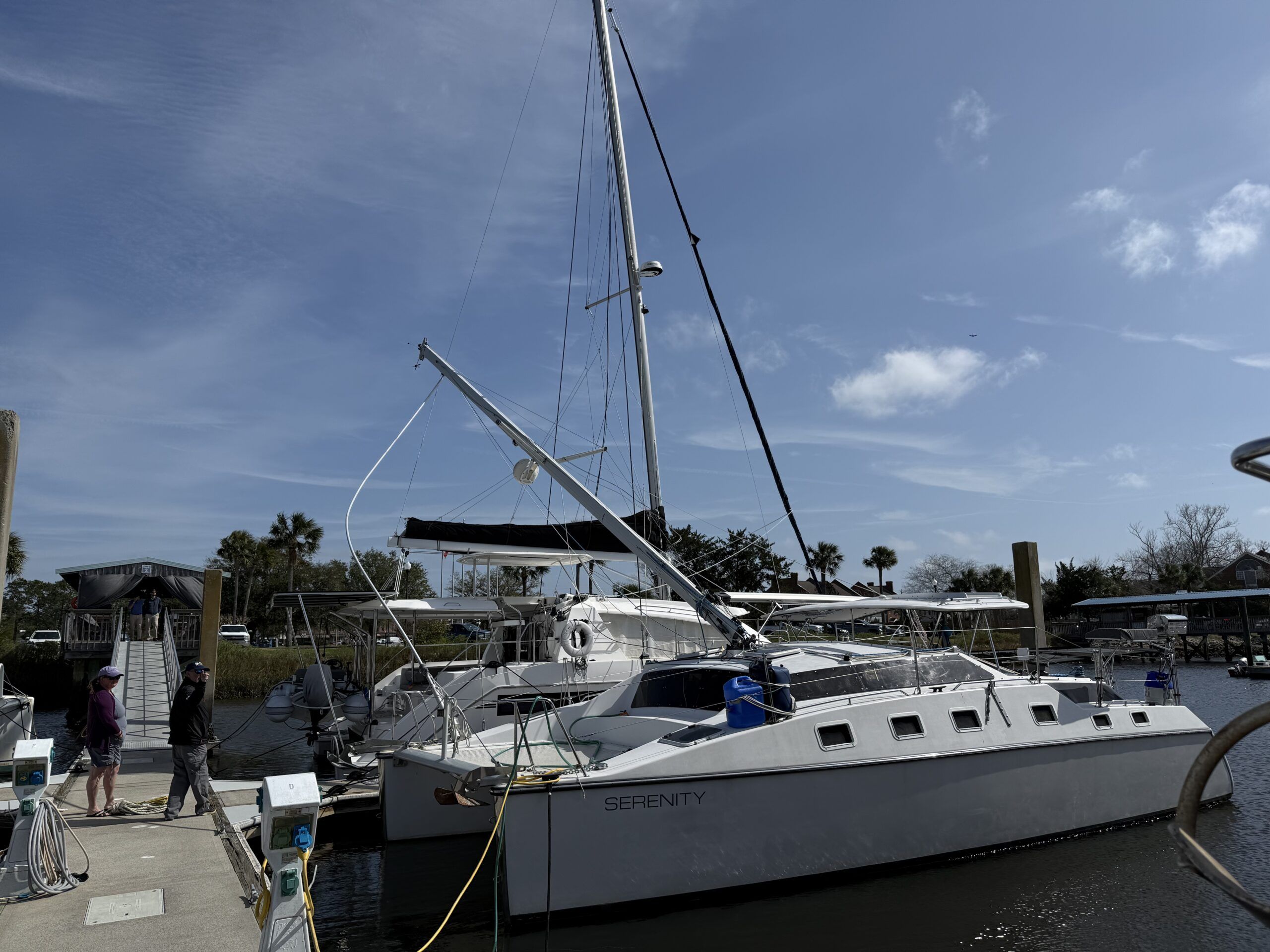
The downside of losing a mast in a marina is all the other expensive boats a falling mast can damage. At sea, it might just be one boat at risk, but the help and safety will be farther away and harder to reach.
Ultimately, we tightened a couple dock lines to reduce the movement of the boats in the wind and considered all sorts of creative ideas to support the mast from the dock, from another boat, or from land. Some marina staff actually went out and bought lumber to build something to support the mast from the dock.
In the meantime, the marina, the rigger, and I all started making phone calls trying to find a crane that could reach the mast. It was over 100 feet from land to the tip of the mast. I am grateful I was in a slip so close to land—most of the slips in this marina are much further away from the parking lot. If I’d been on a T-dock, as I often am as a catamaran, I’m not sure what we would have done.
None of the local cranes on barges were in the area. They were all on jobs too far away to respond. We tried a couple of different land-based crane companies. The local one came and said they simply could not reach the mast with their crane. A second one with a bigger crane said they thought they could reach and sent someone to measure the distance.
The crane arrived almost exactly four hours after the mast fell—just after 4 p.m.
4. Use insured contractors for work on your boat, and be kind to them, even when they make mistakes.
Some marine professionals remain professional and helpful, even when stuff goes horribly wrong. My rigger dropped what he was doing, got in his car and immediately drove to my boat. He was 90 minutes away. He started making phone calls on the way.
While waiting for the crane, the rigger and I sat in his car hiding from the wind and watching the mast defying gravity. At this point, no one wanted to board Serenity and risk that motion might cause the mast to crash down into my neighbor’s solar panels. We talked through a step-by-step plan to secure the mast, free the other catamaran at risk, and then remove the mast to land.
The crane company he found was able to reach the mast. His behavior and words toward me said he was taking responsibility and was going to make the situation right. Again, I was grateful. We were able to tackle the problem as a team. There was no assigning or evasion of blame in the moment. That would not have helped.
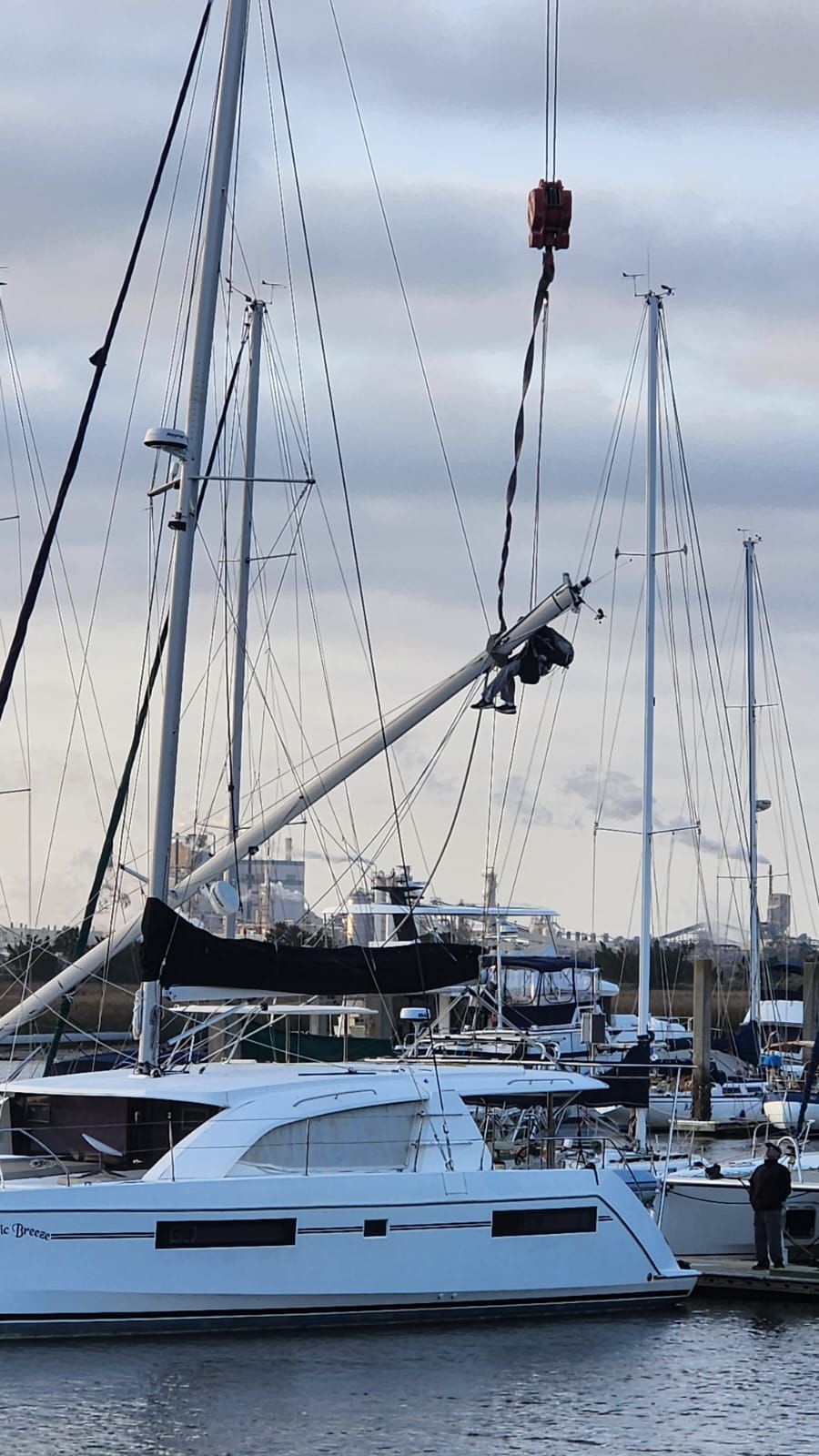
My rigger’s insurance company was in touch with me quickly, within days, and started paying for the damage quickly. But do be prepared for payment by paper checks sent through snail mail, which can be a hassle for cruising boaters.
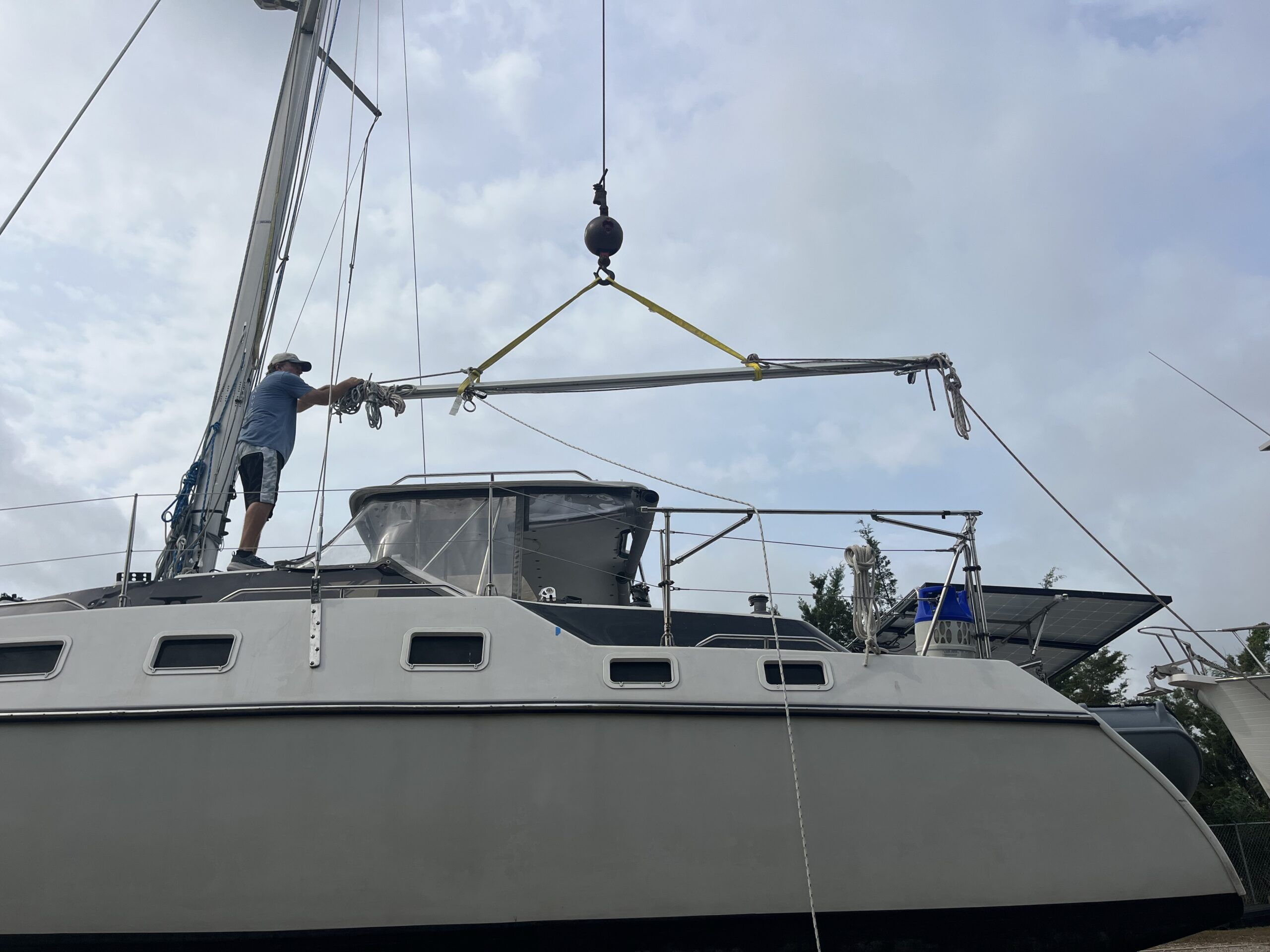
The marina and boat yard staff were helpful and professional. When one newer member of their team was doing too much—he was making me nervous that the lines he was moving might cause the boats to move and the mast to fall further—they appropriately and quietly called him off, and he stopped. The crane crew was great—going above and beyond to help remove twisted rigging from the boat so the mast could be lifted by the crane. Removing the boom and freeing the twisted forestay was especially challenging. The rigger paid for the crane—over $5,800 with his credit card. That became part of the insurance claim.
5. It does take a team to get out of this situation, but be careful who is on the team.
The hardest part about this was the other boaters who wanted to help. One was obviously drunk and very vocal with his not-so-helpful recommendations. It was Friday evening, and happy hour was in full swing at the marina. All the professionals and I politely refused his help.
Please don’t offer to “help” in a precarious situation like this if you’ve been drinking or otherwise under the influence. It is not helpful. I chose to rely on the other boat owner impacted by my mast and the professionals from the marina, boatyard, crane company and my rigger. At this marina, we all have insurance covering our actions. We all have high stakes—our boats and careers—guiding us to be cautious. Other boaters did help, but with a mast defying gravity above another boat, I didn’t want to put another boater in the situation where something they did trying to be helpful might cause the mast to fall.
Around sunset we freed the cat threatened by my mast, and it moved to a new slip safely away from my mast. The crane finally lifted the mast to land around 8 p.m.
The Selden aluminum 45-ft. mast weighed just 250 lb. by the scale on the crane. Our estimate was 400 lb. How far a crane can reach depends on the weight of the object it needs to move. Thankfully, my mast was light enough for the crane to work nearly at its full extension. It had to go 177 feet from the spot in the parking lot where they could park the crane to the tip of the mast. This didn’t quite get to the center of my boat, but it got far enough to lift the mast and ease it to vertical under the crane with some lines secured at the bottom of the mast.
6. My electrical wires running from the mast to the inside of the boat were not where I thought.
I disassembled the ceiling looking for the electrical wires from the deck stepped mast before finding them under the settee and under a heavy portable fridge/freezer. It is amazing to me what I still don’t know about the boat after eight years. I am grateful to the previous owner who labeled most of the wires and included quick disconnects so I could unplug the mast wiring relatively easily. There were a few wires that didn’t have quick disconnects and had to be cut. One of these was for the broken radar I planned to remove but hadn’t been up the mast to do it. No loss there. Another was for the tricolor light—it turns out that line was also damaged at the top of the mast, so got replaced anyway. The VHF antenna and wind transducer cable also got cut and needed to be replaced.
Unwiring the electrical wires running through the mast and re-wiring it was more complicated than I expected. There are several 12-volt lines for lights plus the tricolor light, VHF antenna, a radar cable, and a wind transducer cable. When pulling these lines to disconnect the mast from the boat, we accidentally pulled out the wiring for an overhead cabin light.
I gathered all the parts we removed in a single, large ziplock bag. The one item that went missing was a gooseneck pin. It may have been too damaged to save or gone accidentally into someone’s pocket in a chaotic moment while the team was removing the boom from the mast.
Pictures I’d taken that day helped with the insurance claim and replacing all the running rigging we hastily removed to get the mast off the boat.
7. The universe does not seem to agree with my sailing plans. Again.
‘Nuff said. I’ll follow the universe. Apparently, Serenity is staying at Brunswick Landing Marina for a while. There are way worse places in the world to be stuck. This place is brimming with community, marina events, like the Valentine’s Day brunch, happy hours, yoga, and more and is quickly growing on me.
The catamaran that caught my mast was delayed heading south by just a few days. The rigging company that refused to replace the shrouds with the mast up was working in the marina that week on another boat and was able to inspect their rig and replace their chafed topping lift within a week. Serenity got stuck on the dock for months waiting for a longer list of standing rigging, a new furler, and some wiring to be replaced.
Repairs took about three months on Serenity. By then, we approached my haul out date for hurricane season.
His professional behavior both before and after the mast came down was everything I could ask for and more. He arrived as quickly as he could. He demonstrated what a competent professional should do when something in a project they have been hired to do goes horribly sideways. He found, signed and paid for the crane, and he called his insurance to confirm they would cover the damages and open a claim while he was driving to the marina. He has done everything within his power to correct this situation.
At the End of the Day
Just after 8 p.m., the rigger and I stood in the dark, relieved, next to the mast on sawhorses on land. It was just over eight hours since the mast fell. He said, “I’m starving.” I offered, “I could heat up some food in two minutes.” He asked, “Can I take you out to dinner instead? Do you like Thai? It’s the least I could do.” As a single-handed female sailor, this could have been creepy, but it was not.
So, we tucked away the mast, closed up the boat, and went out for Thai. There was no wait for a table for two at nearly 9 p.m., even on Valentine’s Day. The Pad Thai was delicious. We tried to process the day, and felt the crash after too many hours of surging adrenaline. The restaurant gave me a rose and a couple of chocolates at the end of the meal, thinking we were on a date. We weren’t.
At the end of the day, I got chocolates and roses for Valentine’s Day, after all, and even a dinner for two. Serenity made it clear she is not satisfied with just shrouds, but wanted more new standing rigging, including a new forestay, a new furler and a few new wires. I’m grateful to report the rigger’s insurance company has paid for all that without issue. The dismasting turned a $2,000 job into more than $20,000 of work between my boat and the other boat that caught my mast.




I’ve replaced standing rigging at the dock three times over the years. On a cat, with only three wires, it is easier and should be just as safe as doing it on the hard. You just need to think methodically.
That the rigger allowed the fitting to take the twisting force while loosening is just … sloppy. This is also common; I have seen many sailor adjust turnbuckles without bracing the cable against twist. You ALWAYS protect the shroud from twist with a second wrench, and as we have learned, this is double important with compression fittings. But it is always important. This is the big takeaway. Additionally, the fitting should have had Loctite on the threads, which I do not see (perhaps just not visible).
I suspect what actually happened is that he twisted and twisted the turnbuckle, and because he did not brace the upper fitting, the twists were stored in the wire as torque. When the threads finally broke loose, there were multiple rotations stored in the wire and the fitting unscrewed in a matter of minutes. Something like that.
—
BTW, one of the boats I worked on was my PDQ 32. I know it like the back of my hand.
Hi Drew- That is the best explanation I’ve heard so far. Thanks for posting it!
Glad to help.
And nice boat! I really miss my PDQ 32. High quality in a compact package. I may get another one, someday.
I re-rigged my prior boat twice with Sta-lok terminals. The first time in the water with the mast up. That rig took us across the Pacific. The second time we had the mast down and were able to reuse all but one Sta-lok, which didn’t pass visual inspection. I plan on using Sta-lok terminals for the next re-rig on our new good old boat. My experience would back up Drew’s speculation.
In talking to multiple riggers and many sailors about this experience, no one had experience with a Sta-lok failing.
I actually saw this happen. It was scary. The crane was pretty cool to watch from afar.
Drew, I agree. Sloppy.