
The dream of owning a yacht appeals to many sailing enthusiasts, but the financial realities can make this dream seem out of reach or even cost-prohibitive. Companies like Moorings and Sunsail offer ownership alternatives that allow you to purchase a new yacht and place it into a charter fleet for a specified time—usually five years.
At the end of the agreement, you, as an owner, can choose to keep the yacht, sell it, or trade it for another charter contract. But how does this model work, and does it make sense for your lifestyle and financial goals?
Here’s a quick rundown of the financial mechanics, benefits, drawbacks and alternative approaches to yacht ownership going the charter route.
The Basics of Charter Yacht Ownership Programs
At its core, programs like Moorings and Sunsail are built around a “charter to ownership” model. Owners buy a new yacht (with cash or financing), which is then used in the charter company’s fleet for five years.
During this time, the charter company manages the yacht entirely—covering maintenance, insurance, dockage fees and operational costs. Owners can also use their yacht (or equivalent charter-owned ships globally) for personal vacations, often for up to twelve weeks per year, depending on availability and demand. Owners are given an allotment of points each year that allows them to book their boat of choice at no additional charge.
The trade-off? Owners depend on the contractually guaranteed revenue from the charter company to offset the ongoing costs and potentially significant depreciation of the yacht.
Here’s how it all breaks down:
Purchase Price
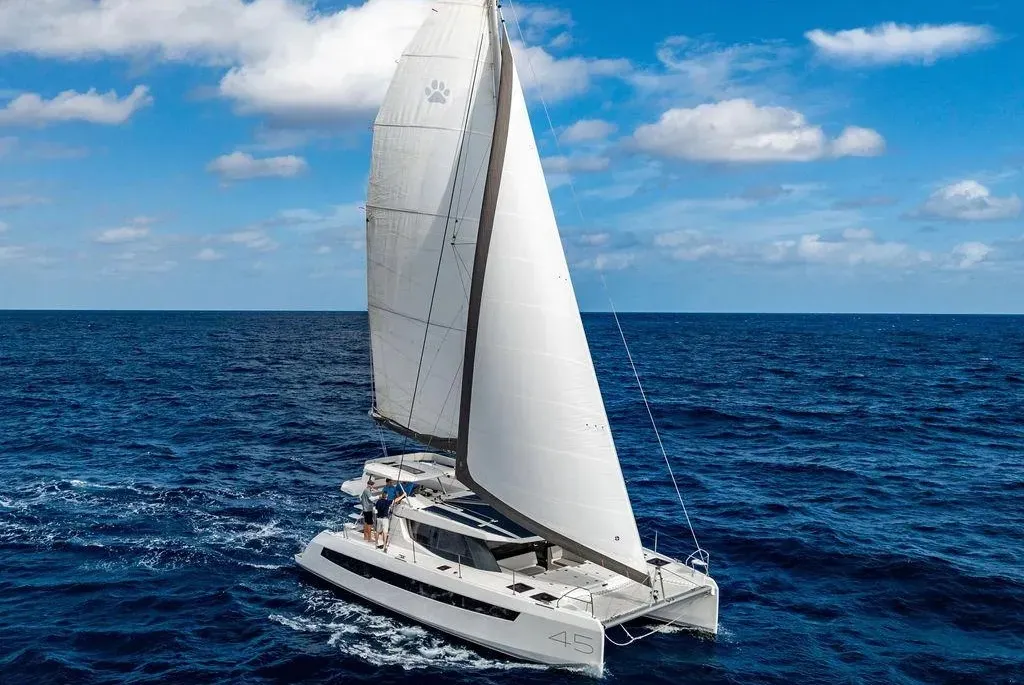
Buyers typically purchase the yacht at market rate, which ranges widely depending on the boat’s size, type and options. For example, a popular cruising catamaran like a Leopard 45 might cost around $600,000 depending on the year, condition and improvement.
Down Payment and Financing
Most programs require a significant down payment—often around 20 to 25 percent of the yacht’s cost, or $120,000 to $150,000 depending on the total purchase price. Financing is an option, but the interest on boat loans is another expense to consider.
Guaranteed Income
Charter companies provide monthly income to owners, regardless of charter activity. This income is often calculated based on the yacht’s total purchase price and can be around eight to nine percent annually. While this helps offset loan payments, it doesn’t always lead to covering the purchase price, much less profitability.
Costs Covered by the Charter Company
The company handles all maintenance, insurance, cleaning and operational costs during the contract period. This level of management makes the program appealing to busy folks with limited time for hands-on boat ownership.
Exit Options
After five years, the owner decides whether to take the yacht for private use, with the company preparing it for delivery (often referred to as the phase-out process), sell the yacht through the company’s brokerage service or roll equity into a new contract for a different yacht.
Financial Analysis of the Program
The key question for new yacht buyers is, “Does this financially make sense in the long term?” While the model is marketed as worry-free, there are several financial elements to consider:
Depreciation
New yachts typically depreciate significantly over their first five years. Comments from experienced buyers report 50 percent depreciation during this period. For a $600,000 yacht, this means the yacht may only retain $300,000 in value after charter life.
While buyers benefit from guaranteed revenue during the five years, it often doesn’t fully counteract depreciation. For example, $2,000 per month payments over 60 months provide $120,000 in revenue, which doesn’t offset the $300,000 depreciation.
Tax Considerations
For high-income individuals, accelerated tax depreciation laws can make the program attractive. Certain countries, such as the United States, have offered bonus depreciation rules for charter assets, allowing owners to write off the yacht’s depreciation against other taxable income.
This approach appeals primarily to business owners or investors with high tax burdens, as it could result in tax savings of $100,000 or more. However, these tax benefits largely depend on local laws and accountants’ expertise.
Many high earners who believe they’ll reap tax benefits from this purchase should beware, as tax rules are extremely specific, and it could be hard to meet the standards for certain tax breaks. Crystal Stranger holds a Juris Doctor of Law degree and is an Enrolled Agent (EA), EOS Integrator, and professionally Senior Tax Director and CEO of OpticTax.com.
She warns that in some cases, “It would be hard to justify the boat investment as a business investment. It is unlikely you will make a profit in a charter program, and without the intent to make profit the hobby loss rules will apply, which will mean that the expenses of the business will only be able to offset the income, and not provide deductions beyond this.”
She adds, “In order to have the losses be deductible against other income you must run a legitimate business, and I just don’t think charter businesses would rise to that level, and even if it is legitimized, it would be a passive loss, so most taxpayers would not be able to deduct this under the passive loss limitation rules.”

Though many charter programs appeal to would-be boat owners with the lure of being able to deduct depreciation, there are strict standards for that as well, “Choosing bonus depreciation or Section 179 for a charter yacht often raises an IRS eyebrow—especially when there’s any personal use blended into the mix,” says Peter Ankeny, CFP and founder of Wolf Pine Capital. He explains, “Strict records are a must because to qualify for active-loss treatment, the IRS typically wants to see at least 500 hours a year of genuine business participation. If they suspect too much personal fun and not enough real ‘business,’ they could classify it as a hobby, erasing those valuable tax benefits.”
Ultimately, it’s best to engage the professional services of both a tax lawyer and a CPA to provide guidance on this purchase, especially if you’re hoping to reap some tax benefits as a boat owner with a vessel in a charter fleet.
Return on Investment (ROI)
Financially, buying a yacht through a charter program isn’t usually marketed as an investment opportunity but more as a lifestyle purchase. Although guaranteed revenue covers many costs, buyers shouldn’t expect a profit or even to recoup what they’ve paid for the vessel. The income is primarily designed to offset loan payments and minimize upfront ownership expenses.
After the five-year term, many owners face additional costs if they choose to keep their boat for personal use, as ex-charter yachts often require significant refurbishment or refitting to make them suitable for personal use.
Pros and Cons of Various Ownership Approaches
For potential buyers, it’s important to compare the charter model to other paths of ownership:
1. Buying and Chartering Through a Program
Pros:
- All operational expenses—including maintenance—are covered during the term.
- Owners enjoy 12 weeks of yacht use annually without additional management effort.
- The boat can serve as a tax-friendly asset for high earners who can make use of the depreciation write-offs.
- Access to a global fleet of sister ships in various locations is ideal for frequent travelers.
Cons:
- Depreciation can significantly outweigh the guaranteed charter income.
- Owners don’t choose custom specifications, as yachts are factory-configured for charter.
- Heavy usage affects cosmetics and wear, as ex-charter boats often have high engine hours and tired interiors.
2. Buying a Used Ex-Charter Yacht
Pros:
- Five-year-old yachts are often significantly cheaper, allowing buyers to avoid initial depreciation.
- With the right refurbishments and maintenance, an ex-charter boat can become seaworthy and personalized at a fraction of the cost of a marine craft.
- Certain charter companies, such as Sunsail, offer supportive phase-out processes and maintenance records.
Cons:
- Higher costs for upgrades and repairs—such as new soft goods, cushions, electronics or engine work.
- Many ex-charter yachts lack custom features, such as water makers, long-range solar systems, and advanced navigation, so refitting, and improvements can significantly add to expenses.
3. Purchasing a New Yacht for Private Use
Pros:
- Owners retain full control over every aspect of the yacht, from specifications to use.
- Lower wear and tear compared to heavily chartered yachts.
- Avoid the expense of upgrading former charter options upon purchase.
Cons:
- All operating expenses, maintenance and downtime costs are the owner’s responsibility.
- A new yacht suffers the same depreciation as one purchased through a charter program but without guaranteed income to offset it.
Which Option Makes the Most Financial Sense?
The decision to buy through a charter company, purchase outright, or wait to purchase an ex-charter yacht largely depends on your financial situation and lifestyle priorities. Below are key considerations for different scenarios.
The Frequent Charterer
If you already spend $30,000 or more annually on charter vacations, programs like Moorings can provide similar vacation flexibility while affording you ownership at the end of the term.
The Investor with High Tax Burden
For those with substantial taxable income, leveraging tax incentives like accelerated depreciation can make charter yacht ownership a financially strategic decision. The ability to offset significant portions of the yacht’s cost against taxable earnings may reduce the effective purchase price considerably.
However, this approach requires expert tax guidance to ensure compliance with local regulations and to maximize the benefit.
The Casual Boater or First-Time Buyer
For those desiring a lower-maintenance introduction to yacht ownership, the charter program model provides minimal operational responsibilities while offering recreational benefits. However, before committing, buyers should carefully assess the long-term financial implications, such as depreciation and the costs associated with post-charter refurbishment.
The DIY Buyer
Those with technical and mechanical marine craft skills or a willingness to invest time into researching and maintaining their vessel may find purchasing a used ex-charter yacht the most financially prudent option.
This strategy allows buyers to avoid the steep depreciation of a new yacht while customizing their boat to suit personal preferences. However, a hands-on approach is critical, as ex-charter yachts require thorough pre-purchase inspections and careful planning for upgrades.
Bottom Line
Ultimately, yacht ownership is as much an emotional decision as it is a financial one. While the numbers can guide buyers toward the most cost-effective choice, each path offers unique experiences that cater to different lifestyles.
Evaluating both the tangible and intangible benefits is key to making the right purchase decision for your personal and financial goals.










Love this article! So well written with all the right details and information.
As a long time regular bareboat charterer, well over 30 years already, I’ve looked at ownership programs with many different charter companies. I my case, after consulting with accountants and CPAs, financially and practicality, charter boat ownership made no sense. Plus, as a Canadian, tax laws do not allow any kind of deductible tax relief.
So for me, booking the boat model and size, where and with whom I choose, is a much more flexible and cost effective way to “sail the world”. Like a rental car, you grab the key, go have fun and return the keys. End of story…
I have met many charter boat owners, mostly American, that do enjoy this formula. Most starting with smaller boats, and moving up to larger and larger boats as each program term comes to an end. With the objective of finishing up with THE boat they want to end up with in time for their retirement, etc.