


A tour of the 2025 Annapolis Sailboat Show showed signs of progress on the electrification of auxiliary power. Particularly notable was the emergence of hybrid propulsion options, with at least four large (44- to 60-ft.) hybrid-powered boats on display at the show. As in the automotive world, hybrid-powered boats promise the combination of diesel engine range and reliability with the torque, efficiency and, most importantly, option of clean and quiet operation using electric motors.
Starting with electric outboards, manufacturers ePropulsion, Temo and Torqeedo all had booths at the Annapolis show with their lineups on display. Temo and ePropulsion, with neighboring booths on the water, went the extra mile by demonstrating their products right from Dock F, taking potential customers for rides on electric-outboard-powered inflatable boats.
As described in Practical Sailor’s recent Buyer’s Guide for Electric Outboards, models with integral batteries and rated up to about 1600 input watts are suitable for hard dinghies and inflatables, but don’t expect the boat to get up on plane. The three to five horsepower equivalency claims for these models apply to low-end torque, but they can’t deliver the same top-end horsepower, measured at the prop shaft, offered by gas outboards.
Pods Present a Saildrive Alternative

Turning to daysailers, lighter boats including a Flying Scot, J/Boats’ J/7, and Argentinian builder Zonda Group’s 24-ft., 2,866-lb. displacement Z24 were exhibited with electric outboards, but the power choice moved up to pod drives on boats exceeding 25 ft. and 1.5 tons.
J/Boats’ 28-ft., 4,250-lb. displacement J/9 displayed at the show, for example, was fitted with the optional Torqeedo Cruise 6.0 (6 kW) pod-drive in place of a standard Yanmar diesel saildrive. Similarly, Zonda Group’s 28-ft., 5,070-lb. displacement Z28 was shown with an optional ePropulsion 3.0 (3 kW) Pod Drive.

Pods are gaining traction with boat builders in part because they are simple and easy to install in place of a saildrive. As their looks suggest, smaller pods are simply the lower units from electric outboards. The foot of the pod houses the electric motor and is cooled by water passing over the bulbous case (so no through-hulls are required for cooling). Installation is a matter of fairing the mounting plate end of the pylon to the shape of the hull (if it’s curved rather than flat) and drilling holes for the mounting bolts and power cable shaft. The remote battery is usually installed in the space where the typically larger and heavier diesel engine would otherwise live. A throttle/shift lever and battery display are installed up in the cockpit.

ePropulsion offers 1.0 kW, 3.0 kW and 6.0 kW Evo Pod Drives while Torqeedo offers the Cruise 3.0 FP, Cruise 6.0 FP TorqLink, and Cruise 12.0 FP TorqLink (at 3, 6 and12 input kW, respectively). Temo also has a line of pods, but they’re not yet available in North America.
Boatbuilders Chime In
Zonda Group used to offer Torqeedo pods as an option on some of its boats, but the builder recently switched to ePropulsion because it offers “the same or better quality at a lower price,” I was told by Andrés Méndez, a naval architect at the firm. Fitted with a two-blade folding prop, the ePropulsion Pod Drive 3.0 Evo drives the Z28 at a decent four-knot cruising speed drawing as little as 250 to 1,000 watts (depending on loads and conditions), said Méndez. From the boatbuilder’s perspective, pods take as little as 1.5 hours to install, he noted, while customers appreciate the simplicity of electric propulsion, with practically no maintenance required.
J/Boats has been internally experimenting with electric propulsion since 2016, Al Johnstone, the company’s vice president and chief designer, told me, but the appeal of electrics is limited by the customer’s access to power. The battery-powered pod drive option offered on the J/9 since 2021 has “done well,” Johnstone said, “but it’s a question of where the boat is kept. If it’s on a dock and you can plug into power every night, it’s like having an iPhone, but it’s much more challenging [to keep the battery charged] on a mooring.”
Even for customers who keep their boat at a dock, some buyers question whether it’s a good fit. “Do you have to fight currents where you sail?” Johnstone posited. “Will you be limited to motoring at three to four knots when you need 20 to 25 miles of range? Some customers will say, ‘what’s my time worth?’”
Hybrid: The Best of Both Worlds?
Builders of large, cruising-oriented boats know all too well that buyers don’t want to be tethered to shore-based power, but the qualities of quiet operation and reduced emissions are still appealing. Thus, many builders are working with emerging manufacturers of hybrid systems that combine the range and reliability of diesel with the quiet operation, torque and efficiency of electric motors.
The combination of diesel engines for generation and electric motors for instant torque has been around for nearly a century, widely used to power large ships, submarines and locomotives. The innovation with the latest hybrid marine propulsion systems for recreational use is the addition of high-capacity, lighter weight lithium batteries and smart battery-management systems. The greater storage capacity extends the range of electric propulsion. The systems also support power conversion and management to meet modern house electrical requirements, including air conditioning, cabin heaters, induction stove tops, microwaves and even washers and dryers.
Hybrid boats are usually fully electrified, doing away with propane, alcohol and other fuel sources other than diesel for electric generation. Solar panels, wind generators and hydro generation can help recharge the battery banks, but the ace in the hole for hybrid systems is having a diesel engine (or two) to ensure reliable propulsive power, range and plentiful electric generation.
Hybrid Suppliers Emerge
Two leading makers of hybrid systems supplied to boat builders present at the Annapolis Show were U.K.-based Integrel Solutions and French manufacturer Joool—a play on “joule,” the unit of energy measurement. Both Integrel and Joool tout their respective hybrid system’s ability to deliver the reliability of diesel but with greater range and fuel economy with the option to quietly cruise using electric propulsion. The icing on the cake, in southern climates and on summer days, is the ability to run AC systems all night without running a generator.

Integrel’s E-Drive system harnesses a dual-purpose 15 kW generator/20 hp electric motor coupled with an automated power management system. The system is offered to boat builders as the E-Drive 15 SE for single-engine installations or as the E-Drive 30 DE (30 kW generation/40 hp propulsive power) for dual-engine installations suitable for catamarans. Either way, the generator/motor is fitted by the boatbuilder between conventional diesel drive engine(s) and transmission(s), with adapters available for popular Beta, Nanni and Yanmar engines and either shaft drive or saildrive configurations.
Integrel’s E-Drive was announced in 2024, but it was not yet installed on any boats at the Annapolis show. Integral partner Xquisite Yachts did, however, show a mockup of Integrel’s system alongside its new Xquisite 60 Solar Sail, a 60-foot catamaran featured in Practical Sailor editor Tim Labute’s recent walkthrough video. The big cat, which is built in South Africa, boasts up to 7 kW of solar panel capacity that supplements the Integrel system in charging the boat’s 60 kW hours of battery capacity.
Joool’s system, which was installed aboard a Leopard 52 and a Fountaine Pajot 44 shown in Annapolis, differs from Integrel’s design in that in employs electric pod drives combined with a single, high-capacity “range-extending” diesel generator that can directly power the pod drives while also recharging the battery bank for propulsion as well as all house loads. The Fountaine Pajot harnessed a single large battery bank for all loads while Leopard specifies an extra inverter and separate house bank on its hybrid models for the sake of redundancy.
Joool’s pod drives are available at 25 kW, 35 kW or 50 kW. According to Jeremy Benichou, Joool’s product manager of hybrid systems, the 25 kW pods are typically used with 41- to 48-ft. boats, the 35 kW on 48- to 55-ft. boats, and the 50 kW on 56- to 65-ft. boats.
Partnerships and System Smarts
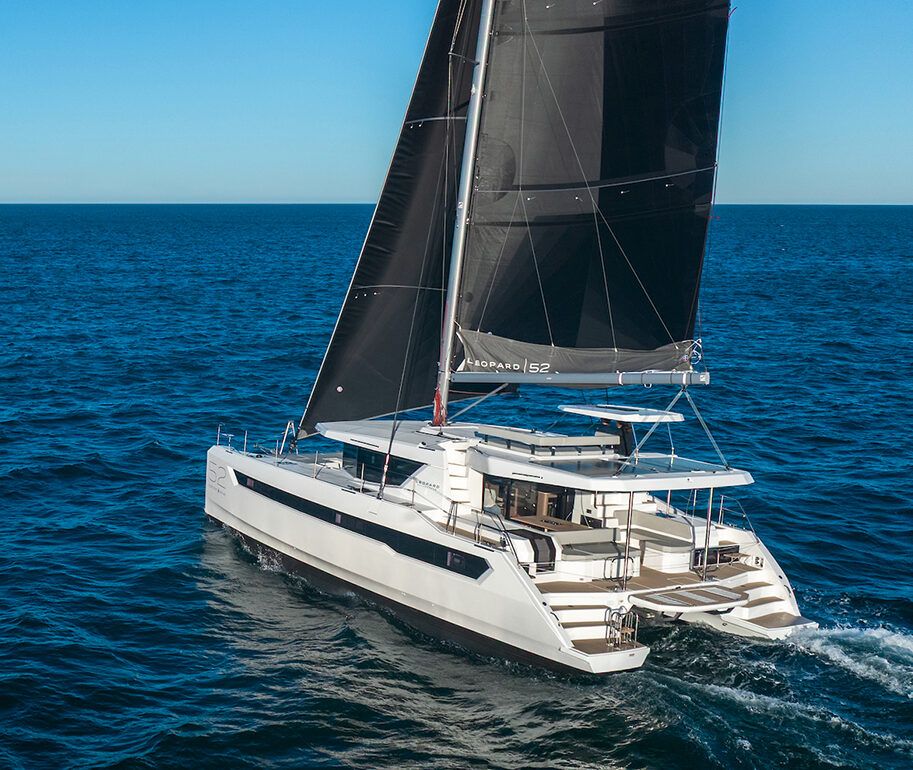
Joool has partnered, thus far, with boat builders including Fountaine Pajot Group (owner of Fountaine Pajot Catamans and Dufour Yachts), Leopard Catamarans and RMYachts. Whether under battery power or supplied directly by the high-capacity generator (typically 24 kW or higher, versus 8 kW to 12 kW in ordinary genset/inverter installations), the idea with hybrid, as with hybrid cars, is to avoid range anxiety and the dreaded fate of being caught with dead batteries.
Joool’s system is at the core of Fountaine Pajot Group’s ODSea+ program, which aims to reduce the carbon footprint of boat construction while also driving toward “low-carbon, autonomous cruising.” The ODSea+ electric propulsion option, now available on six Fountaine Pajot cats and five Dufour monohulls, “guarantees a minimum speed of 4 knots even if there are very low battery levels and strong winds,” according to Fountaine Pajot’s website. The Joool-powered Leopard 52 is also engineered to sustain a minimum of 4 knots against 30-knot headwinds, according to Benichou.

Despite the importance of ensuring range and a safety factor for motoring, “eighty percent of the energy supplied by our system is for loads other than propulsion,” Benichou said. That’s because sailboats are usually under sail while requirements like running air conditioning all night without running the generator demand considerable energy storage.
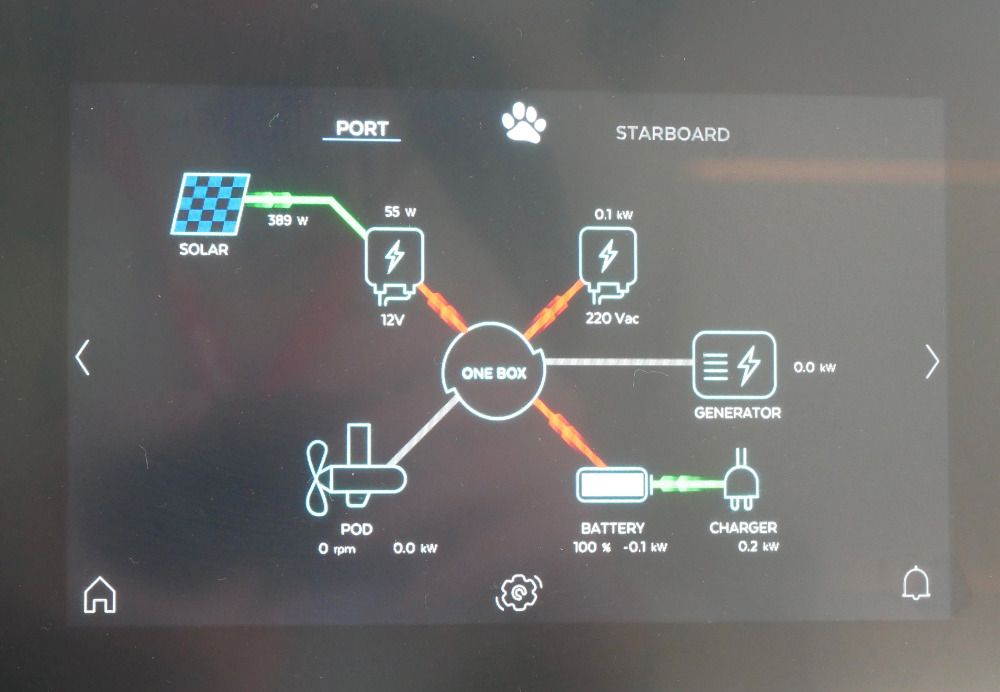
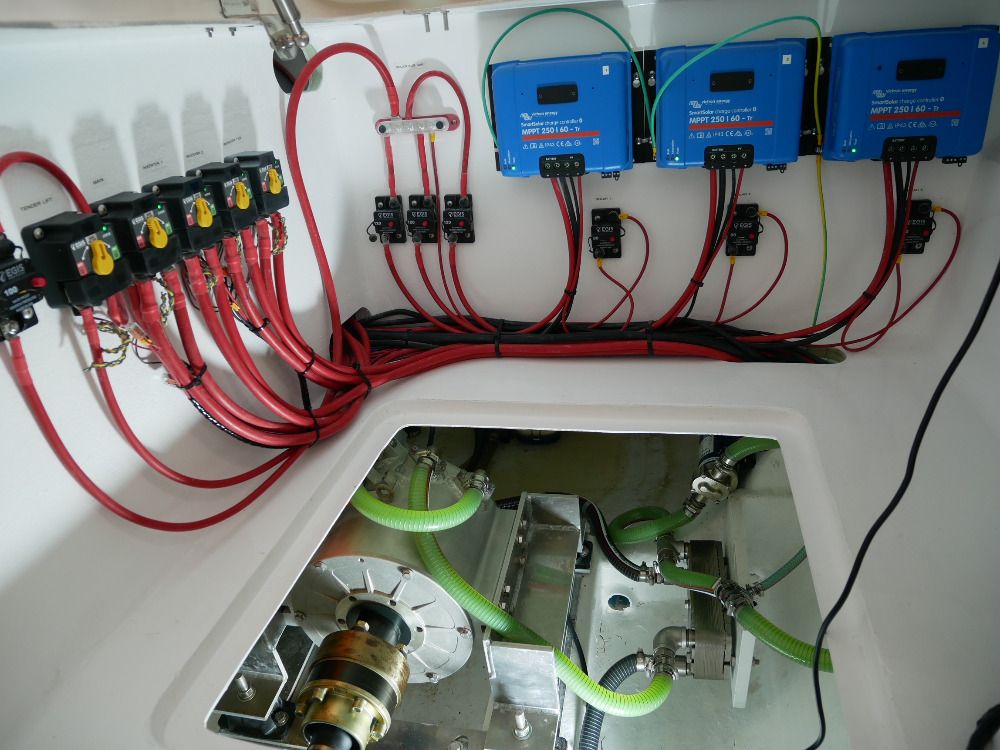
In addition to the pods and generator, Joool’s system includes a proprietary high-capacity battery bank that uses the same batteries used in electric vehicles, according to Benichou, along with a built-in, lithium-specific fire-suppression system. A separate module houses the smart energy management system while a “One Box” energy hub handles power conversion for propulsion and house electrical loads as well as power input management for the generator, solar panels, wind generation and hydro generation (through the pod drives).

Joool’s system is smart enough to function autonomously, according to Benichou, yet it also can be manually controlled by even smarter operators who are familiar with the system. For example, a hybrid system set up for a charter operation would automatically turn the gen set on whenever battery charge levels fall below 40 percent. If an owner or captain knows that the destination is only 20 minutes away, the automatic charging could be deferred.
Costs, Benefits and Customer Demand
Hybrid propulsion systems are not inexpensive, but then again, neither are the yachts in which they’re installed. According to pricing posted on Leopard’s website (in late October), the Leopard 52 shown in Annapolis lists at $1.31 million. The electric propulsion option adds $194,817 and replaces the standard-equipped twin Yanmar 57-horsepower diesel inboards. Whatever the boat and brand might be, Benichou said Joool’s system typically adds 10 percent to 15 percent to barebones “starting at” list prices.
What are the benefits of the hybrid systems? Beyond reduced consumption of fossil fuels and emissions of associated greenhouse gases, the top qualitative benefits are quiet motoring and quiet evenings aboard without having to run the generator for big loads such as air conditioning. The top quantitative benefit is 15 percent greater range than conventional diesel installations using the same tankage, according to Laurent Fabre, vice president of sales and marketing at ACY Yachts, a 12-location yacht sales organization that handles Fountaine Pajot and Dufour throughout much of North America, Hawaii and the Caribbean.
“You get better range because generators always run at the optimal RPM for fuel efficiency,” Fabre told me during a dockside meeting in the Fountaine Pajot booth. In contrast, two larger engines are required for conventional inboard power, and they can’t run as efficiently at variable RPMs. What’s more, solar panels, wind generators and hydro-generation can further extend the range of a hybrid boat.
“ODSea+ now accounts for 10 percent of U.S. sales, but I expect it to be 50 percent within three years,” Fabre said.
Island Spirit’s Home-Grown Hybrid Option
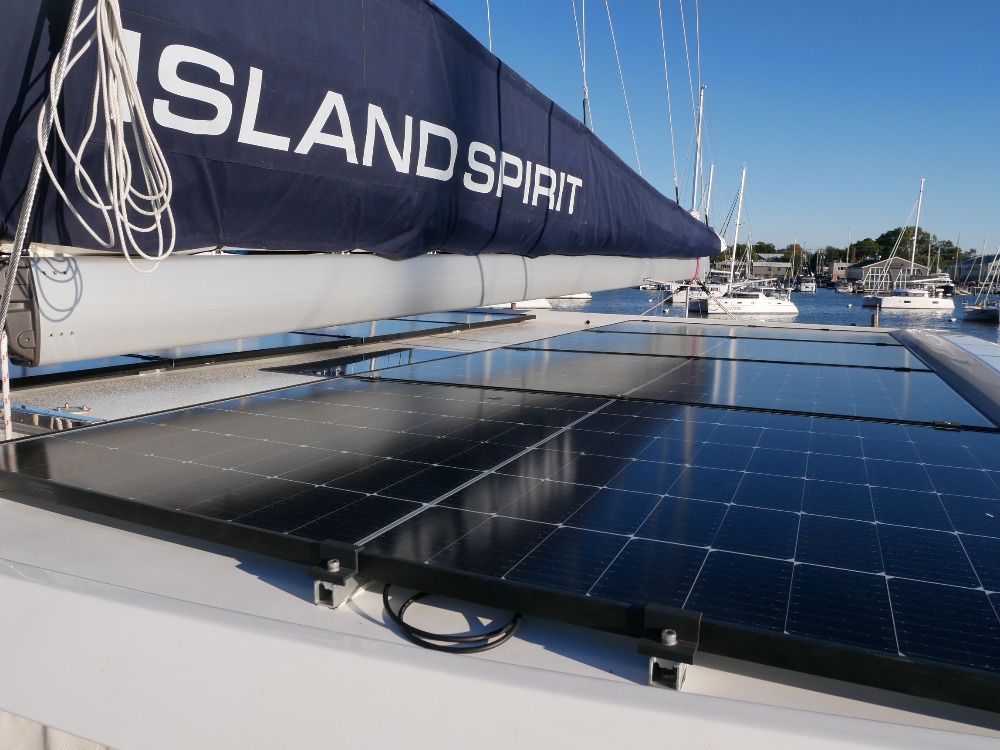
Not all boat manufacturers are turning to separate suppliers for hybrid propulsion systems. Island Spirit, which debuted its 52-ft. 525e in Annapolis, has rolled its own hybrid system using a combination of components and software sourced “completely from the auto industry,” said the company’s COO, Ron Patston, during a launch press conference at the Annapolis show. Patston cited software and component suppliers including Bosch and Siemens, and he noted that the 525e even has an industry standard CCS (Combined Charge System) supercharger port for rapid charging.

While the Leopard 52 and Island Spirit 525e are similar in size, the latter is nearly 9,000 lb. lighter while packing substantially more power. Whereas the South-African-built hybrid Leopard harnesses two 25 kW pod motors, two 27 kW batteries and a 24 kW generator (with a separate inverter and batteries for house loads), the Island Spirit, which is manufactured in Thailand, is powered by two 65 kW inboards, a 210 kW hour main engine battery bank, and a 50 kW main battery generator. Only 37 kW is required to power the boat at 8 knots, according to the manufacturer, and the boat can be fitted with up to 4.9 kW of solar charging capacity.
“We wanted a hybrid system that would enable customers to use the boat like they would use any other boat, without constantly running the generator or recharging at a dock,” said Patston. “What’s more, you won’t pay hundreds of thousands of dollars more for the electric option.”
The Island Spirit 525e show in Annapolis had six cabins and six heads and is destined for charter. The retail price for the hybrid is $1,459,314. The same boat (the IS 525) with twin 57 hp Yanmar diesels would be $1,335,000 (with an upgrade to 80 hp diesels available).
Incumbent Power Providers Catch Up

The emergence of hybrid power has not gone unnoticed by traditional power providers such as Beta and Yanmar. Both vendors have introduced electric saildrives: the Beta 14 and 21 E-Drives and the Yanmar SDe7, SDe10 and SDe15, respectively. Enthusiasm at their booths at the Annapolis Sailboat Show was mixed. A representative of Beta Marine was downright dismissive, describing electric propulsion as something best suited to European canal boats plugged into shore power each night.
In contrast, a Yanmar representative was more upbeat about the prospects for electric, noting that Yanmar has developed and is in talks with boatbuilders about using the vendor’s hybrid propulsion package. But he, too, cautioned that it’s “early days” for the technology.
“The drive systems and control systems are here and ready,” he said. “The battery energy density is rapidly advancing, but it’s not quite there yet as a replacement for diesel power.”
Integrel Solutions, Joool, Fountain Pajot, Dufour, Xquisite and Island Spirit would likely disagree with that readiness assessment, but it’s notable that the propulsive power, battery capacities and regenerative capabilities of hybrid systems and boat-specific installations vary widely. The Xquisite 60 Solar Sail, for example, has just 30 kW of electric propulsive power (integrated with twin 110 hp diesels), so the focus is on quietly motoring out of marinas and harbors and getting underway under sail. At the opposite extreme, the Island Spirit packs two 65 kW electric inboards and enough generator and battery capacity to drive the boat at hull speed for extended periods. Not discussed by any of these manufacturers was the rare but real risk of lightning strikes, which, as discussed in this recent Practical Sailor video, can wreak havoc with electrical equipment.
So it seems we’re at the beginning of the beginning when it comes to proving these systems at scale and under a variety of conditions. Surely the world’s oceans and seas will provide more demanding tests than running the air conditioning all night.



I see the small pods 1 to 3 kw being an excellent option for day sailors. Years ago we started to convert to a system being marketed by MinKota, but they dropped the product. This was pre LifePo, so power storage was limited and they could not find a market.
I’m surprised the article didn’t mention OceanVolt. I have a 2016 J/88 with an OceanVolt electric motor. Lack of range is a big problem with all electric motors. It would be helpful to retrofit the boat with a suitably sized, permanently mounted internal generator to use the system as a hybrid, but I have not found a suitably sized (that is, relatively small) generator.
Matthew, OceanVolt is, indeed, one of the larger suppliers of electric marine propulsion, but the company was not a direct exhibitor in Annapolis and I’m not aware of any OceanVolt-equipped boats having been at the show.
On the subject of generators, Powerflow Marine, one of the e-propulsion vendors exhibiting in Annapolis, had a small generator (for a hybrid system) on display that is powered by a compact, two-cylinder Yanmar engine.
Thanks for your interest. —Doug Henschen