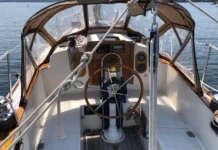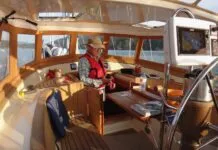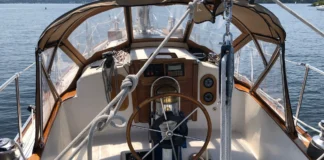

While the basic boat has remained unchanged since it was introduced in 1975, there have been dozens, perhaps even hundreds, of minor developments in the boat in the course of a production run that is approaching 4,000 hulls.
The advantage of a boat in production for so long is a high degree of product refinement over the years. The challenge for the owner of an early version of the boat is to upgrade his boat to the standards of models currently in production.
In the case of the Catalina 30, a number of bulletins have been published by the builder over the years, detailing improvements to the boat. In addition, there is an active owners’ association, and many individual owner shave embarked on significant programs of upgrading their boats.
As a rule, the changes to the boat over the years of production have been true improvements. At least one change, however, changeover to was less successful. The original diesel power resulted in a boat that was significantly underpowered, according to many owners.
Almost all the suggestions presented here for the upgrading of the Catalina 30 come from owners. Over 80responded to the detailed questionnaire about the boat, and many added more pages of comments to the responses. The owners responding own boats that run the gamut of the production history of the , from hull number 2 to hull numbers well over 3,000!
Here, then are the suggestions of Catalina 30 owners for the improvement of the world’s most popular 30-footer.Not all will be applicable to any particular hull. Many of the changes suggested or performed by owners of early boats were incorporated into the production of later boats. In addition, some of the changes became factory retrofits, so that some older boats have been upgraded to the specifications of newer models.
Hull and Construction Details
Until very recently, all through hulls in the boat below the waterline consisted of gate valves screwed onto pipes fiber glassed into the hull. Current models utilize RC synthetic sea cocks incorporating recessed through hull fittings.
The advantage of the old system is that there is no ex-posed, drag-inducing external skin fitting. The disadvantage is that gate valves are a generally poor substitute for sea cocks, since it is not always possible to determine if they are open or closed, they can be jammed in the open position by debris, and they are as a rule more subject to corrosion.
Replacement of the gate valves with proper sea cocks, either of tapered plug or ball valve construction, is recommended. Proper skin fittings should be installed at the same time, and these can either be faired in externally, or recessed (see Better Boat, February 1984).
As a rule, deck hardware is installed with large washers, but without proper backup plates. Stanchions, pulpits, and cleats can be made stronger by the addition of aluminum backup plates to help distribute load. (This technique is detailed in the February, 1984 issue of Better Boat.)
Like many other builders, Catalina has finally abandoned running lights mounted in the topsides. If being seen at night is a priority, install a pulpit-mounted combination running light, as is used in current production models of the Catalina 30.
Generally a little more attention to bottom detailing on the Catalina 30 should get you a little more speed. The rather large gap between the skeg and rudder should be filled in with fairing flaps to reduce cross flow. This improvement, suited to many boats, will be detailed in a future issue. In addition, lines and seaweed can jam between the forward part of the rudder blade and the bottom of the skeg. A deflecting rod, perhaps a piece of 5116”diameter bronze rod, can be glassed into the bottom of the skeg, just overlapping the opening between the rudder blade and the bottom of the skeg. In New England, this type of rudder/skeg configuration, without the deflector, is known as a “pot catcher” because of the amount of lobster pot warp that can lodge in the opening.
Prop skeg configuration has changed slightly over the years, but as a rule, the skegs are fairly clean airfoil bronze castings. On the new Catalina 30’s we examined, the casting was quite rough, however, and would benefit from a touchup coat of epoxy and micro balloons, followed by a thorough sanding to smooth it out. Prop wash when under power can make the Catalina 30a bear to handle for extended periods. The original rudder was redesigned, and many older boats have been retrofitted with the improved rudder which greatly reduced the helm problem. If you bought your Catalina 30 used, and find the helm excessively heavy when powering, contact Catalina for information on the new rudder. If in doubt, send a photograph of your rudder to the company. They’ll tell you whether you have the new or old version.
Rig
The rig of the Catalina 30 is decidedly old fashioned, with its un-tapered mast tube, wooden spreaders, and un-anodized mast and boom. Mast and boom should be painted, both to reduce surface oxidation and improve appearance.
Standing rigging, chain plates, and rigging fittings bring negative comments from a surprising number of owners, who consider this part of the boat a weak point. Beef-up kits for lower shrouds are available from the builder at nominal cost, and most older boats have had this modification. If you have an older boat and don’t know, compare your boat to a recent model nearby or take a picture and send it to the builder.
If you have closed body, stainless steel turnbuckles, replace them with open body turnbuckles of bronze, chromed bronze, or mixed bronze/stainless steel construction. Steel on steel turnbuckles have a nasty habit of seizing, and the closed body makes its difficult to judge the amount of adjustment left in the screw.
The small diameter wire used for shrouds and stays stretches excessively, according to some owners, making it difficult to maintain head stay tension. Going up one wire diameter, at least on forestay and backstay, is suggested by many owners.
Although it is rarely mentioned by owners, we would suggest replacing the wooden spreaders with air foil aluminum spreaders.
Internal halyards, led aft along the cabin top to the cockpit, are a popular modification. There is just enough room between the forward edge of the sea hood and the cabin top handrail to put turning blocks on the deck for the halyards. Be sure to stagger the halyard exit holes on the mast, and fit them with chafe guards to keep the halyard wires from eating into the mast tube.
The boat quickly develops weather helm as it heels, a not uncommon trait of wide boats such as the Catalina 30.Even sailing upright on a broad reach, there is a fair amount of weather helm. This is minimized with the tall rig/bowsprit option, and can be reduced on the standard rig by raking the mast forward slightly, and having the mainsail cut with minimum roach. Unfortunately, reducing the roach gives away sail area that the boat may need in light air. We see no reason why the bowsprit couldn’t be added to the standard rig boat to move the center of effort of the sail plan further forward. This will; of course, increase the boat’s rating under any racing rule.
Although the shrouds are set well inboard, the genoa track is mounted atop the toe rail. This may be fine for reaching, but it leaves too wide a sheeting angle for going upwind, according to owners. Installing a genoa track in-board, between the stanchions and the cabin trunk, would decrease the sheeting angle by about 5 ‘, and significantly improve windward performance. It may be necessary to install foot blocks at the aft end of the existing genoa track to get a good lead to the sheet winches, but this inboard track could probably be used with the working jib as well, which has a poor lead to the jib sheet winches without leading the sheet through a second block on the outboard track.
Traveler location is problematic. At the aft end of the cockpit, the lead to the boom is poor, and the main sheet can pose a problem when jibing, according to owners. Locating the traveler forward, over the companion way, both interferes with the companionway and complicates the installation of a dodger.
As on most boats, we suggest the installation of the largest self-tailing jib sheet winches that will fit atop the coamings. Overkill is a nonexistent word when it comes to handling headsail sheets, and the self-tailer is the only way to go. Once you’ve tried them, you’ll never go back.
Engine and Installation
Over the years, five different engines have been used in the Catalina 30: the workhorse Atomic Four gasoline engine, and the Universal 5411, Yanmar YSB12, Universal Model 18, and Universal Model 25 diesels. The engine compartment was designed for the Atomic Four. Some of the diesels present a tight fit.
According to owners, boats equipped with the YanmarYSB12., and Universal 5411 diesels are underpowered. The current Universal Model 18 is only slightly larger. The two most desirable engines are the Universal Model 25and the Atomic Four.
The Atomic Four is relatively quiet and powerful. All of the diesels are more noisy, and with the exception of the Model 25, much less powerful. If you’re going to re-power, go to the Universal Model 25. Slight modification of the hatch under the port settee will be required to fit the diesel, which is about 3” taller than the Atomic Bomb, as it is affectionately known.
If you can possibly manage it and space is at a premium here try to fit some sound insulation in the engine compartment, as the boat is noisy below underway with any of the diesels.
Since the prop installation is exposed, the boat could benefit from a folding or feathering prop. Since we have experienced a slight loss in speed and power with most folding proprs, don’t do it unless you have one of the larger engines. As a rule, we prefer the feathering Max-prop to a folding prop because it generates equal thrust in both reverse and forward, unlike most folding props. Watch the tip clearance carefully; as there isn’t much room here.
If you have a 25 amp alternator and dual batteries, you should switch to a larger, 55 amp alternator. According to owners, this is a simple adaptation.
While dual batteries have always been optional, most boats are equipped with them. If yours isn’t, do it. If the batteries are in the original port side location, shift them to the starboard side, under the chart table. This will eliminate the slight port list found in some older boats.
Comfort and Convenience
Ventilation is a problem on older boats. According to many owners, the sliding port in the head leaks, and there is no provision for ventilation in bad weather. The forward-sloping bulkhead between the cockpit and the main cabin makes it impossible to leave a hatch board out in rain or heavy weather.
Opening cabin top ventilation hatches over the head and forward end of the main cabin, as found on new versions of the boat, can be easily installed on older boats.
A cockpit dodger makes it possible to leave the hatch open in bad weather but makes access to the mainsheet a problem if the hatch-mounted traveler is installed. If you don’t want a dodger, and haven’t led the halyards aft along the cabin trunk, cowl vents in Dorade boxes on either side of the cabin top at its aft end will provide ventilation with the main hatch shut off.
The strong taper of the sides of the companion way, coupled with the fairly narrow internal and external teak pieces which hold the drop boards, strikes us as a serious weak point. While modification of the hatch, which we feel is just too big for offshore use, may not be practical, there’s no reason that the teak retainers for the drop boards can’t be made an inch wider, both inside and out-side. This would mean you’d have to lift the boards further to either remove them or install them, but it would also make them more secure in a knockdown.
Modifications below decks are as many and varied as the personalities of the owners. As a rule, most Catalina30s from all years suffer from inadequate division of storage spaces. Vertical dividers in the galley storage spaces behind the stove would greatly increase the practicality of that storage area.
Several other galley improvements will pay dividends. While the two galley sinks help give the Catalina 30 the feel of a big boat, the outboard sink, according to owners, can flood back through the drain if the boat is well heeled on starboard tack. We’d eliminate the outboard sink, fit-ting a dry well for storage instead. The inboard sink probably can’t flood under most sailing conditions, so the sink drain can then be left open for use.
Owners report mediocre icebox insulation, particularly on older models. Some owners merely stuff fiberglass house insulation between the outside of the icebox and the hull, but a far more effective solution is to glue on sheet urethane.
Older boats have no insulation in the icebox lid. This can be corrected by gluing sheet urethane to the underside of the hatch, fitting as closely to the sides of the hatch as possible to still give clearance on the inside. The sheet urethane can be glassed over directly. Don’t use Styrofoam it’s less efficient and don’t glass over it, if you do. It will dissolve in polyester resin. Even the insulated hatches on new versions of the boat need improved gasketing between lid and icebox to reduce heat intrusion.
The chart table has been improved on new models by making it flat, rather than angled. Angled chart tables only work when they are mounted athwart ships, rather than fore and aft. There’s no reason older tables can’t be modified in the same way. While you’re at it, add drop leaves to the fore and aft ends of the table to increase the working surface, and make the fiddles removable so you can use all the surface
If the boat is to be used for any serious cruising, consider replacing the standard alcohol stove with a gas stove. CNG is offered as an option on new boats, and it will greatly increase the livability of older boats. We guarantee that the improved performance of the cook will make this a worthwhile change every time.
Your cruising will be more comfortable if you add an extra water tank under the forward cabin berth. This has become a “standard option” on new boats, and is an easy retrofit in older boats. Do not, however, keep this tank full for day sailing or day racing, as the weight this far for-ward will accentuate pitching moment.
Conclusions
The Catalina 30 comes as a fairly well equipped basic boat. However, the responses of owners indicate that a lot of customizing can significantly improve the boat’s function.
The Catalina 30 comes as a fairly well equipped basic boat. However, the responses of owners indicate that a lot of customizing can significantly improve the boat’s function.
Every boat is a compromise, from the moment it leaves the designer’s drawing board until the end of its life. With a lot of thought, some money, and a fair amount of thoroughly enjoyable labor, you can improve any boat. And the Catalina 30 must surely be one of the most thoroughly owner-improved boats in the history of boat-building.
Improve Your Catalina 30: Upgrading the World’s Most Popular 30-Footer