
Now celebrating its 55th year in business, Catalina Yachts is one of the most enduring companies in the U.S. sailboat building business. For most of the company’s life, production took place at two facilities: one in Woodland Hills, Calif., where the company has its roots, and the other is a factory in Largo, Fla., that Catalina acquired from Morgan Yachts in 1984.
Currently, the company website lists its fleet at 12 models—from the 12.5 Expo dinghy to the 45-foot 445 ocean cruiser—but a few of those, including one of the best-selling boats of all time, the Catalina 22, have been retired—the Catalina Sport replaced the Catalina 22.
Catalina is one of the main production boat companies that still produces boats in the U.S.—Beneteau sold their South Carolina production facility in 2020. In addition to shedding the high cost of doing business in California, the move of production to Florida brings Catalina closer to its customers. More than 70 percent of Catalina’s new boats go to owners east of the Rockies.
Catalina is a privately held company—it was previously co-owned by founder Frank Butler (who passed away in 2020), former Marketing Director and President Sharon Day (who retired in 2025), and former Vice President and Chief Engineer Gerry Douglas (who retired in 2021). In 2025, Michael Reardon, founder and CEO of Daedalus Yachts, bought Catalina Yachts.
The sort of foresight that moved production closer to Catalina customers, along with Butler’s irrepressible drive, is what has helped Catalina weather the economic storms that have sent other U.S. builders to the bottom. Butler’s contagious passion for his work and his hands-on approach to customer service earned the loyalty of legions of Catalina owners.
“We do well in a down market,” says Douglas, succinctly. “We always have.”
Although the market for new boats soured considerably in the 2010s, two boats in the Catalina line sold relatively well. The first was the Catalina 375, a mid-sized cruiser launched in 2008 and had a short production run—the other is the Catalina 445, launched in 2009. Both boats earned high praise in the advertising-supported sailing magazines, so Practical Sailor was curious to see how the boats held up to these reviews.
Design Details
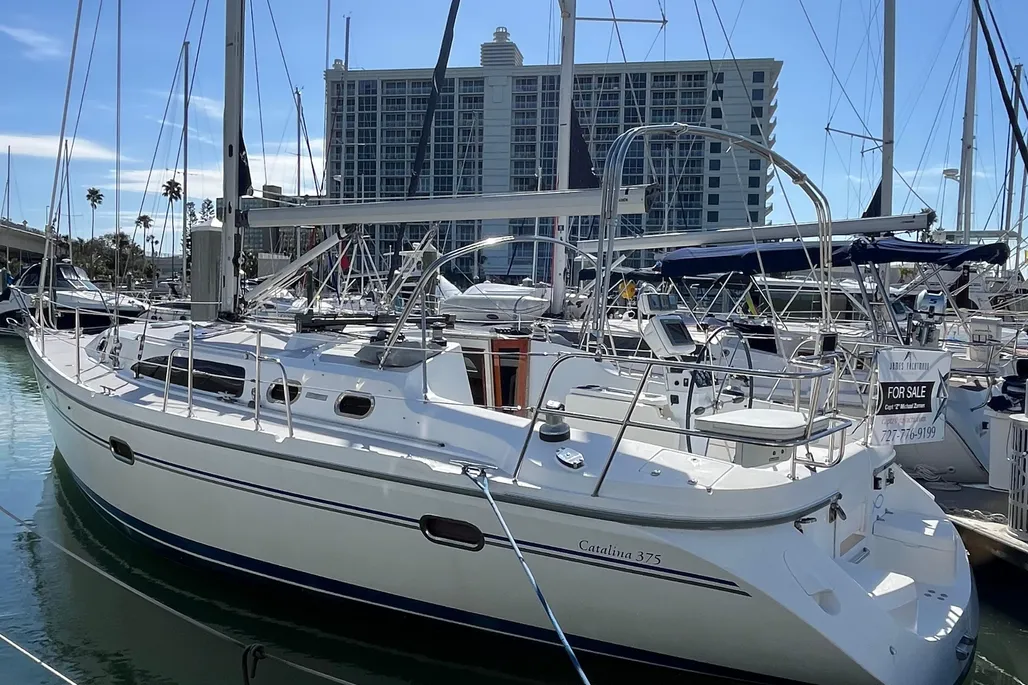
The 375 replaces the very popular Catalina 36, which was first launched in 1982 and went through one major design change in 1995 to become the Mark II. Combined, the two versions account for more than 3,000 hulls. Looking at the wishlist of today’s Catalina owners, it was clear that modifying the C36 was not a practical option. Expectations called for a longer boat, and a new hull form would give more flexibility.
Better performance, Douglas says, was at the top of the list, and giving the 375 a longer waterline and greater sail area-displacement ratio than the C36 ensured success on that front. Clearly, the 375 has a greater potential for faster passages than its predecessor, but it is, for all intents and purposes, a family cruiser, with comfort taking precedence.
Comparing the fin keel versions of the 375 and the 36 Mark II reflect the thought process at work. The 375 has 14 percent more waterline, 9 percent more beam, 15 percent more displacement, 13 percent less ballast, and 17 percent more sail area. Its displacement-to-length ratio of 169 puts it right in the middle of the Hunter 38 and the Beneteau 37, with the Beneteau being the more performance-oriented boat.
Given the popularity of the tall rig version of the C36 (with an additional 50 square feet of sail area), it is no surprise that the design team added more sail horsepower to the 375. Its sail area to displacement ratio is close to that of competing boats from Hunter and Beneteau.
There are two versions of the hull available: a deep-draft model that draws 6 feet, 10 inches and a shoal-draft model that draws 4 feet, 8 inches. The deep draft model is more than a foot deeper than the C36, and this is consistent with current trends. When it comes to performance dividends, a well-proportioned deep keel offers plenty of bang for the buck.
While owners clamored for more headroom below, Douglas said he wanted to maintain a fairly low profile like that of the C36. As a result, the deck house extends farther forward than that of the C36-reducing the working area in the bow-but the overall profile remains fairly low. Two aft opening ports instead of the fixed glazing on the C36 make good sense and give the boat a slightly more salty appearance. The profile view of this boat, in our opinion, is one of the nicer ones in the Catalina line.
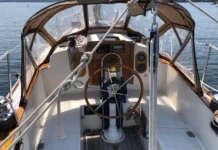
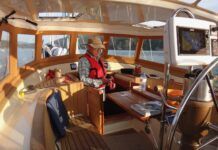
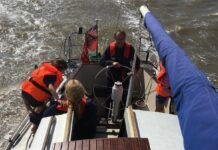
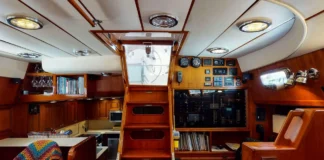
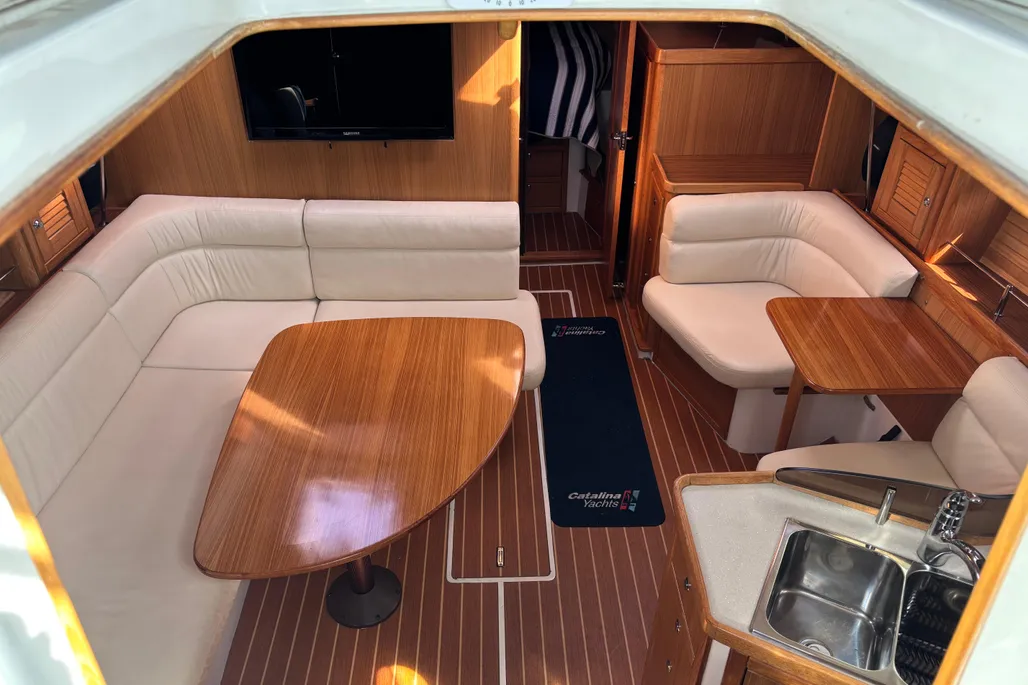
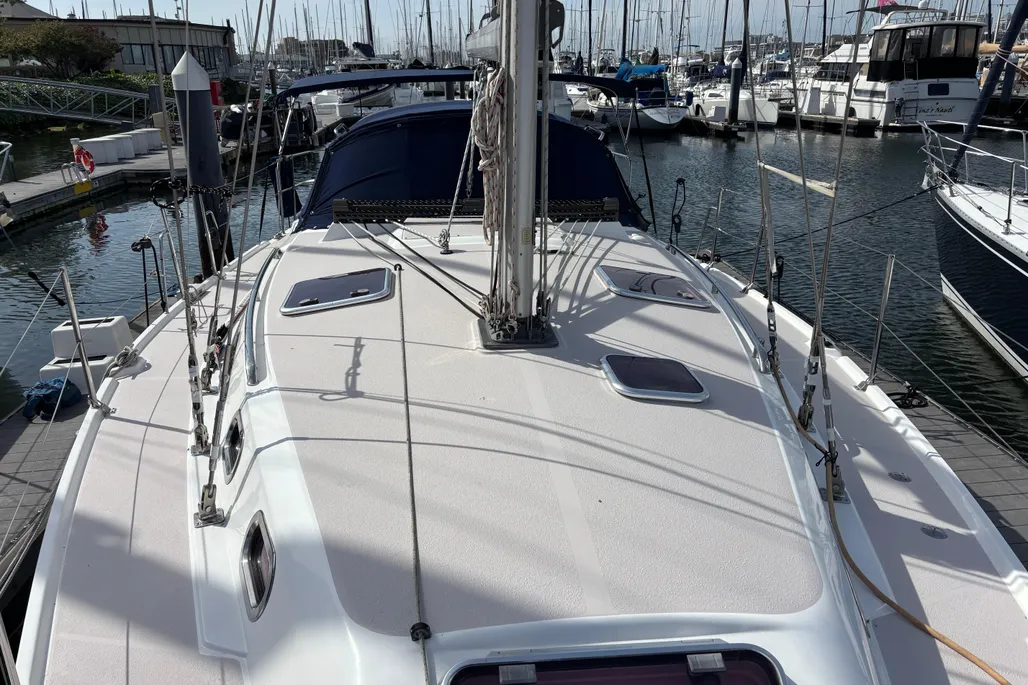
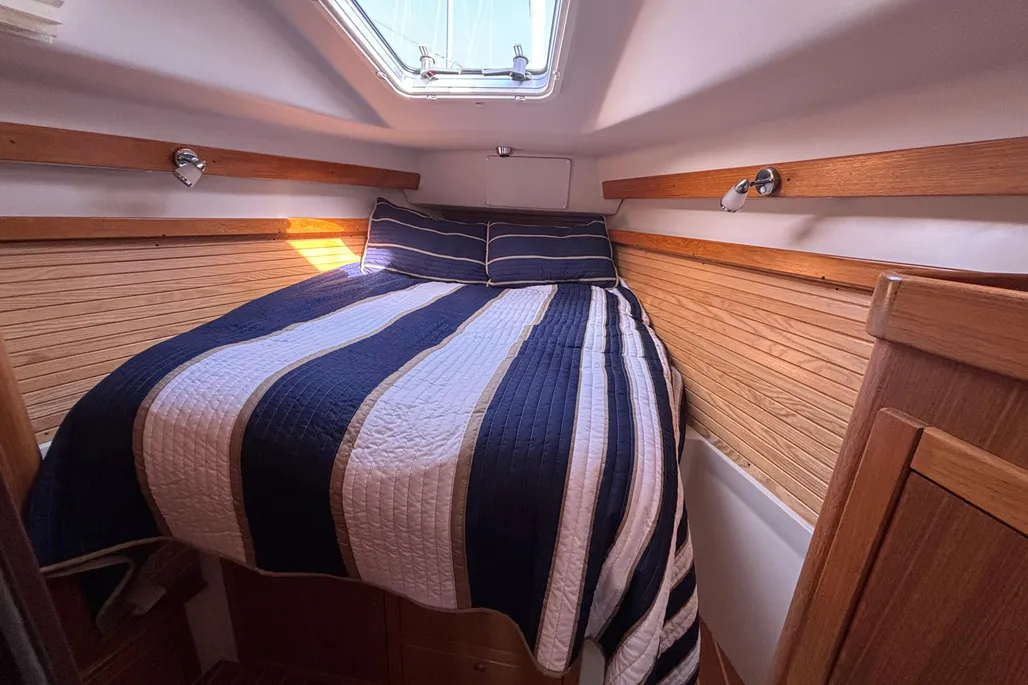
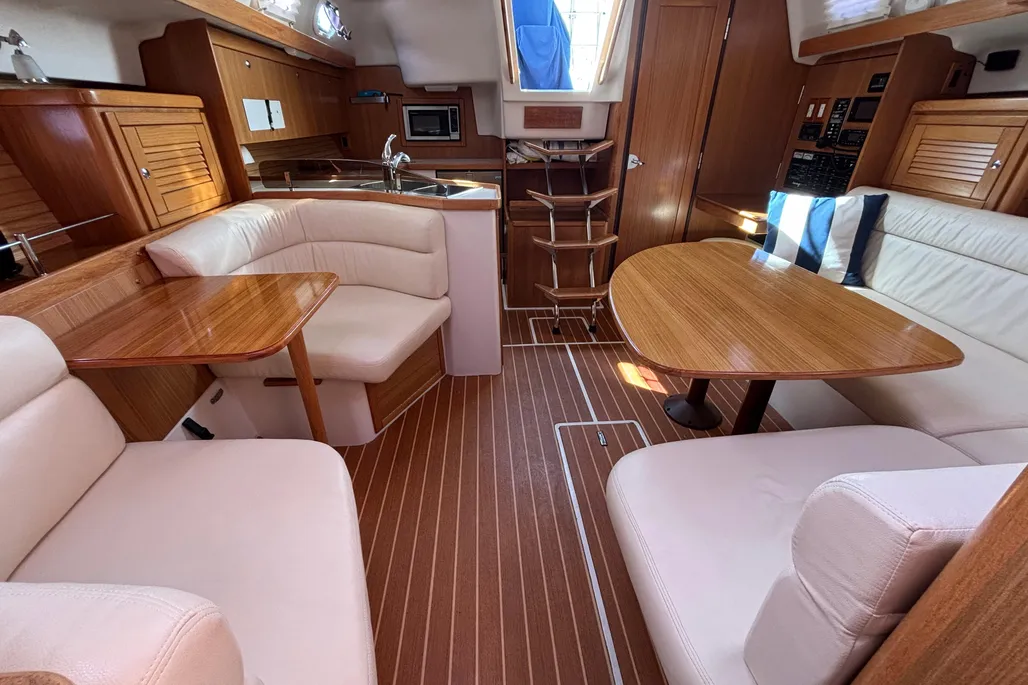
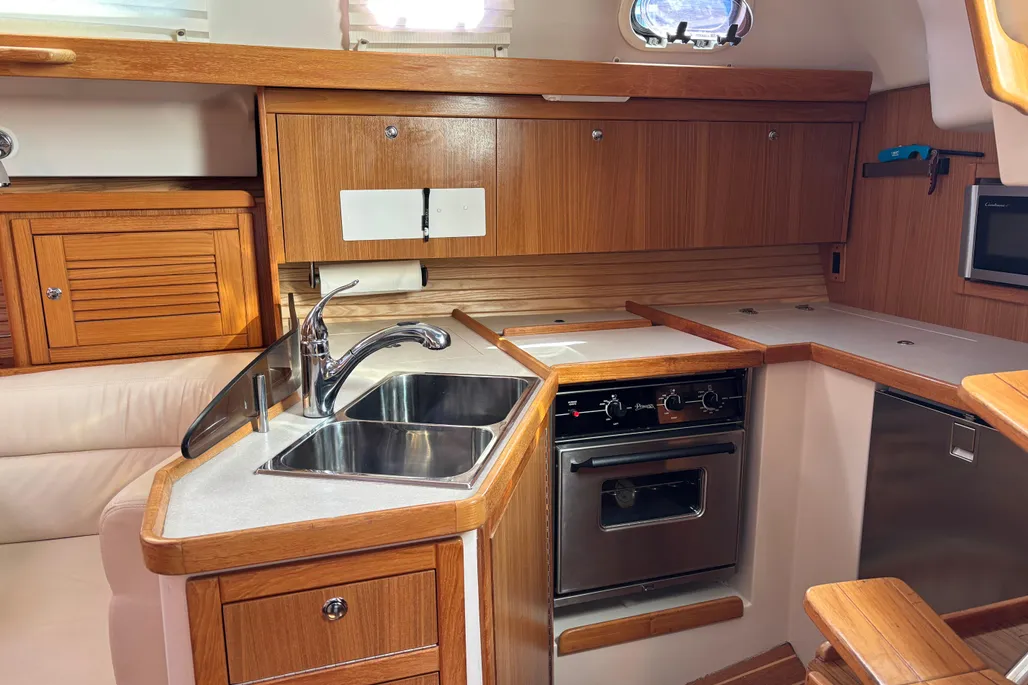
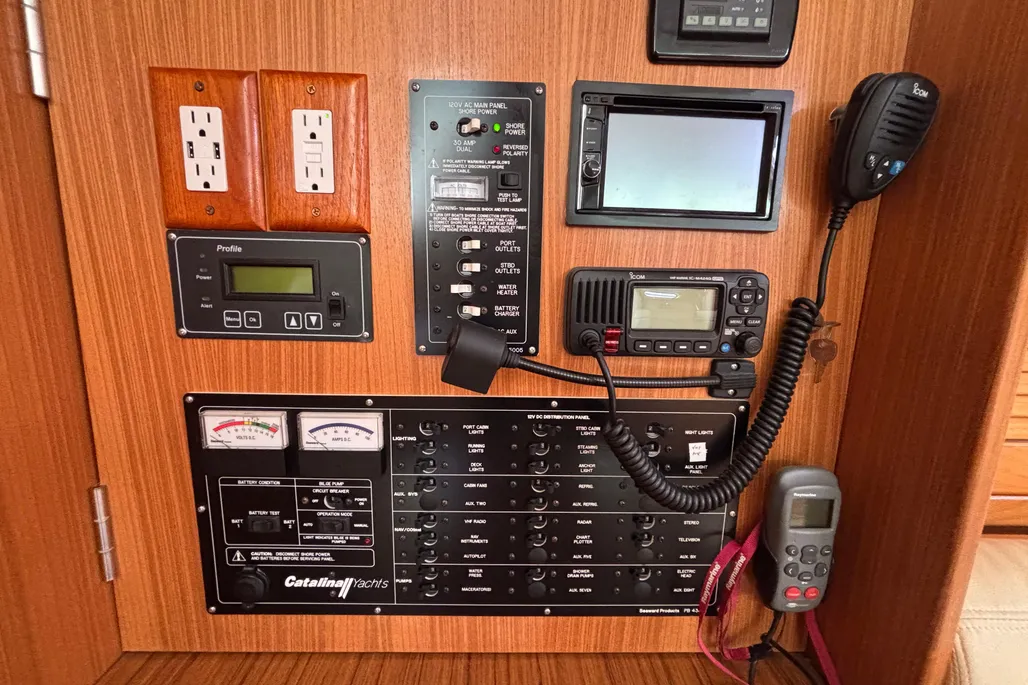
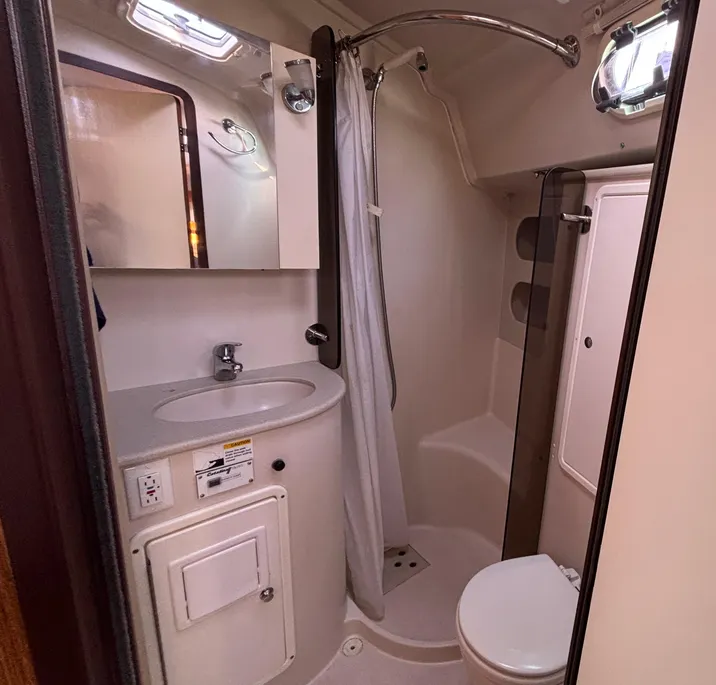
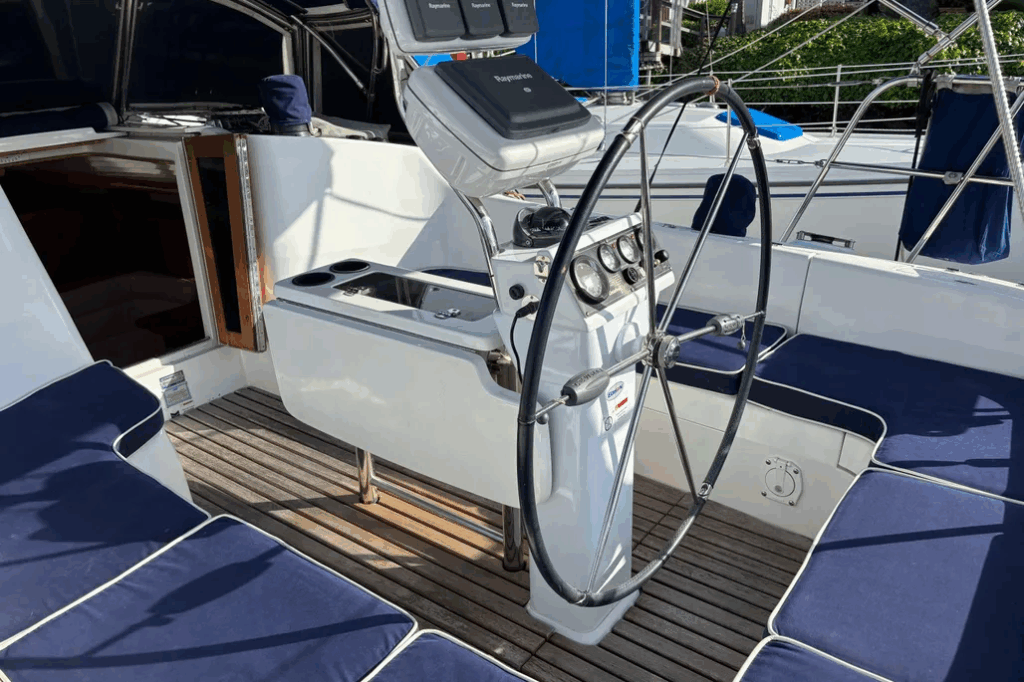
As a family cruiser, the Catalina 375 tries to strike a balance between its dual missions of providing safety and efficient sailhandling at sea, and providing comfort and convenience at the dock, at anchor, and underway. An obvious example of the challenges of this undertaking is the roomy cockpit, where a fixed centerline table with drop-down leaves takes up a large chunk of real estate. Coastal cruisers will find the convenience of the tables two cup holders and center-bin storage worth the hassles of having a mid-cockpit obstacle. Wednesday-night racers, on the other hand, may want to make room in their garage for the furniture during race season. Ample cockpit storage allows room for fenders and lines, and there’s even a fixed mount for a small outboard. Storage in huge cockpit lockers leaves room for a generator, watermaker, and air-conditioning unit, although the effect of piling all this weight aft does not come without consequences. Genoa sheets lead to two Harken ST44 winches mounted on the coaming near the helm. A two-speed Harken ST40 and a gang of four Spinlock XTS rope clutches to port of the companionway take care of the halyards, main outhaul, and boom vang. A matching winch and three rope clutches on the starboard side manage the spinnaker halyard, mainsail furling, and mainsheet controls. A convenient double-ended line controlling the Garhauer mainsheet traveller leads to a pair of cam cleats, making it easy for one person to adjust the traveller. Sidedecks are wide and clear, and the 28-inch-high lifelines are a welcome improvement over the 24-inch lifelines on the original Catalina 36. A divided anchor locker meets the needs of coastal cruisers and rail-mounted 10-inch bow cleats avoid chafe while benefiting from the beefed-up solid glass at the hull-to-deck joint. A 12-volt Maxwell 1000 vertical windlass manages anchor duties. For most coastal cruisers, this unit will provide adequate service, but it would not be our first choice for long-term cruising. Unfortunately, since the vertical windlass is integral to the locker design, installing a more robust horizontal unit is not a simple upgrade. The deck-stepped mast is supported by twin backstays and inboard shrouds, allowing tight sheeting angles. Seldén Mast’s in-mast furling is standard. In PS’s view, a conventional mainsail with slab reefing offers a more practical and efficient way to deal with a wide range of wind conditions on a voyaging boat. Of the 56 owners of Catalina 36s who responded to PS questionnaires sent out in 1985, 1989, and 1998, the majority rated the boats interior as “Good” or better. But interior details were also a source of many of the complaints. Leaky ports and chainplates, poor ventilation, and “cheap” furniture were among the most common gripes. Catalina appears to have answered many of these concerns with improvements in the 375. Ports and chainplates are well sealed, headroom has been increased, quality of joinery has been stepped up, ventilation has been improved (with eight ports and five opening hatches), and the cabin has a new layout. The combined result is more spaciousness, particularly in the main saloon. This roominess quickly loses its appeal at sea, when you are searching for something solid to brace against, but Catalina has made an effort to place grabrails where they are convenient. Varnished teak presents a warm interior that isn’t dark. With solid wood doors and corners, the joinery will stand up to abuse. Door frames are a powder-coated aluminum, ensuring a satisfying fit. The cabin sole is a synthetic faux teak-and-holly material called Lonseal. Wood lovers might turn up their noses, but this PVC product isn’t a bad facsimile, resists stains, and has good non-skid properties. Catalina’s answer to the often conflicting roles of the main saloon (passageway, storage space, dining area, entertainment room, etc.) is to use convertible furniture and offer an optional main saloon layout. The standard layout features a portside settee with a table that folds down from the main bulkhead. Seating can be added by installing a bench seat, which stows-inconveniently-in the aft cabin when not in use. The second layout features an L-shaped dinette, with a triangular table that seats fewer people. Former Catalina 36 owners will notice that the galley has been shifted to the starboard side. While some argue that the traditional portside galley is more desirable when crossing oceans, the point is moot for a family coastal cruiser. Our tester liked the galley’s twin sinks located well inboard for self draining, but noted that putting a front-opening fridge right next to the engine compartment flouted the laws of thermodynamics. The optional top-opening fridge/freezer is less prone to the caprices of convection. Good galley ventilation, through opening ports, is much improved over that on the C36. Engine access is adequate through removable stairs at the base of the companionway and access panels in the aft cabin. Opposite the galley is a compact, outboard-facing nav station with a well-organized AC-DC control panel and system monitors. The chart table is too narrow in our view (as are most today), and the limited vertical space may require some creativity to fit a full suite of cruising electronics, but is adequate for coastal hops. If the door to the aft cabin is open, it blocks access to the nav station. The head, with separate shower, is accessible through not one, but two doors; one from the forward cabin and the other from the main saloon. (Following the logic of this trend to its extreme, one wonders if a companionway entrance to the head is in the works.) In the forward cabin, the traditional V-berth with a filler cushion found on the 36 has been replaced with a wider centerline berth. The aft cabin, entered through a door on the portside of the companionway, makes more sense than the expansive bunk found on the C36. One complaint among owners of the C36 was the aft cabins lack of ventilation and low headroom. Although headroom is still low beneath the cockpit of the 375, opening ports improve ventilation, and there is a small hanging locker for clothes. Our last interior comment is held for the starboard side “game table” and facing upholstered chairs that date back to the original C36 and the heydays of backgammon. Today, the table offers a convenient place for laptop computers, but PS laments the loss of another full-length sea berth. We sailed the 375 with a shoal keel in winds that ranged from 8 to 15 knots, with occasionally higher gusts. Combining a shallow-draft fin keel with a beamy hull presents several challenges for a designer. Some concerns that were discussed in our article on modern sailboat design are the effect that the shape of the immersed hull and the lead (the fore-and-aft distance between the center of effort and the center of lateral resistance) can have on helm balance when the boat is heeled. That article also points out how shallow rudders can lose effectiveness when the boat is heeled. According to Douglas, the boat was given plenty of working sail so that it would be fun to sail in light air, without raising the spinnaker. Equipped with a 140-percent genoa, our boat was clearly at home in the lighter wind ranges. In 10 to 12 knots of wind, we were able to reach along nicely at 6 knots, and the boat was particularly sure-footed on a beam reach. It is worth noting that, unlike Hunter’s B&R Rig, Catalina’s cruising boats do not have swept-back spreaders, allowing sailors to ease the main more without worrying about sail chafe. However, when beating to windward in gusty 12- to 15-knot winds under full sail, the boat rounded in the puffs and weather helm was persistent. Reducing sail eased the weather helm, but the resulting sail shape was less than ideal. Achieving a lightly balanced helm in these gusty-and somewhat challenging-conditions required attention. This article was first published on 16 September 2010 and has been updated. 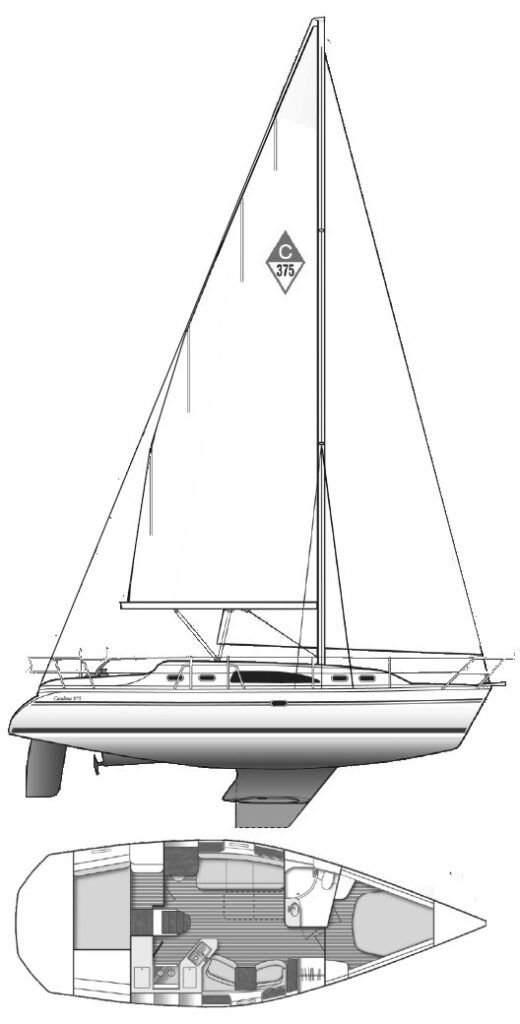
Sailboat Specifications Courtesy of Sailboatdata.com
Hull Type: Fin w/spade rudder
Rigging Type: Fractional Sloop
LOA: 38.50 ft / 11.73 m
LWL: 34.42 ft / 10.49 m
S.A. (reported): 646.00 ft² / 60.02 m²
Beam: 13.00 ft / 3.96 m
Displacement: 15,500.00 lb / 7,031 kg
Ballast: 5,200.00 lb / 2,359 kg
Max Draft: 6.83 ft / 2.08 m
Construction: FG
Ballast Type: Lead
First Built: 2008
Builder: Catalina Yachts
Designer: Gerry Douglas
Make: Yanmar
Type: Diesel
HP: 40
Fuel: 40 gals / 151 L
Water: 97 gals / 367 L
S.A. / Displ.: 16.69
Bal. / Displ.: 33.55
Disp: / Len: 169.69
Comfort Ratio: 22.07
Capsize Screening Formula: 2.09
S#: 3.05
Hull Speed: 7.86 kn
Pounds/Inch Immersion: 1,598.82 pounds/inch
I: 47.58 ft / 14.50 m
J: 14.75 ft / 4.50 m
P: 43.50 ft / 13.26 m
E: 13.58 ft / 4.14 m
S.A. Fore: 350.90 ft² / 32.60 m²
S.A. Main: 295.37 ft² / 27.44 m²
S.A. Total (100% Fore + Main Triangles): 646.27 ft² / 60.04 m²
S.A./Displ. (calc.): 16.69
Est. Forestay Length: 49.81 ft / 15.18 m
Mast Height from DWL: 54.00 ft / 16.46 m
Deck Details
Cockpit
Sidedecks and Foredeck
Mast
Interior
Galley
Nav Station
Head
Aft Cabin
Game Table
Performance
Market Scan Contact
2009 Catalina 375 Atomic Tuna Yachts
$149,000 USD 888-833-8862
Alameda, California Yacht World
2012 Catalina 375 Edwards Yacht Sales
$189,900 USD 866-365-0706
Punta Gorda, Florida Yacht World
2011 Catalina 375 Sail Annapolis Inc.
$169,000 USD 410-280-8878
Solomons, Maryland Yacht World
Conclusion