

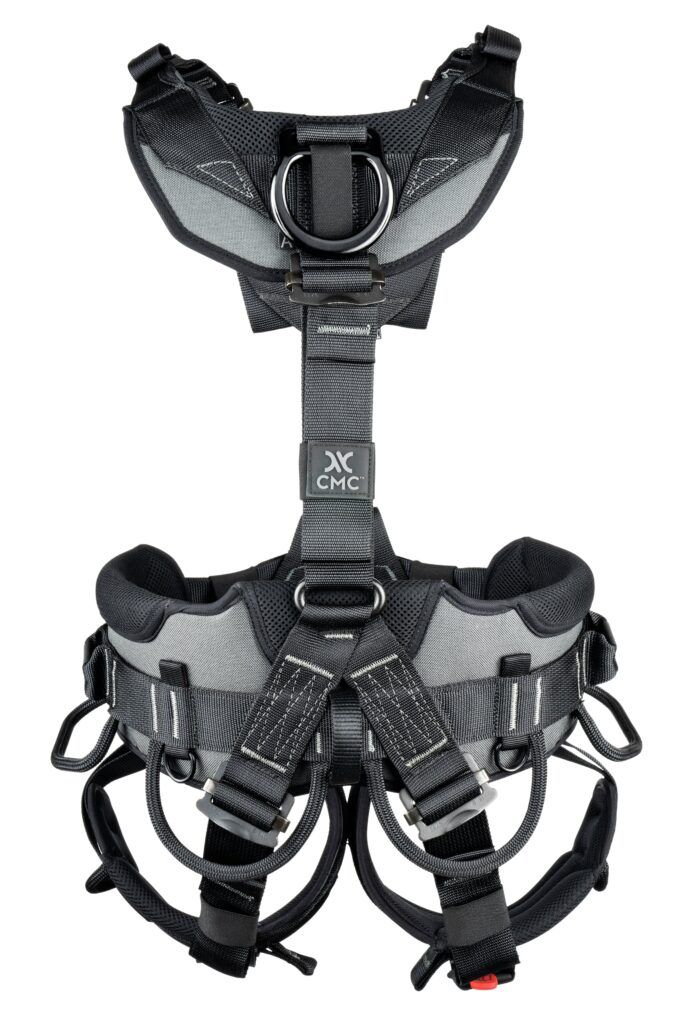
I’ve long thought there must be a safer, more comfortable way to go up our mast than a Bosun’s Chair. When I criticized our use of this ancient design concept, my fellow sailors and racers would give me that all too familiar judging smirk, followed by something like: “We all have to do it; just get up there.”
It was time to put my money (and effort) where my mouth was and find a better solution. What do professionals use in other industries when they have to be working, safely, suspended up high? Surely the energy sector and wind power have some solutions that even insurance companies would sign off on?
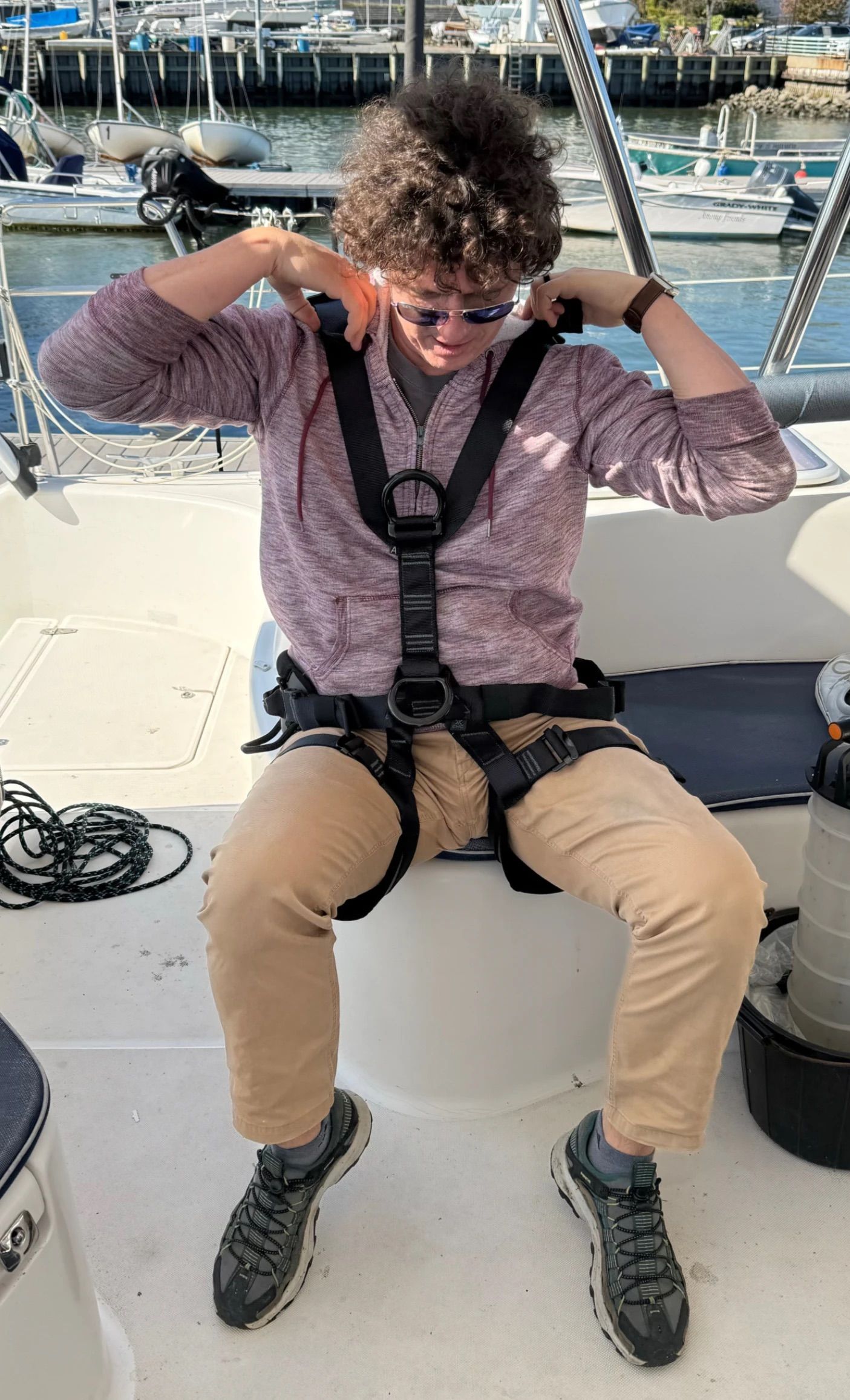
After a good amount of research on options, I picked up the CMC ATOM Global Harness. Being the brave soul that I am, I gave it straight to our crewmate, Oliver, to test it out.
We’re now fully converted. It’s safer, more comfortable, and—once you’ve felt the difference—it’s hard to understand why bosun’s chairs are still the default. Let’s see why I think everyone should switch.
Bosun’s Chairs: A Tradition We Don’t Usually Question
Whether you call it a bosun’s chair, boatswain’s chair, or go awol with boson/bosin/boat’sman chair, these things always looked more to me like they belonged on a children’s swing set than a safety device to send me up the mast.
See any resemblance between this: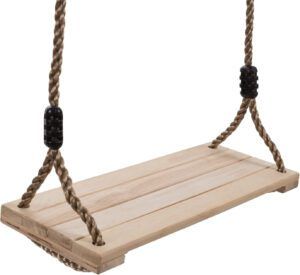
And this?
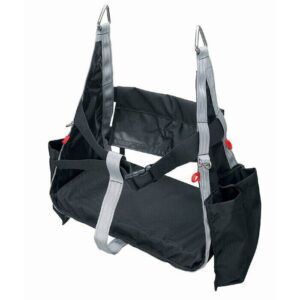
Or this: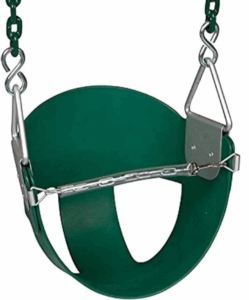
And this?
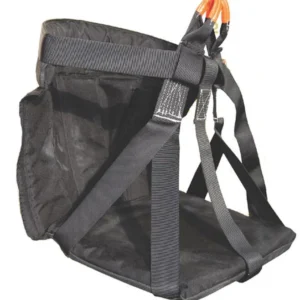
Oliver—our longtime crewmate and go-to mast guy—has always been the one we hoist when something needs troubleshooting up top. I’ve never loved heights, and he never minded doing the climbs.
Was it the actual bosun’s chair that I hated? Oliver always seemed fine with it, but should he be? Comfortable? Not really. Safe? Safe enough, I suppose. I figured that there must be something out there that’s a little more…modern.
After some digging, I stumbled on professional “rope access” gear, built for people who spend long hours suspended by ropes while working at height. I looked at options from Petzl and CMC, and ultimately chose the CMC ATOM Global Harness, mostly based on the reviews on comfort.
The CMC Atom Global Harness
Trying the ATOM: Trepidation Turns to Revelation
Yep, we flew the main halyard up the mast. The eight knot at the end had come loose, and I had just added some McLube OneDrop—a favorite of mine—to the mast cars, and whoosh the halyard flies right up through the mast.
As soon as we found a reason to go up the mast, I pulled the new harness out of the stern locker and dropped it in Oliver’s lap. From the look on his face, he wasn’t exactly thrilled.
He’s used to the bosun’s chair. He’s gone up dozens of times—probably a half dozen on Confianza already.
Some convincing was required that it’s professional equipment and has many fancy certifications, and he strapped in.
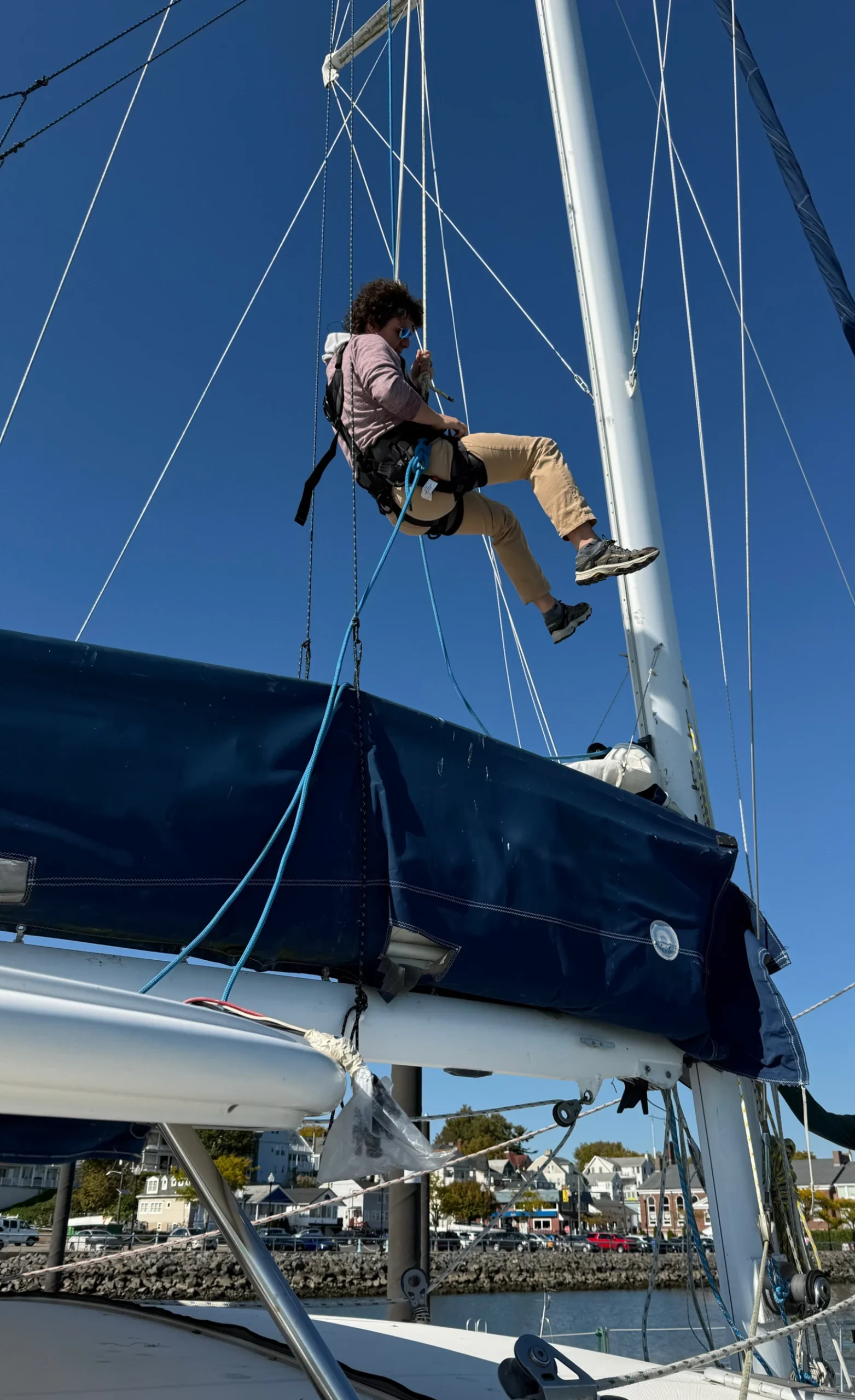
And up he went!
After we brought him down, he sang a much different tune.
“That felt completely different. Like… I felt secure the whole time. Not just held up but in. It’s not even close to a bosun’s chair.”
He described how he could’ve stayed up there much longer with a couple tweaks on the leg straps.
It’s a lot easier to get work done aloft when you’re comfortably strapped in and secure.
Even Harken Admits that You Need a Real Harness
Pulled right from the user manual for the Harken Deluxe Bosun’s Chair: “This chair is designed to be used as a work positioning platform to ensure comfortable seating while suspended. It must be used in conjunction with a separate full-body, fall-arrest harness.” (Italics added by me for emphasis).
Unlike a bosun’s chair, these rope access harnesses come with actual certifications for safety and comfort. The CMC ATOM, for instance:
- CE
- EN 361:2002 – Certifies the harness is built to safely catch and hold your entire body in a fall.
- EN 358:2018 – Confirms the harness supports secure work positioning.
- EN 813:2008 – Ensures comfort and support in a seated position.
- NFPA Class III – Validates that the harness is rated for rescue-level loads.
- ANSI Z359.11 – Meets U.S. fall protection standards for professional use.
- CSA Z259.10 – Adds Canadian certification for fall arrest systems, reinforcing that the harness performs under multiple national safety codes.
The Right Tool for the Job
Practical Sailor has broached this topic on a number of occasions (see: Practical Sailor Tests Bosun Chairs and Harnesses). This is the quote that struck me when reviewing this iteration: “None of the mast-climbing devices in our test could be considered “comfortable” in the easy-chair sense of the word. Working aloft typically involves some awkward positions, and in all of these chairs, we were using our abdominal muscles (or what’s left of them) to carry out tasks aloft.”
In our own experience with the ATOM, comfort and security made it a completely different experience. You can just get more done up there, and more quickly. I think it can be boiled down to:
Supported Sitting Position
The straps, padding, and adjustment angles around the thighs and waist keep you in a comfortable, seated position without balancing yourself. Weight was distributed better. You can shift around, grab tools, comfortably use both hands on a task, etc.
We Stopped Thinking About Falling
I’ve never been in a bosun’s chair and felt secure, which is why I shy away from going up the mast unless I absolutely have to. Bosun’s chairs always give me that sense that you have to keep yourself in it. In the ATOM, your whole body is secured—back, legs, waist, chest. There’s nowhere to tip or slip.
Our brave test pilot, Ollie, is also on a J105 racing team. After race day, they coincidentally also flew a halyard up the mast. Ollie asked to borrow my CMC harness and sent the captain up. His team was quickly converted.
How Much More Does it Cost?
Here’s a quick comparison at the offerings from Defender and West Marine (at the time of writing):
- Traditional Marine Bosun’s Chairs
- West Marine’s Premium Bosun’s Chair – $169.99 (westmarine.com) Harken Ballistic
- Nylon Deluxe Bosun Chair – $222.99 (defender.com)
- Professional Rope Access Harnesses
- CMC Atom Global Harness – $471.99 (firesafetyusa.com)
- Petzl Avao Bod $499.95 (pksafety.com)
Having professional gear that’s actually meant for the job does come in at more than twice the price.
One of the rules that we have on Connie is, “The less risky options always wins.” That means we also try to not to budget shop for safety gear whenever possible.
And it’s not just the safety factor. It’s the right tool for the job. It makes it easier and faster to get work done up there.
Can you do it for half the cost (or cheaper)? Most definitely.
Wrapping Up
Why are most of us still using a piece of kit for a dangerous job when there are much better options? Tradition?
In the middle of editing this article, by chance, I had SV Delos Episode 419 on in the background while taking apart my autopilot. In the episode, one of the crew, Hannah, goes up the mast while underway in a traditional bosun’s chair, and she yells down:
“It’s so sketchy!”
I submit that it doesn’t have to be—with the right gear.







Good article. A rock climbing harness is way less expensive and made for the same purpose.
Although, the two harnesses reviewed certainly look like they provide great support.
Cheers!
Thanks for the comment David. I might disagree, by only to a degree. The rope access harness is much…beefier? and optimized for comfort and secure feeling for working on jobs while suspended. The rock climbing harness is more optimized for agility. I’m talking in generalities, so I’m sure there are exceptions.
I think the extra cost is warranted. However, going up the mast is definitely not my favorite job. It’s something that I’m willing to splurge on for comfort and safety.
I’d like to see a comparison between this and the similarly-priced harness sold by Brion Toss Yacht Riggers.
The Brion Toss Yacht Riggers harness sure looks like a quality harness. Hopefully one day, I’ll be able to test them side by side.
My thought process was/is—with a professional rope access harness, you’re getting the testing and certification to standards plus thousands and thousands of hours of real world use in a professional industry.
I’m going to see if I can find a BTYR harness in the wild, though!
As an ex-caver I was around when much of the techniques for professional rope access work was being developed. I a lot of cases by the caving community. I would suggest looking at this gear and technique if you are interested in upgrading mast climbing safety and comfort.
As an aside one thing that always concerns me is that many people go up the mast on one of the normally rigged halyards that has been up on the mast and in the elements sometimes for years!! The first step is safely climbing the mast is to keep a low stretch line to hoist people on and climbing rope as a safety line that are only used for that. Have a means where these can be easily sent up either on a separate pulley or replacing an existing halyard.
The main reason climbers can use waist harnesses and industry requires full-body harnesses, is that climbers are fit and have a waist. They are also trained to fit the harness such that it can NOT be pushed over the hips in an inverted fall. There is zero risk of falling our of a Properly Fitted rock climbing harness; thousands of climbers take crazy falls every day. OSHA regulation has to allow for overweight no-waist workers and spotty training. The upper part does add some comfort, but not nearly so much as the increased leg padding typical of tower harnesses. They are very good for the purpose.
If you have a climbing harness (UIAA certified) and you have a waist, then you can improve hang-time comfort with two simple steps.
* Add leg padding. Although I have a tower harness, my favorite, most comfortable harness is a rock climbing harness with foam tiles taped inside the leg loops. It is very light and flexible, and I can be up there for an hour without my legs going to sleep. The padding is not structural, so while duct tape looks dodgy, it is not a safety issue. In fact, Brian Toss’s rigger’s harness is a waist harness with added leg loops padding much like this ($399).
* Add some sort of foot support. This can be steps near the top, a MastMate ladder or similar, or a sling that clips to the harness belay loop and is long enough to stand on. You should always have a few carabiners and sling on the harness for securing yourself against swinging, for bracing, and contingencies. No climber leaves the ground without them. Getting weight on your feet also adds stability and leverage.
Very good points, and thanks for sharing your expertise!
It’s great to have safe/comfortable options for folks to see what works best from them. Just, not a bosun’s chair…
I admittedly don’t love going up the mast, so I find the whole secure body feeling of the rope access harness as a big benefit. For an experienced climber, you’ve probably got a lot more options!
I use my climber’s sit harness for decades. I have a fishing vest for pockets.
I also use a climbers chest harness when clipped in on deck at night or during rough weather.
But I am from “old school” Montana. We rarely had any fall protection in my 30 plus years of timber framing, mostly residential. My partner fell 18 feet and trashed his heel. He was lucky.