



Will Your Tanks Be Clean Next Spring?
When contributor Drew Frye commissioned his familys PDQ 32 catamaran six years ago, his daughter asked, What are these pink lumps in the sink, Dad? The toilet bowl was even more spectacular, a science project in a dozen hues of pink, green, yellow, and black. The boat had been winterized for some time, down in south Chesapeake Bay, where winters are mild and many boaters and don't take freezing seriously.

Repairing Worn Gelcoat
Regarding your blog post on restoring gelcoat (posted online March 18, 2014): Ive seen many similar articles over the years directed toward refinishing topsides. However, Ive seen no discussion about restoring decks. I have an 18-year-old boat, and Im beginning to see pinholes in the deck gelcoat, particularly on edges and curves where I suspect the gelcoat is thinner. Im curious what the experts would recommend.
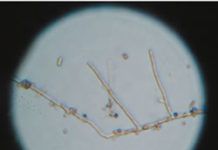
Testers Check Growth in the Lab and on the Boat
When testing a chemicals toxicity and its ability to biodegrade, a common procedure is to dilute each target chemical at various ratios of interest, and then to inoculate each with an acclimated microbiological seed. For our test, the seed was developed by filling a five-gallon bucket with several gallons of water and a weak mixture (two percent total glycol content) of all of the winterizing agents to be tested.
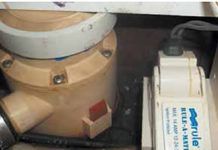
Backup Bilge Pumps
If I ever discover seawater sloshing around my cabin floor, I cannot be sidetracked by the need to operate a manual bilge pump; I need to be free to search for the leak and correct it. A reliable, high-capacity, electric bilge pump, reserved just for emergencies, is a necessity. On board our boat, Brick House, a Valiant 40, we mounted the backup pump in the extreme forward bilge area, which never gets wet in normal conditions but would certainly be flooded about the time the floorboards started to float. In fact, a manual bilge pump was once located there.

Bottom Paint Checkup 2014
Bottom paint? Again? Frankly, sometimes we feel that way, too. According to company lore, more than a few former Practical Sailor editors ran screaming for the exits after phrases like ablative copolymer and Irgarol began creeping into their dreams. As much as some like to poke fun at our bottom paint obsession, antifouling is a topic that deserves attention. Choosing the wrong paint can set a boat owner back $1,000 or more, but more importantly, antifouling is a fast-moving topic; paints available last spring are suddenly gone, renamed, or reformulated. This is particularly true for the newer eco-friendly paints.
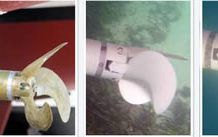
Prop Paints Show Familiar Signs of Failure
Weve experimented with several different prop paints with varying degrees of success, although none of the results so far have been dazzling. Some of our testers have had better success with dedicated slick prop paints such as PropSpeed. In our testing, however, mostly in Chesapeake Bay, no prop paint had lived up to our increasingly faint hope that the paint repel growth as effectively as our hull paint.

The Ins and Outs of Choosing a Bottom Paint
When choosing a bottom paint, make sure it is compatible with your existing paint, or be prepared for whatever extra prep work might be required. Usually, all that is required is some light sanding and possibly, a primer coat, although in some cases, more aggressive sanding and surface prep is required.
Coolants that Fight Corrosion
Salt and water conspire to reduce our boats, our pride and joys, to pitted and unreliable money pits. Weve investigated corrosion of wiring (see PS July 2010 online), gasoline (see PS August 2012 online), diesel (see PS August 2013 online), and winterizing fluids (see PS September 2014 online), uncovering additives and practices that dramatically reduce deterioration and increase reliability. Engine cooling systems have similar vulnerabilities, and fortunately for us, the automotive engine manufacturers have invested millions in finding those solutions. However, the marketing materials don't always make the differences clear, and its hard to know which product is the best for your engine.

ASTM D1384 Serves as Model for Testers
Samples were tested for corrosion protection following the ASTM D1384 Corrosion in Glassware method (www.astm.org). Samples were diluted to 33-percent glycol, dosed with ASTM synthetic corrosive water (similar to 2-percent seawater), continuously aerated, and heated to 190 degrees for two weeks. As a laboratory control, a reference coolant (ASTM D 3585) was also exposed to provide a baseline.

Propane Leak Action Plan
While docked at a municipal marina last year, I detected a strong propane odor. I immediately informed the harbormaster, and we agreed that calling the local fire department would be prudent. The fire department arrived in short order, went below, and confirmed the propane odor. Their only suggestion was to open all the hatches and ports to air out the boat and wait.

O’Day 40 – A Budget Cruiser for the Bahamas
The O’Day 40 (1986) is one of those cruising sailboats that somehow slipped through the cracks of sailing history. Built during the final years...



Latest Sailboat Review
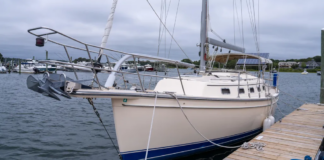
Island Packet Estero Used Boat Review
Florida-based Island Packet targets a relatively narrow niche, so the toughest competitors to its new boats are often older Island Packets. Introduced in 2010, the 36-foot, shoal-draft Estero is the company’s latest attempt to introduce a distinctive model that doesn’t stray too far from the company’s proven formula for success: moderate displacement, full-keel cruisers designed to be lived on, sailed far and in comfort, and endure the bumps, scrapes, and storms that cruising boats inevitably encounter. After sailing the Estero on Florida’s Sarasota Bay and inspecting its interior, construction, and systems, Practical Sailor testers noted that the shoal-water cruiser will appeal strongest to Island Packet fans who’ve been waiting for a shoal-draft, easy-to-sail boat that compares to the IP37 in terms of interior space. These strengths will be most apparent on intracoastal or riverine adventures like the Great Loop.