



The Complete Propane Appliance System
Of course, everything on a boat is a compromise, and so it is with propane. It has two nasty traits that must be dealt with: Propane is heavier than air, which allows the gas to collect in the bilge in the event of a leak; and propane is explosive when it collects in such places.
Boat Clinic: Minor Repair to Cored Decks
A fairly common ailment with cored decks is the presence of soft spots where the outer skin has delaminated from the core material. Typically these areas are found around the mast and on the foredeck where heavy-footed spinnaker handlers have trod, but they are candidates to occur anywhere in a relatively large, flat span of unsupported deck.

A Permanent Mount for the Sensibulb LED Reading Light
I have always been a big fan of brass berth lights, but have never really liked the halogen bulbs commonly used in them. The little halogen bulbs run hot, use a lot of power, and are prone to vibrating loose. When Sailor's Solutions (www.sailorsolutions.com) introduced the Sensibulb, I quickly ordered a couple to test in our custom built boat Suzy. They worked so well that I converted all six of our berth lights. The original Sensibulbs were nice units, but the mounting system was iffy. I elected to bypass the mounting system by removing the ceramic bulb holder and directly gluing the bulb support post to the back of the Sensibulb.

Chasing Deck Leaks – Painting Non-Skid Decks
The problem with any type of headliner is that it can disguise the origin of leaks. Water may travel many feet behind the headliner before it finds an exit point. If removing the headliner is impractical, you’ll have to begin your detective work from the outside. Any place the deck is pierced by a mounting bolt, hatch, window, mast opening, electrical outlet, or the like, is a potential source of leaks. Assume that if the deck leaks with the boat at rest, the source of the leak will be uphill from the place water appears on the inside of the boat.
Any Boat They Can Build, You Can Make Better
When the 28’ Pearson Triton appeared on the market in 1959, a revolution began in the boatbuilding industry. Fiberglass made economical mass production of boats a reality , and helped make sailing - and boat-owning - an activity for everyman. And Everywoman.For sailors who have never known boats built of anything but fiberglass, the changes in boatbuilding that can be attributed to the prosaic laminate of glass fibers and polyester resin are hard to imagine.
How to Restore Teak Wood on Boats
Probably nothing can make or break the appearance of a fiberglass boat more quickly than the appearance of the exterior teak trim. Contrary to popular belief, teak is not a maintenance-free wood that can be safely ignored and neglected for years at a time. Though teak may not rot, it can check, warp, and look depressingly drab if not properly cared for.

Hard-to-Find Mercedes Parts – Knotmeter Fouling
Given the number of Mercedes diesels you see on the highway, its amazingly difficult to find parts for the marinized versions of these engines. Part of the difficulty is the origin of the marine versions of the various Mercedes engines. Mercedes, like several other engine manufacturers, doesn't make marine diesels. They do, however, license other companies to do marine conversions using their engine blocks.

Keels: Minor Maintenance and Repair
The best way to treat an iron keel that’s rusting is to sandblast the whole thing and apply a complete, new, epoxy-based coating system. But that’s not always feasible or desirable. Because of the mess involved, many boat yards do not allow sandblasting. Even when this is permissable, a complete recoating job also means a complete re-fairing job, and that in turn means lots and lots and lots of slow, boring, dirty work if anything approaching a proper, smooth foil is to be achieved.

Two Ways to Build a Teak Cockpit Grating
A snug-fitting teak grating adds safety and a touch of class to the cockpit of any boat. Spray or rain runs under the grating to the cockpit drains, leaving a reasonably dry footing for hopping about the cockpit as you haul in sheets to tack or trim sails. Unfortunately, you can't buy a grating off the shelf to fit your boat, and having a grating custom-built can be a costly and nerve-wracking experience. The solution to both of these problems: build your own grating. Its a fun job that can keep you busy for a few winter evenings, and you can build it for less than one-third the cost of a custom-built job.
Battery Care Pays Off
Among the more neglected pieces of gear aboard most boats are the primary storage batteries, which faithfully crank the engine and light the lights. In the case of the typical lead-acid battery, even benign neglect is tantamount to abuse. It’s small wonder that many battery manufacturers refuse to recognize the warranty on batteries used aboard boats. The normal marine battery cycling - relatively high discharge rates with no charging, followed by rapid charging at a high rate by high-output alternators - is murder on conventional automotive batteries, and not exactly a piece of cake even for deep cycle batteries, constructed to absorb this type of abuse.

O’Day 40 – A Budget Cruiser for the Bahamas
The O’Day 40 (1986) is one of those cruising sailboats that somehow slipped through the cracks of sailing history. Built during the final years...



Latest Sailboat Review
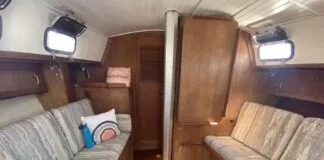
Caliber 33 Used Boat Review
The Caliber is a peculiar blend of tradition and innovation, of security and performance, of practicality and pizzazz. All of the owners we heard from were "satisfied." One called the 33 his favorite boat over six decades of sailing.