


Mailport: January 2010
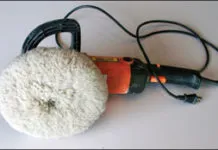
The January 2010 issue of Practical Sailor features letters on such subjects as: orbital polishers, seasickness, MOB technology and heads.
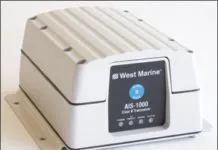
PS Advisor: Can AIS Serve as Backup GPS?
In your testing of the West Marine AIS1000 (September 2009), did you identify what NMEA sentences it outputs? I’m thinking of buying one and agree that their documentation is not adequate. I’m trying to determine whether it can be used as a general-purpose, backup GPS receiver.

Mailport: 12/09
I have a Pearson Ensign 1962 now at a slip in New Rochelle, N.Y. This season marked the first time we had the luxury of keeping our boat at a slip. In order to maneuver through the marinas byways without worrying, I bought a 24-volt Minn Kota outboard (80 pounds of thrust) and two 12-volt batteries, which I hook up in series. Not only am I able to stop start, turn, etc., in the marina, but-to my surprise-in the calm sound water, I can nip along at about 3-4 mph with myself, two crew, and the 3,000-pound boat. The result is that Ive only used my 5-horsepower Mercury outboard once this year. My electric outboard doesn't stall; it has variable speed like no ones business; reverses with relative ease, and is less expensive-though more cluttered-than the self-contained electric outboards you recently reviewed. Am I part of a growing trend or just weird? If the former then it might be worthwhile testing electric outboards for boats my size (22.5 feet) and commenting on their applicability.

Mailport: 11/09
To keep from being pulled under in a collision between a tanker and my sailboat, I "pulled the ripcord" to release the snap shackle on my Standard West Marine Safety Tether . The tether release lanyard was outfitted with a series of balls. (See bottom photo at right.) I had rehearsed reaching for and feeling the release toggle many times so it would come naturally in an emergency. The balls have a distinct feel. There was nothing on my PFD or foul-weather jacket that resembled them. The replacement tether I bought from West Marine (ISAF Specification Safety Tether, No. 9553504) has a new toggle on the snap-shackle release lanyard that consists of an open triangle of plastic. This is dangerous, in my opinion! In my first few hours of using the new tether, in moderate sea conditions, I managed to snag the triangular loop on something and release the snap shackle. I am now replacing all triangular loop pulls with bead pulls that I have crafted myself.
PS Advisor: Replacing Lifelines
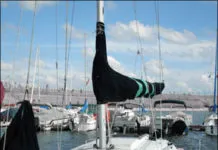
The International Sailing Federation (ISAF) and other regulatory bodies frown upon using PVC-coated 7x7 wire for lifelines. As you noted, this is because lifelines should be easily inspected for corrosion or other signs of possible failure. The corrosion that can take place under the coating is not just a saltwater issue. Air quality and other factors also can lead to corrosion. We suggest uncoated, 1x19 stainless-steel wire with swaged terminals—3/16-inch wire for upper lifeline and 1/8 inch for the lower. Uncoated 1x19 is easy to inspect, and even though the top wire is overkill from a tensile-strength perspective, it will be durable and almost as comfortable to lean against as the coated wire. It’s also more convenient to lash netting to than a smaller-diameter option.

PS Advisor: Safe Mounting for Radar
I am looking at antenna mounting options for my 2.2-kilowatt radar. I like the idea of keeping the antenna out of the foretriangle and its sail and rigging, but am a little concerned about crew exposure by mounting the antenna aft on a pole or lower on the backstay. The manufacturer (Furuno) mentions nothing about exposure hazards in its installation manual. Does a hazard exist in this configuration?
Mailport: 10/09
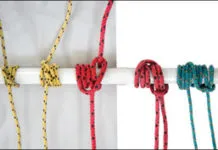
The way I was taught towing Lightnings to LIS regattas, you used a towing hitch around the mast for the line ahead and a similar hitch around the mast for the line to the boat astern. A towing hitch (two wraps around the mast, a wrap around the standing part, back the other way around the mast and two half-hitches around the standing part) could be cast off under tension or even eased under way to place the boat astern on the second wave. Bowlines, we were told, presented a danger of catching a finger in the knot if the towline came under tension while you were catching on or casting off the tow.Recently, a sailing director setting up a tow of Ideal 18s, directed us to tie a bowline with a generous bight around the mast and then to take up the towline from the boat astern and tie a bowline through the bight around the mast. He asserted that this would produce no pressure on the mast at all, as the forward pressure of the tow would be offset by the aft pressure of the boats behind. Can you advise on the best method for securing sailboats in a tow? And what is the optimal distance between boats in a tow?

PS Advisor: The Curse of the Pox
Boat maintenance master Don Casey, on the BoatUS website (www.boatus.com), suggests cleaning the surface using a mild abrasive like Bar Keeper’s Friend (www.barkeepersfriend.com) and fine bronze wool, and then sealing the surface with a wax. Sparmaker Seldén Mast recommends applying Woody Wax (www.woody-wax.com) using bronze wool to seal the surface and remove the pox. Casey cautions against using a polish on aluminum as some are so abrasive they will peel away the anodizing. We’ve had success with Mothers (www.mothers.com) and Prism Polish (www.mppros.com), but we do not recommend using the Mothers with the Powerball on aluminum. Be sure to read the label on any polish before using it; some advise against use on anodized aluminum.

Mailport: 09/09
As a prior owner of a Charley Morgan yacht, I greatly appreciated your article on the Morgan 30. I could relate to the difficulties of that boat, having had to replace a broken centerboard pennant, replace the Palmer M60 with a Yanmar diesel, install a second battery, and live with fairly primitive belowdecks amenities. Yet for all those issues, I loved the boat. The centerboard could be used to move the lateral resistance forward or back, so it was possible to get the boat to balance perfectly and track with barely a finger on the tiller. Ive sailed the Chesapeake Bay for 39 years and have owned a Morgan, Bristol, and Pearson. Of the three, the Morgan was the most fun to sail.

PS Advisor: ‘Weathered’ Teak
Isn’t there an old adage about rousing the rain gods by opening a can of varnish (or paint)? Having lived (and sailed) mostly in sub-tropical climes, we can definitely sympathize with a rain-delayed boat project. The rain actually isn’t doing any harm to the wood or varnish so much as it’s just a nuisance, adding more work and time to the job at hand. After the rain ceases, let the wood dry for several days. The higher the humidity, the longer the dry time. Denatured alcohol or Naphtha can remove surface moisture. Once the wood has dried, you will need to resand any bare wood areas so that you’re coating fresh wood.
How Long Do Sails Last?
How long do sails actually last? Sailmakers often say cruising sails last around 10–15 years, but what happens when you discover a sail that’s...



Latest Sailboat Review

Jeanneau 55 Boat Review
This recent sailboat from Jeanneau may as well be a spaceship. They’ve taken all the time-honored designs of a monohull aft cockpit and turned...