




Mailport: April 2010
Letters to Practical Sailor's April 2010 issue include: MOB drills, tethers, nav lights, cleats, no-buff shines and tankless water heaters.

PS Advisor: Fires at Sea and Raft Stowage
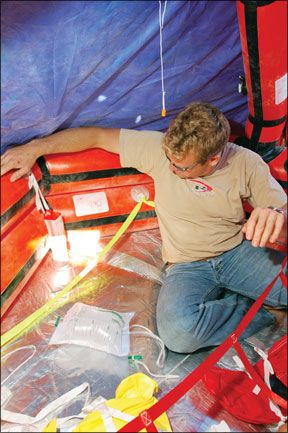
I need to buy a marine offshore life raft, and I’ve been considering stowage spots. I considered a deck-mounted canister. But I’m concerned that my wife would not be able to deploy the raft safely. The canister-packed rafts are typically too heavy for her to lift, and I seriously doubt she’d be able to control one on a wet, heaving deck in heavy weather. I was all set to store the raft in one of our lazarettes, and then it occurred to me that the raft might be particularly vulnerable to an engine-room fire, because the genset and propulsion engine compartments are located underneath the cockpit sole, inboard of the lazarettes. Both engines are diesel, and I have an automatic fire extinguisher. Nonetheless, the fact that a fire would likely start in one of those engine rooms has me rethinking my idea about stowing the raft in the lazarette. Do you have any information on raft fire resistance?
Mailport: March 2010
The March 2010 issue of Practical Sailor features letters from readers on such subjects as: household adhesives, Union 36s, foggy electronics, digital freezer controls and converting a boat from gas to electric.

PS Advisor: Do Alcohol and Antifouling Mix?
Today I went to paint the bottom of my boat with Interlux’s VC-17m, which I have used since it first came on the market. I had always cut/thinned the paint a bit with acetone. Today, the West Marine store manager (who is an experienced boater) told me that Interlux changed the VC-17m formula and that you should thin it with simple rubbing alcohol. When I used the paint with the alcohol, I noticed that it did not dry as quickly as it had with acetone and seemed thicker than usual after mixing the copper powder. Is it correct that you can now use isopropyl (rubbing) alcohol to "thin" VC-17m antifouling?

Mailport: February 2010
The February 2010 issue of Practical Sailor has letters on the following topics: requests for more used boat reviews, foggy electronics, hard varnishes, propane fridges and Iphone apps.

PS Advisor: Replacing Wire Rigging
Over the years, I’ve heard various timeframes for when to replace standing rigging, but I’ve never seen any empirical data to back up those recommendations. It would be very informative to know from a metallurgical/metal failure point of view estimated lifespans of the average wire used for standing rigging.
Mailport: January 2010
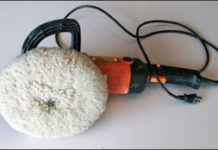
The January 2010 issue of Practical Sailor features letters on such subjects as: orbital polishers, seasickness, MOB technology and heads.

PS Advisor: Can AIS Serve as Backup GPS?
In your testing of the West Marine AIS1000 (September 2009), did you identify what NMEA sentences it outputs? I’m thinking of buying one and agree that their documentation is not adequate. I’m trying to determine whether it can be used as a general-purpose, backup GPS receiver.

Mailport: 12/09
I have a Pearson Ensign 1962 now at a slip in New Rochelle, N.Y. This season marked the first time we had the luxury of keeping our boat at a slip. In order to maneuver through the marinas byways without worrying, I bought a 24-volt Minn Kota outboard (80 pounds of thrust) and two 12-volt batteries, which I hook up in series. Not only am I able to stop start, turn, etc., in the marina, but-to my surprise-in the calm sound water, I can nip along at about 3-4 mph with myself, two crew, and the 3,000-pound boat. The result is that Ive only used my 5-horsepower Mercury outboard once this year. My electric outboard doesn't stall; it has variable speed like no ones business; reverses with relative ease, and is less expensive-though more cluttered-than the self-contained electric outboards you recently reviewed. Am I part of a growing trend or just weird? If the former then it might be worthwhile testing electric outboards for boats my size (22.5 feet) and commenting on their applicability.

Mailport: 11/09
To keep from being pulled under in a collision between a tanker and my sailboat, I "pulled the ripcord" to release the snap shackle on my Standard West Marine Safety Tether . The tether release lanyard was outfitted with a series of balls. (See bottom photo at right.) I had rehearsed reaching for and feeling the release toggle many times so it would come naturally in an emergency. The balls have a distinct feel. There was nothing on my PFD or foul-weather jacket that resembled them. The replacement tether I bought from West Marine (ISAF Specification Safety Tether, No. 9553504) has a new toggle on the snap-shackle release lanyard that consists of an open triangle of plastic. This is dangerous, in my opinion! In my first few hours of using the new tether, in moderate sea conditions, I managed to snag the triangular loop on something and release the snap shackle. I am now replacing all triangular loop pulls with bead pulls that I have crafted myself.
Latest Logbook

Practical Sailor Logbook – September 2026
In September we tour the Hans Christian 48T — the offshore cruiser many sailors call the holy grail — walk the custom Antigua 60...

Video: The BEST Sailboat You Can Buy for $35,000 – Catalina...
If you’re searching for a mid-30-foot sailboat, affordable cruising sailboat, liveaboard sailboat, first sailboat, or a capable used sailboat for coastal cruising, the Catalina...



Latest Sailboat Reviews

Learning by Doing on a $5,000 Catalina 30 Mk II
When Davis’s mother started talking about wanting to do something “big” for retirement, Davis and Gloria half-jokingly threw out an idea that seemed suitably...