
The Hunt is on for a Quality, Well-placed Emergency Tiller
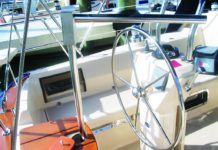
A decade ago, Practical Sailor editors began scouring boat shows for the perfect emergency tiller and an ideal stowage system for it. Little more than a simple lever arm that attaches to the head of the rudder stock, the emergency tiller is the device a sailor relies on in the event a steering cable parts or theres some other steering system failure. Our seemingly simple search turned out to be a nearly fruitless enterprise. Boat after boat fell far short of delivering even an average emergency tiller. Heres a look at our favorites and favorite offenders as well as our criteria for a good emergency tiller and where to keep it.
Medical Kits for Offshore Cruising
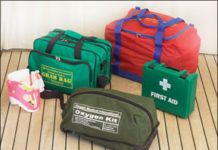
Practical Sailor’s ongoing evaluation of medical kits continues with a review of pre-packaged first-aid kits designed for offshore cruising. These kits address a full-range of medical needs, from minor cuts, lacerations, abrasions, bruises and sprains to sunburn, seasickness, head trauma, fractures, hypothermia, and burns. Offshore first-aid kits are designed for sailors who might not have access to medical personal for more than 24 hours and contain equipment and medicines capable of sustaining badly injured crew. They also enable a trained caregiver on board to monitor an injured crew member while seeking advice of professionals via electronic communication. The three pre-packaged medical kits reviewed were the Adventure Medical Marine 2000, Fieldtex Coastal Cruising Pak, and OMI Class B Daytripper by Ocean Medical International.
Inflatable Life Jacket-Safety Harnesses Performance Test
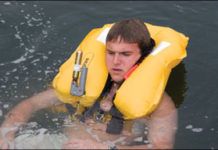
Two years after last testing inflatable life jackets with integral safety harnesses (December 2006), Practical Sailor takes a look at those products that have since hit store shelves. This go-around, testers evaluated eight personal floatation devices (PFDs) to find the best inflatable life jacket-harness of the bunch and compare it to the 2006 top performer, the Mustang 3184 hydrostatic inflatable life vest and harness. Each life vest was tested for design and function, construction and materials, fit, comfort, and adjustability. Practical Sailor tested three PFD-harness combos from Bluestorm: the Pro Sail 33, X-treme Sail 33, and Sport Sail 33; two Revere ComfortMax series PFDs, one manual and one automatic/manual; the Helly Hansen HI250; and Protexion's Nautilus Deluxe. Testers favored the two vests from Revere Survival--both have a good fit on land and in the water, are readily available, and have moderate pricing and decent warranties. But neither topped the reigning Practical Sailor Best Choice: the Mustang automatic/manual inflatable PFD, which remains the favorite.
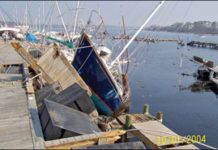
Gear for Battening Down Ahead of Storms
Practical Sailor offers an overview of products designed to help secure a boat for a major storm or hurricane. Well ahead of storm season, each boat owner should devise a hurricane preparation plan and should inspect the marina, dock, mooring, or hurricane hole where he intends to ride out the storm. One of the most important aspects of storm readiness is being sure you have the right gear and ground tackle to handle the loads of high winds and rising seas. In this overview, Practical Sailor takes a look at line choice and chafe gear for storm mooring. More line is obviously better, but more of what type and size? Editors discuss Fiorentinos RodeRap and LineRap, Davis Secure Chafe Guard, and the Chafe Guard from Taylor Made. We also consider docking aids including snubbers such as Shockles, Bungy Shock, and Synergy Marines braided poly dock lines; shock absorbers; and tidal-surge protectors including Tideminders, TideSlide, and the Slide-Moor.
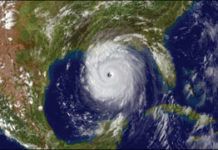
Trying to Reason With . . .
The article on hurricane gear starting on page 26 brought back memories of one of my most terrifying cruising experiences. In 1997, Super Typhoon Paka tore through the island of Guam while my wife and I were huddled on the cabin sole of our 32-foot ketch Tosca with our dog, Coco. Peak sustained speeds were later estimated at 100 miles per hour. Our boat was spider-webbed to trees, poles, and buried anchors along a shallow canal in Piti, a former Navy service area on the islands east side. In a basin nearby, a couple dozen sailboats were closely arrayed on four-point hurricane moorings. About five of those boats also had crew on board. Winds hit 50 miles per hour in the early evening, and didnt drop below that again until the next morning. Hurricane-force winds lasted for more than six hours. At the peak of the storm, the air was dense with debris, a scouring mix of sand, gravel, and leaves. Corrugated tin roofs, lumber scraps, and coconuts added to the potentially lethal rain. Several times, the empty CT 40 ketch to port would slam to starboard, and its rigging would scrape ours with a groan. At some point, hot wax from our hurricane candle dripped on Cocos nose. His howls added to the bedlam
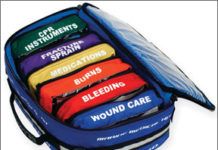
Medical Kits for Coastal Cruising
Practical Sailors review of medical kits designed for coastal cruising is the second in a four-part series on on-board first-aid. The first part reviewed medical kits for daysailing, while this one examines medical kits for boats with a crew of one to four people where help may not be available for up to 12 hours. Practical Sailor examined the contents, packaging, instruction manual, and organization for four kits: Ocean Medical International (OMI) Class C Day-Tripper, Adventure Medical Marine 1000, Fieldtex Excursion, and Orions Open Ocean. Marine 1000 met most of the content requirements we deemed necessary for coastal cruisers needs, and it excelled at the organization.
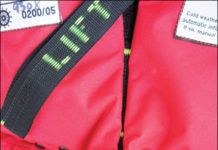
Comparing the Latest Inflatable PFDs
One of the most important pieces of boat safety gear is a PFD, or personal flotation device. This update test included the reigning top inflatable PFD, Crewfit 150N, from UK-based Crewsaver, as a baseline for comparison of the other nine life jackets tested. The test field included Three SOLAS (Safety of Life at Sea) rated vests from European safety-gear maker Viking; two Coast Guard-approved PFDs from the Revere ComfortMax series; the new MD0450 inflatable vest with hydrostatic activation from Mustang Survival; and the inflatable bladder from Float-Techs popular float coat. Rounding out the field were a manual and an automatic PFD from West Marine, both of which are made by Stearns Inc. None of these had integral harnesses, though some have alternate versions with that option. PFD/harness combinations will be reviewed in a future issue.
The Art of Defying Gravity
It is easy to dismiss singlehanded ocean sailing as sheer madness. It is challenge enough to meet the sea in a small boat-why would anyone choose to do it alone? During our liveaboard years, my wife Theresa and I always seemed to connect with the singlehanders in the anchorage. Often, we ended up sailing in their company for weeks or months. Perhaps we were touched by a bit of madness ourselves. In retrospect, though, I think it was a mixture of sympathy and fascination that drew us toward singlehanded sailors. Theresa couldnt bear to watch a handsome sailor survive on rice and beans-most of them were young men with little money. And their spirit of adventure, if not sheer recklessness, intrigued me.
Saving the Man Overboard
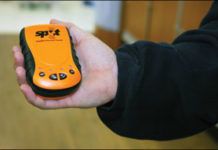
Although Practical Sailor contends that the best way to save a crew member is to do everything possible to keep them on board in the first place (lifelines, jacklines, harnesses, tethers, non-skid decks, grab rails) and to perfect MOB drills, there are times when a crew member will go over. New waves of electronic devices on the market are designed to alert the crew to a man in the water, and to locate the MOB. These devices include beacons, alarms, and trackers aimed at expediting alert and recovery. Some products signal that a person is no longer on the boat. Other devices broadcast a radio (RF) signal that can locate a man overboard with on-board direction finding (DF) equipment Theres even a new type of mini-406-Mhz EPIRBs called Personal Locator Beacons (PLBs) that can summon the U.S. Coast Guard via satellite. Add to these choices the recently introduced satellite messenger system that can pinpoint the position of its owner and the choices become more varied. Practical Sailor evaluates a handful of these devices including Mobilarm MOBi-lert 720i and the 7200 and 7600 alarms, and Raymarine LifeTag alarm; beacons Emerald Marine Products Alert2, and Marine Rescue Technologies Sea Marshall SARfinder 1003, which is classified as a Maritime Survivor Locating Device (MSLD); and two personal locator beacons, ACR Electronics ResQFix PLB and SPOT Satellite Messenger. All Mobialarm units can interface with National Marine Electronics Association (NMEA) 0183-compatible devices.
Medical Kits for Onboard First-Aid
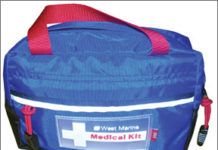
One of the most important pieces of gear on any boat is a first-aid kit. For evaluation purposes, weve divided pre-packaged medical kits into four categories, based on voyaging needs and price. Our first group, first-aid kits for less than $100, is designed for boats operating on waterways where professional medical help is available within hours. These are basic medical kits for small sailboats designed to help users deal with minor cuts and severe lacerations, abrasions, bruises and sprains. Sunburn, seasickness, head trauma, fractures, hypothermia, and burns are also medical issues daysailors need to be ready to cope with. Kits should include supplies such as band-aids, Ace bandages, gauze, aspirin, and tweezers. We reviewed four kits in this group, rating them on their contents, their storage container, organization, and price. The kits were the Adventure Medical 250, Ocean Medical Crew/Day kit, Fieldtex Day Pak, and West Marine 300. Our top pick contained all but one of the items on our list of basic requirements and came in a durable, shock-resistant case. It is also extremely well organized, making it easier to use in an emergency.
Latest Logbook

Practical Sailor Logbook – September 2026
In September we tour the Hans Christian 48T — the offshore cruiser many sailors call the holy grail — walk the custom Antigua 60...
Video: If You See This on a Used Sailboat, Walk Away
If you’re searching the used sailboat market, comparing sailboats for sale, or learning how to inspect a sailboat before buying, these are the red...
Latest Sailboat Reviews
Cal 2-27 Used Boat Review
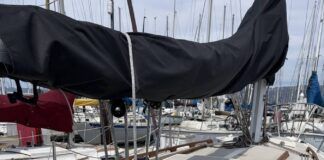
Our story begins in 1970, with the introduction of the Cal 29. Looking for something similar but a bit smaller, the company asked designer Bill Lapworth for a 27-footer, which at first was the Cal 27, a fin keel, spade rudder design with a convertible pop top; another incarnation of this basic hull was the T/2. But the concept of the 29 found its full expression in the Cal 2-27, which began production in 1975 and continued to 1977, after which it was again modified and called simply the Cal 27...again. Production of it ceased in 1986.