


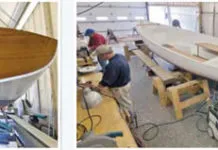
Craftsmanship is at the Heart of Construction
Modern engineering works well with many older designs. In the Stuart Knockabouts original plans, soft wood planks were mechanically fastened to hardwood frames and the its shoal-draft keel/centerboard was bolted to the keelson. Timber boatbuilding is labor intensive and the time-saving shortcuts found in molded FRP hull and deck construction have a well-proven track record. Add to this the fact that wooden hulls and decks are susceptible to rot, and its clear that Hardings vision of a fiberglass/foam sandwich Stuart Knockabout was a best-of-both-worlds solution rather than a sacrilege. The result of the FRP conversion is a stiffer/stronger, monocoque hull that required less maintenance and is much more immune to the elements.
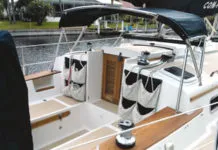
Cruising the Com-Pac 35
Com-Pac Yachts is a Florida boat builder with a particularly interesting history. The company was formed in 1957 by W. L. Hutch Hutchins Sr., an entrepreneurial tool-and-die maker who operated a metal-stamping and fabrication shop in St. Louis, Missouri. A successful inventor, he created everything from automobile accessories, including the Ah-ooo-gah horn often retrofitted on Model A Fords, to a unique folding high-chair.
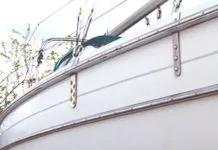
Constructing the Com-Pac 35
The primary components of the Com-Pac 35 are the hull, a pan that provides housing for cabinetry and the motor mount, a headliner, and the deck. The hull construction begins with the application of a coat of Neste gelcoat. The skin coat is a layer of 1.5-ounce mat bonded with Riechold Hydrex vinylester resin to prevent osmotic blistering.
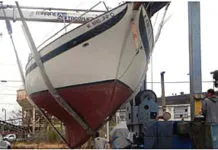
Owners Say Beauty, Solid Hull Outweigh Clippers Flaws
We spoke with several owners of Cheoy Lee 42s and 36s for this article, and among the most seasoned was Kieron OConnell, a two-time owner of Cheoy Lee boats-first an Offshore 31, now a Cheoy Lee Clipper 42. OConnell sailed the 42 from California to Australia. He had this to say about the Cheoy Lee Clipper 42.
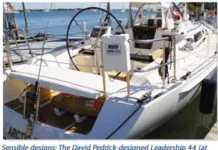
A Stern Look at Boat Sterns
In the January 2013 issue of Practical Sailor, we took a close look at the bow and noted the trend toward plumb stems, multiple furlers, and a longer resting waterline. We also recognized the tradeoffs involved, such as the need to perch the anchor further forward on a mini sprit or small strut in order to keep the flukes from chewing away at the topsides. When it comes to ground-tackle handling, its clear that for decades, cruisers have understood and retained a commitment to anchor deployment and retrieval-and designers and builders have responded appropriately. However, an even bigger shift in yacht design has overtaken the aft end of the modern production sailboat-and the implications are hard to miss.

Former Marketing Director, CR38 Owner Offers His 2 Cents
Practical Sailor reader Allen Taylor so loved his Cabo Rico 38 that he eventually started working for the company as the marketing director. Now, with his stint at Cabo Rico far behind him, the former marketing director offered this insightful view of the Crealock 38, which he lived on and cruised for several years. Although he still holds the boat in high esteem, he offered this list of potential trouble spots.
Alberg Owners Love Their A35s, Warts and All
Nearly every owner we spoke to about their Alberg 35 had small gripes about the boats performance, cosmetic defects, and outdated equipment. Nevertheless, it was clear that each had great confidence in the hull design and construction, and took pride in the boats enduring classic aesthetics.
Find More PS Online
Practical Sailor is working on updating some used boat reviews and adding some new ones to our online library, and we need your help. Were looking for opinions (and photos) from current or former owners of the following boats: Cabo Rico 38, Com-Pac 35, Cheoy Lee Clipper 42, Stuart Knockabout, Express 37, and CSY 37.
Carl Alberg’s Timeless Designs
Wed tucked into Hatchet Bay, Eleuthera, when the pretty green sloop sailed through the narrow slot into the basin. A ballsy kid, he didnt even furl the jib. I can't recall his name. He was in his 20s-handy with tools and a brush. The boats coamings gleamed with nine layers of varnish. The boat, I remember well. It was the first time I got a really close look at an Alberg 30. She was, in many ways, the sort of sailboat an elementary school artist might render, if you asked him to draw a sailboat. Deceptively simple. Elegant and well-balanced.
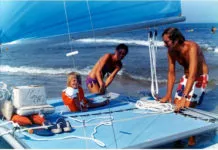
Hobie Alter, Cheryl Tiegs and a Yard Full of Hobie Cats
Hobie asked: Are you near Norfolk or New York?, and I said no to both. He then paused and said: I could sell you one, but if you buy three boats you can be our dealer in that area. . . . My wife was not too pleased with 140 cardboard boxes (each box holding a hull) in our backyard. She had just given birth to our first child three months earlier!

How Long Do Sails Last?
How long do sails actually last? Sailmakers often say cruising sails last around 10–15 years, but what happens when you discover a sail that’s...



Latest Sailboat Review

Jeanneau 55 Boat Review
This recent sailboat from Jeanneau may as well be a spaceship. They’ve taken all the time-honored designs of a monohull aft cockpit and turned...