

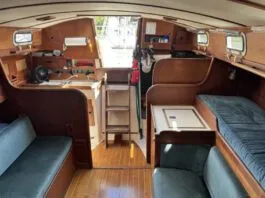

The Magic of Munroes Sharpies
There is magic in sailing. What is sometimes harder to grasp is the magic in boats. But it is there. It is undeniably there. It is there when first you step aboard and feel the boat come alive underfoot. It is there when the sails fill and quiet as you come out of the eye of the wind. And it is there when you take the tiller under a dome of stars and realize youre connected to something much, much bigger than a rudder. There IT is, as persistent as a heartbeat: a pulse, a throb, a jolt of I-cannot-explain-this magic.
Improve Your Catalina 30: Upgrading the World’s Most Popular 30-Footer
The Catalina 30 is a remarkable success story. We suspect that more Catalina 30s have been built than any other boat of that size anywhere in the world. While the basic boat has remained unchanged since it was introduced in 1975, there have been dozens, perhaps even hundreds, of minor developments in the boat in the course of a production run that is approaching 4,000 hulls. The advantage of a boat in production for so long is a high degree of product refinement over the years. The challenge for the owner of an early version of the boat is to upgrade his boat to the standards of models currently in production.
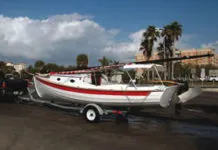
Boat Review: Norseboat 21.5
The Norseboat 21.5 is designed for the small-boat adventurer who likes to travel with as few mechanical encumbrances as possible. Its light weight makes it easy to tow with a mid-size car, and its shallow draft (less than 18 inches) opens up remote coastal cruising areas that bigger boats can’t reach. For those who like to explore by backpacking, bicycle, or canoe, the boat is a logical upgrade. But you don’t need a $35,000 Norseboat 21.5 to poke around the many outstanding small-boat cruising areas. Some sailors might be happier to have a renovated 38-year-old Venture 21, like the one we reviewed in the April 2011 issue, and put the $30,000 they’d save toward the next adventure. However, several important features—a contemporary, sea-kindly underbody, high-quality construction, good fit and finish, and a sensible centerboard arrangement—put the Norseboat head and shoulders above vintage trailer-sailers.
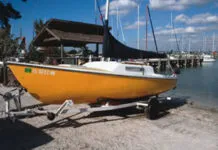
Venture 21 Used-boat Review
The MacGregor Venture 21 was designed to be affordable, easy to trailer and launch, and fun to sail, with enough room below for storing gear or spending the night at anchor. With a 15-year production run (1965-1980), the Venture was aimed at new sailors, but also appealed to those who wanted to step up from an open daysailer. Its size, sail area, and hull design were tailored for lakes and bays with fickle winds of less than 15 knots. The Venture design was driven by seaworthiness and performance, but pragmatic and aesthetic appeal also guided the creation of this trailer-sailer. Testers liked the boat for coastal and lake adventures. It is a good option for those with a 2,000-pound tow capacity limit who are looking for an affordable weekender.

Seduced by the Nearly Free Boat
Our review of the trailblazing trailer-sailer, the Venture 21, brought to mind a recent phone conversation with my friend Andrew regarding a similar boat. I just got myself a free sailboat, he announced cheerily. Well, almost free. Husband, father, and the owner of a new business, Andrew had no time for a boat. But hed sailed as a boy in England and, by jove, he wanted to start again.

Hobie Mirage: Paddle, Pedal, Power, or Sail
The Hobie Mirage Tandem Island, a mouthful we’ll refer to as the HMTI, is the latest incarnation of Hobie’s capable and creative engineering team. This triple-play trimaran can be paddled, pedaled, and sailed using dozens of Hobie’s in-house designed parts. A specialized Torqeedo electric outboard (www.torqeedo.com), which can be dropped into a drive slot, adds a forth dimension to this multi-tasking multihull.

In-Boom Furling: Five Systems
There's no perfect solution to boom furling. It's not an easy bit of engineering. Still, all the systems on the market continue to mature. Schaefer's new offering looks like a good bet for medium-sized boats.
Upgrading the C&C 33 Part I
In July 1990 we bought a 1975 C & C 33 to function as a test platform for Practical Sailor. We chose it above others for several reasons: The design seemed typical of many modern sailboats, with a fin keel and spade rudder and moderate displacement; C & C had a good reputation; and the price was right.
Improve Your Catalina 30: Upgrading the Worlds Most Popular 30-Footer
The Catalina 30 is a remarkable success story. We suspect that more Catalina 30s have been built than any other boat of that size anywhere in the world. While the basic boat has remained unchanged since it was introduced in1975, there have been dozens, perhaps even hundreds, of minor developments in the boat in the course of a production run that is approaching 4,000 hulls.
Mast Support for Trailerable Boats
On most trailerable boats, when the mast is stowed for travel it is lashed to the bow pulpit and stern rail with no support at all in the middle.

Morgan 382 – The $30K Boat Nobody Talks About
The Morgan 382 might be one of the most overlooked cruising sailboats ever built. Designed by legendary naval architect Ted Brewer and produced between...



Latest Sailboat Review

Jeanneau 55 Boat Review
This recent sailboat from Jeanneau may as well be a spaceship. They’ve taken all the time-honored designs of a monohull aft cockpit and turned...