



Practical Sailor Resumes its Search for the Best Boat Wax
Practical Sailor tested a field of 10 tubs of paste waxes for ease of application, gloss, texture, finish, and price. Most of the products did a fairly good job of producing initial shine. The two waxes with the most glossy fiberglass test patch were not the easiest to apply nor were they the least expensive. The boat wax test included marine paste waxes and car waxes-some with carnauba-from Meguiars, Turtle Wax, 3M, Collinite, Kit, Mothers, Nu-Finish, and Star brite. You need only dip a toe into this topic to realize that there are almost as many recipes for a glossy hull as there are sailors whod rather do anything than wax their hull. As long as marketeers keep alive our hopes for a glossy finish that will last forever, there will be people who will plunk down hard-earned money for the latest and greatest gelcoat elixir. We generally define gloss as being the surface ability to reflect light. Gloss, along with ease of application and the ability to repel dirt and water, are the features that Practical Sailor focused on for this report (see "How We Tested," page 32).
Practical Sailor Takes a Look at Trends in Modern Boat Design
Practical Sailor editors have noticed the increasing tendency in newer-model sailboats to be ill-mannered in gusty conditions. Establishing balance between the sails and the hull is one of the main factors in quality boat design. For correct trim, many things must be considered: the ballast package location, the combined longitudinal center of gravity (LCG), and the longitudinal center of buoyancy. At the same time, to maintain a balanced helm, the keel must promote sufficient lead (the fore and aft distance between the center of effort and the center of lateral resistance). To highlight how these boat design principles play out, Practical Sailor looks at classic sailboats such as the Bill Shaw-designed Pearson 32, Ericson 41, Valiant 40, and Peterson 44, and compares their keel/sail ratios and lead values to more modern sailboat designs such as the Catalina, Hunter, Tartan, and Beneteau.

Getting Rid of Mold and Mildew Onboard
Among the marine maintenance products Practical Sailor evaluated recently were 14 pump-spray mildew cleaners to find out which one was the most effective at removing severe mildew stains. We tested chlorine bleach cleaners, chlorine-free cleaners, hydrogen peroxide cleaners, and ammonium chloride cleaners on a variety of materials, ranging from mildewed shower curtains to moldy vinyl seat cushions and moldy life jackets. We also used them to clean a mildewed sail and mildewed Sunbrella. All products were effective at removing the mold mildew from the shower curtain, but the cushions, life jacket, Dacron sail, and Sunbrella were more of a challenge. One product stood out as a more effective mildew cleaner: Klean-Strip Mildew Stain Remover. Klean-Strip is a highly concentrated product with 19 times more sodium hypochlorite than common bleach, and we do not recommend it for cleaning sails or fabrics. Other products tested include 3M mildew stain remover, Boat Armor mildew stain remover, Boatlife mildew remover, MaryKate mildew stain remover, MDR Amazons Amazing Mildew Stain Away, MDR Moldaway, Naturally Clean Mildew, Nautical Ease Mildew Stain Remover, household Spray Nine, Star brite Mildew Stain Remover, Sudbury Mildew Cleaner and Stain Remover, Thetford Mildew Stain Remover, and West Marine Mold and Mildew Cleaner.

PS Advisor: Water-logged Rudder
Each year, the rudder on my 1986 C&C 35-3 has to have water drained from it. It is my belief that water gets in from the shaft/stock entrance to the rudder, but with the rudder in place, access is restricted. From speaking with other boaters, I’ve found it to be a common problem. The initial concern is of water freezing inside and splitting the rudder, but I also have the longer-term implication of possible internal, and unseen, corrosion. For now, I drill a couple of holes in the fall, and epoxy them before launch. Is there a fitting that could be implanted in the rudder, with a screw to be easily removed for drainage?
The Daysailers of Daydreams
A daysailer was once simple and small, an entry-level passport to the sport. In the new millennium, however, that has changed. Simplicity may still be a watchword, but the boats have grown into what could be called trophy boats. Hinckley Co.s latest daysail boat is 42 feet long. Morris Yachts is marketing a boat that stretches 53 feet as a daysailer. Ted Fontaine at Friendship Yachts already has built one that size. And these are only a few of the daysail boats with minimal accommodations, big cockpits, and over-size price tags that are filling up the fleet. In all, more than a dozen elegant daysailers have made it to market. This article compares an even dozen: the Alerion Express 28, 33, and 38 (Pearson Composites); e33 (e Sailing Yachts, Robbie Doyle and Jeremy Wurmfeld); the B-38 (Luca Brenta); Bruckmann 42 (Bruckmann Yachts); Crosscurrent 33 (Maxi Dolphin); the Friendship 40 (Ted Fontaine); Harbor 25 (W.D. Schock); Hinckley 42 (Hinckley Yachts), J-100 and J-124 (JBoats), Morris 36 (Morris Yachts), Sabre Spirit (Sabre Yachts), and the wallynano (Wally Yachts).

Etchells-inspired e33 – A Practical Sailor New Sailboat Review
The trophy daysailer market is rife with branding, image, and various forms of snob appeal. The e33, however, makes its pitch on practical grounds. Reports from the field highlight the performance/comfort/control combination that makes the e33 a fun raceboat. You don't need a big crew, you can exercise your tactical talents to the max, and you give away nothing in boatspeed. Our time sailing the e33 convinced us that it is not only a legitimate performance sailboat, but that attaining that performance is sinfully easy. The e33 daysailers bonus points include a cockpit that takes up more than half the deck space and can hold five or six adults comfortably; cockpit-led control lines; carbon-fiber spars; and a hydraulic headstay control. Below, Spartan accommodations include berths for four, an enclosed head, and a built-in cooler. With the look of a classic and the innovative design of a modern daysailer, the e33 is e Sailing Yachts intelligent, inspired, comprehensive attempt to capture the fun of performance sailing.

The Merits of Madness
It always seems that a storm rolls into Annapolis, Md., just in time for the United States Sailboat Show. Held in October, the annual exhibition is the nations biggest sailboat-only show. Until this year, my favorite show was in 2006, when a 40-knot gale whipped into town, and the floating docks rolled like a Nantucket whaler with her decks awash. With the wind and spray lashing the show tents, boat buyers defiantly carried on, one hand groping for a lifeline, the other grasping the checkbook. This years storm was of a different sort. Theres something eerily soothing about a large crowd of people ogling new boats while the world markets go into a death spiral. During the shows opening day, five televisions in the waterfront bar Pussers Landing tracked the Dows precipitous plunge. In one fell swoop, my boys college fund and any hope of retiring before Im deaf as a post were carried off in an avalanche of debt. To my surprise, the people around me seemed preoccupied with only boats.
New Navy 44 Sail-training Sloop Built to Last
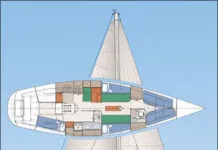
The U.S. Naval Academy’s new Navy 44 MkII is a seaworthy workhorse that skips the design fluff and focuses on being training-boat tough and race-boat efficient. Designed by David Pedrick, the Navy 44 MkII—younger sister to the Navy MkI racer-cruiser-teacher--is meant to be cruised and raced for 20 years, and to endure two or three times the wear and tear of the average production boat. The boat was designed to act as a sail-training platform with heavy-duty usage by midshipman, while at the same time performing like a race boat for experienced crew. The biggest challenge in designing the boat lay in achieving the requisite strength, stability, and longevity while keeping the vessel's weight from overwhelming performance. Equipped with a Yanmar 4JH4E, and a full array of B&G electronics, the sloop also has Furuno radar, GPS, a NavNet digital chart system, Icom VHF, and SSB.

Practical Sailor Tests Lightweight 10-foot Rigid Inflatable Boats
Eight fixed-transom Hypalon and PVC rigid inflatable boats (RIBs) from seven manufacturers were put through their paces as testers inspected each for on-the-water performance, inflation ease, lifting, seating, storage space, transom design, and hull design. RIB brands tested were AB, Avon, Achilles, Brig, Mercury, Caribe, and Zodiac. With a 9.9-horsepower Mercury outboard four-stroke engine pushing it, each dinghy was tested for speed, ability to plane, handling, tracking, stability, comfort level, and how well it deflected spray when powering through 1- to 2-foot wakes. The test RIBs from Achilles, Caribe, and Zodiac rated the highest in the field of fixed-transom rigid inflatable boats. Testers liked the ring-type oarlocks on the Caribe L10 and the Brigs bow handle. Practical Sailor pet peeves included bad oar stowage on most of the boats and thin rub strakes. Although classified as lightweight, the average weight of these test boats was 136 pounds.
Compact Weta Trimaran Screeches Past the Big Boys on Biscayne Bay
When it comes to the pure love of sailing, its hard to beat a small, light efficient boat whose sole mission is to harness the wind. Designed in New Zealand, built in China, imported to the U.S. by Nor Banks Sailing of Duck, N.C., the 14-foot-6-inch, 220-pound Weta 4.4 trimaran with 158 square feet of sail was conceived in New Zealand by father-and-son team Roger and Chris Kitchen, and designed with collaborative help from a handful of experienced sailors. The challenge was creating a cost-effective boat with the strength-to-weight ratio needed for performance sailing. The boat uses carbon fiber on the framework, and on the mast and sprit while the light, stiff hull structure, daggerboard and rudder are built using less costly E-glass and Divinycell foam. The boomless mainsail, made by windsurfer sailmaker Gaastra, incorporates five full tubular battens that control draft and allow the mainsheet to be attached to a well-reinforced clew rather than a conventional boom. The high-tech Gaastra sail package, like the Harken hardware and carbon sprit and mast are all standards. The success of this pocket-sized trimaran is due in part to its triple threat sailplan of main, jib, and easy-handling, furling screacher. The screacher can add a virtual turbo boost. This 60- square-foot gennaker deploys like any roller furler but is trimmed via a single sheet led through both port and starboard leads. The ride is both exhilarating and responsive.

Morgan 382 – The $30K Boat Nobody Talks About
The Morgan 382 might be one of the most overlooked cruising sailboats ever built. Designed by legendary naval architect Ted Brewer and produced between...



Latest Sailboat Review

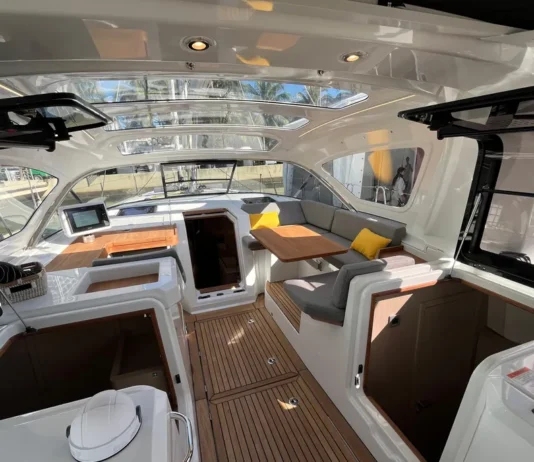
Jeanneau 55 Boat Review
This recent sailboat from Jeanneau may as well be a spaceship. They’ve taken all the time-honored designs of a monohull aft cockpit and turned...