

S2 8.5 Meter
In the early '80s, S2 8.5 Meter reached more for the performance market with the Grand Slam series of small boats, and the 10.3 "offshore racer-cruiser." These higher performance boats were designed by Scott Graham and Eric Schlageter, well known for their MORC and smaller IOR designs. The S2 8.5 is a 28-footer cast in the company's traditional mold. Her hull dimensions, sail area, displacement, and general design characteristics put her square in the middle of the modern 28-footers such as the Tanzer 8.5, Newport 28, O'Day 28, and the Pearson 28.

Sabre 28
Owners report that the primary motivation for purchasing the Sabre 28 can be summed up in one word: quality. Sabre is quite conscious of their image as producing a high-quality boat. The boat attracts buyers willing to pay a little more than average for a boat that is better than average. The Sabre 28 is conventionally modern in appearance. She has a modest concave sheer, straight raked stern, and short after overhang. With optional wheel steering, optional cockpit-led halyards, and optional self-tailing headsail sheet winches, the Sabre 28 can easily be handled by one or two people. The mainsheet is within easy reach of the helmsman. Unfortunately, his head is also within easy reach of the mainsheet when jibing, except on newer boats; the mainsheet was relocated to the cabin top in 1982.
Sea Sprite
The Sea Sprite 23 is a trim but rugged daysailer-overnighter from naval architect Carl A. Alberg that enjoyed a 25-year production run under several different Rhode Island builders, most notably Clarke Ryder. It's a typical Alberg design--narrow beam, full keel and conservative ballast-to-displacement ratio and graceful lines. This is a boat that still turns heads when it sails into a harbor.
Stiletto
It's hard to mistake the Stiletto's appearance, with blazing topside graphics and aircraft-style, pop-top companionway hatches. It's also hard for the average sailor to appreciate the sophistication of the Stiletto's construction--epoxy-saturated fiberglass over a Nomex honeycomb core.
Tartan 27
The Tartan 27 went into production in 1961 with fiberglass boatbuilding in its toddler stage; production ceased in 1980, after 19 years interrupted only by a fire in 1972 that resulted in no 27s being built that year. The greatest number of 27s built in one year is 85; the year was 1964. In all, 712 Tartan 27s were built, including a dozen boats under license in California. Remarkably few significant changes were made to the boat until near the end of the long production run, after hull #650.
Rob Roy 23
In 1983, the Rob-Roy 23 was the only trailerable canoe-stern yawl in town. Its appeal, however, goes beyond novelty. This is a boat with character: She looks salty; sails well with working sails alone; and she provides accommodations for two. Simplicity, from a space-saving centerboard to a "hardened" kick-up rudder, from an unstayed mizzen mast to a tabernacle-mounted mainmast, is a watchword. The Rob Roy can be launched at a ramp and is easily beached due to its 1' 7" draft with the board up. Owners have cruised her for weeks at a time and routinely cross the Gulf Stream and other formidable chunks of open water.
Melges 24
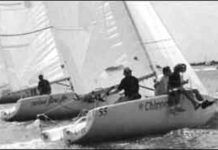
Introduced as a prototype at Key West Race Week barely three years ago, the Melges 24 has already created the same sensation in the small boat performance world as the J/24 when it was first introduced. We're not suggesting that we should commence composing the epitaph for the J/boat, especially since hull number 5,500 was launched recently and sales are still strong, but we are preparing ourselves for a high noon, main street shoot-out between the aging sharpshooter and the young gun as they wrangle for ownership of the small-boat race market.
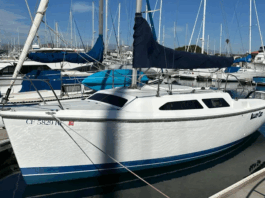
Catalina 27
The Catalina 27 has been in production since 1971, and well over 6,000 of them have been built. This is undoubtedly the largest production run of any 27' sailboat in US history, and probably the biggest anywhere. The flip side of the coin is that Catalinas are known as cheaply built boats, with lots of corners cut in places they shouldn't be cut.
Santana 2023
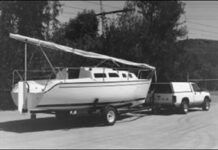
With the introduction of the Santana 2023, one of the newer water-ballasted trailerables, the W.D. Schock Corp. in Southern California offered entry-level sailors the same types of mix-and-match options available at an automobile showroom. The A model is your basic family sloop with a contemporary, low-profile cabin. The 2023 C (cruise) has a longer trunk cabin with more amenities below. The 2023 R (race) is optimized for performance with a sprit for flying asymmetrical spinnakers, though you can add a tall mast to either the A or C model. The R model has the same cabin top as the A model, which we think is more attractive, but has less headroom below, of course.
Chrysler 22
According to the BUC Research Used Boat Price Guide, Chrysler first offered recreational boats in 1957, building three aluminum runabouts and cruisers from 16' to 21'. Its first fiberglass boat was the Caribbean 19' cruiser in 1958. The Buccaneer was the first sailboat in the Chrysler line, introduced in 1971. The Chrysler 22 appeared in 1975. Just when Chrysler stopped building it is uncertain, but according to BUC, 1979 was the last year; we have not received information from readers owning boats built later than that, so perhaps '79 was indeed the finale.
Latest Logbook

Practical Sailor Logbook – September 2026
This month we tour the Hans Christian 48T — the offshore cruiser many sailors call the holy grail — walk the custom Antigua 60...
Video: Morgan 44 Review – The Catalina Cruiser Everyone Forgot
The 1989 Morgan 44 is a big center-cockpit cruising sailboat with Catalina DNA—but it may be one of the most overlooked boats of its...


Latest Sailboat Reviews
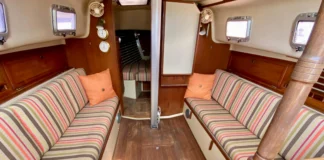
Bayfield 32 Used Boat Review
At first glance, the Bayfield 32 looks less like a fiberglass production boat from the 1980s and more like somebody shrank a traditional sailing...