


Mailport: Tourniquets at Sea
Add a tourniquet to your first aid kit and know how to use correctly - it is less likely to accidentally loosen or inflict additional tissue damage.For further training, I would refer you to the American Red Cross, they have a Basic and Advanced First Aid certification, and along with the American Heart Association offer classes in cardiopulmonary resuscitation, and the use of automated external defibrillators (AEDs).
High-Tech Anchor Rode
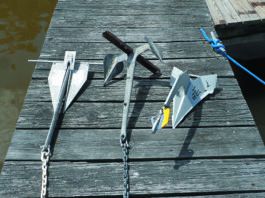
My primary anchor is a big hunk of steel on an all-chain rode, handled by a windlass. Secure in all bottoms, idiot proof, easy to handle, and thus perfect for everyday use. But when the need arises to set a second anchor-either to restrict swing or to increase holding in horrible mud-the last thing I want is a heavy steel anchor connected to chain that I have to drag across deck.
Fenders and Lines for Seawalls
To the lubber, tying-up to a bulkhead seems like the simplest of all docking situations. Perhaps with floating docks this is true. You just throw in a few fenders and tie a few lines. Simple. But in the world of tidal bulkheads with pilings or rough concrete facings, it is often a hammer and anvil situation, with the wind and waves hammer incessantly as the anvil moves up and down with the tide, causing fenders to slip out of position.
Dodging a Bullet When Caught on Bulkhead
The following is aimed primarily at boats that are unable to leave an alongside dock or bulkhead before wind and seas become dangerous. Any fetch beyond 200 yards is dangerous, and there may be nothing you can do to protect the boat. However, if you are in a protected marina, well up a creek, and the storm is moderate, these actions can help. Just remember that low breakwaters will be overtopped, wooden breakwaters fall apart, other boats will come loose, and there will be lumber in the water from broken docks.
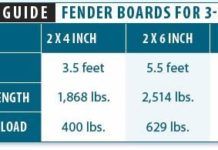
Make Your Own Rugged Fender Boards
We described a simple home-built version several years ago (Practical Sailor, December 2011); here we present a few simple upgrades on the same basic design, allowing for simpler deployment, better fender retention, and more stable positioning. Pressure treated lumber provides inexpensive durability.
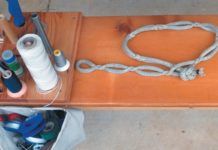
Make A Tie-down Strop
After hundreds of years of seafaring, there shouldnt be any new rope tricks. Then new high-strength materials like Amsteel came along, suggesting new applications for old-school knot craft. The age-of-sail strop morphed into the versatile the soft shackle (see Going Soft on Shackles, April 2015). Racing sailors employ it to eliminate weight aloft, and cruisers like the economy and versatility. Weve found good uses for soft shackles on jib sheets and ground tackle, but the strop is also alive and well, securing tarps and gear. The best part is you can make them from old rope, costing nothing.
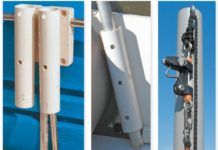
DIY Fishing Gear for Sailors
We reviewed clamp-on rod holders a few years in the past, but found them expensive (see PS October 2006). Fortunately, there are alternatives that can save hundreds of dollars and be installed in an afternoon. Less shiny, but functional.
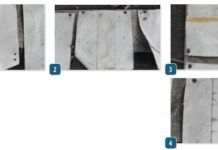
Simple Sail Repair
Often an old sail wont hold stitches, and some sailors hate to sew. A number of products proved strong enough and flexible enough to make serviceable repairs. In Stitch-free Sail Repair, (see November 2017) we reviewed repair tapes, epoxy, polyurethane, and a few other common adhesives for usefulness as no-sewing options for sail repair, and in September 2017 we reviewed options for Sunbrella repair. After two years in the Maryland sun, the rankings have changed…
Make a Mini Dodger
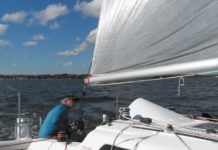
A companionway slider and hatch boards are the most common type of cabin entry on sailboats. Its seaworthy, lightweight, and inexpensive. Unfortunately, you can't leave the hatch open when its raining without getting water below. Swapping the hatch boards for a hinged door is a popular upgrade, but in many boats there simply isn't space for an opened door.

Reliable Chain Connections
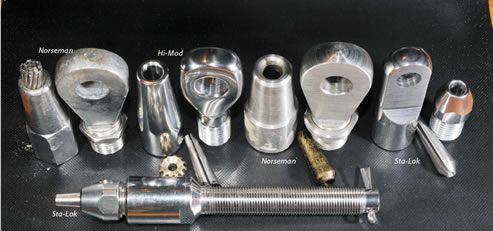
We often get asked about joining two shots of chain together without compromising strength. You have a number of options-including some that are just plain bad. The important thing is to make sure the connector is of the highest quality and that it matches or exceeds the strength of your existing chain.
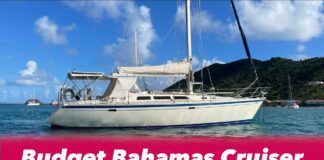
O’Day 40 – A Budget Cruiser for the Bahamas
The O’Day 40 (1986) is one of those cruising sailboats that somehow slipped through the cracks of sailing history. Built during the final years...

Latest Sailboat Review
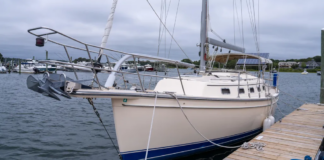
Island Packet Estero Used Boat Review
Florida-based Island Packet targets a relatively narrow niche, so the toughest competitors to its new boats are often older Island Packets. Introduced in 2010, the 36-foot, shoal-draft Estero is the company’s latest attempt to introduce a distinctive model that doesn’t stray too far from the company’s proven formula for success: moderate displacement, full-keel cruisers designed to be lived on, sailed far and in comfort, and endure the bumps, scrapes, and storms that cruising boats inevitably encounter. After sailing the Estero on Florida’s Sarasota Bay and inspecting its interior, construction, and systems, Practical Sailor testers noted that the shoal-water cruiser will appeal strongest to Island Packet fans who’ve been waiting for a shoal-draft, easy-to-sail boat that compares to the IP37 in terms of interior space. These strengths will be most apparent on intracoastal or riverine adventures like the Great Loop.