
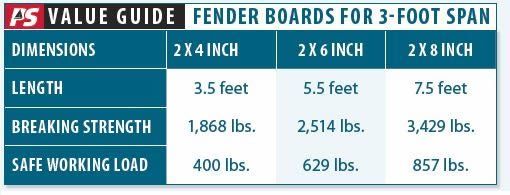
We described a simple home-built version several years ago (Practical Sailor, December 2011); here we present a few simple upgrades on the same basic design, allowing for simpler deployment, better fender retention, and more stable positioning. Pressure treated lumber provides inexpensive durability.
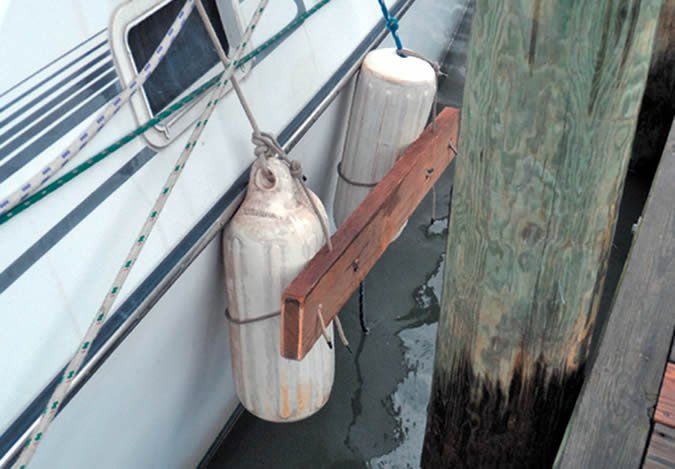
Suspension line holes. Drill these vertically through the timber to eliminate chafe on the pilings. If a long bit is unavailable, drill an intersecting hole from the side large to create a recess large enough to accommodate the stopper knot, protecting it from chafe. You will need a long bit, or will have to drill from either side to meet in the middle.
Fender loops. Place near each end retain the fenders. Drill a counter sink to hide the stopper knots from the pilings and prevent chafe (the tails may protrude). The holes are one fender diameter apart. Some folks like bungee cord, but we find 5/16-inch line easy to work with, far more durable, and better able to keep fenders in position.
Bracing lines. Drill a hole at each end for bracing lines to prevent the board from swaying laterally. This helps a short board perform as well as a longer board in rough conditions.