

Assessing the Anchor Kellet
One of all-chain rodes most popular features among cruising sailors has little to do with anchoring-and everything to do with stowing. With a well-designed bow roller, windlass, hawse hole, and chain locker, your rode and anchor will deploy and stow belowdecks faster and with far less effort than nylon rode requires. But for a smaller boat without a windlass or deep chain locker, an all-chain rode is often impractical. Even cruising sailors who are perfectly equipped for all-chain anchoring often find that their nylon secondary anchor better is suited for some anchoring situations.
In Search of the Ultimate Boat Hook
The basic design of the humble boat hook hasn't changed much over the years, but it has seen upgrades in construction and materials, along with some minor design tweaks. For this report, we set out to determine what constitutes the ideal boat hook. We evaluated boat hooks currently on the market and took a look at some old models still in service.
Rest Easy with a Riding Sail
Even when your anchor is well designed and ideally matched to your boat, there are four common factors that can cause an anchor to drag: poor bottom, short scope, insufficient shock absorption, and yawing. Each of these reduces the holding capacity of the anchor, and they are additive. That is to say that any one of them can ruin your day, solving only one or two of them does not ensure good holding, and the more problems you solve, the better youll sleep.
Ground Tackle Inspection Tips
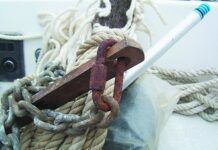
Your anchoring system is only as strong as its weakest component, which includes not only the rode, but also shackles, splices, mooring bitts, cleats - in short, any gear used to secure your boat while at anchor. Proper maintenance includes inspection of these as well as laying the rode out for thorough examination at least annually.
Reducing the Nylon Rode Slingshot Effect
Again we speak heresy! Practical Sailor has published at least four articles explaining why stretchy nylon bridles and snubbers are vital. But if the rode is nylon instead of chain, this no longer applies. The rode provides all the impact absorption we need, perhaps more than we need. By analogy, a bridle should function like an anti-sway bar on an automobile, keeping the boat centered.
Other Methods to Control Yaw
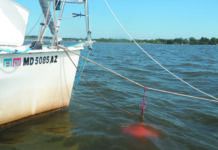
Yawing is the result of imbalance between windage (you want it aft) and underwater resistance (you want it forward). If the center of windage...
Rethinking Anchor Snubbers
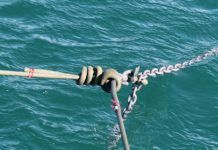
Anyone who has spent a night pitching in an exposed anchorage would not be shocked to learn that in many dragging incidents the snubber parted, or was stretched to its limit, allowing the chain and boat to absorb some teeth-rattling shock loads before something finally gave. Recently, PS testers have devised a series of tests to determine what the ideal snubber looks like. Some of our findings run contrary to popular assumptions. Some will surely surprise you, and may even-one day-save your boat. What does your snubber look like?
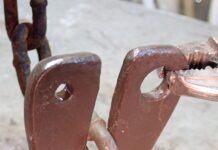
A Better Bridle Plate
In the midst of discussing bridles, snubbers, and rigging multiple anchors, ten years ago we introduced the idea of an improved bridle plate—see “Adjustable...
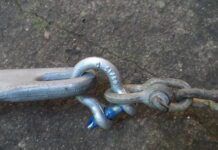
Hole or Slot? Getting Shackle Side Loading Right on Your Anchor
“This anchor has a hole instead of a slot like the others. Is that OK?” A fair question. Surprisingly, perhaps, name brand anchors can...

Anchoring in Crowded Harbors
Stagger while you anchor? It sounds like Ive either been drinking too much or sailing too long. Bear with me.
Latest Logbook

Practical Sailor Logbook – September 2026
In September we tour the Hans Christian 48T — the offshore cruiser many sailors call the holy grail — walk the custom Antigua 60...
Video: The BEST Sailboat You Can Buy for $35,000 – Catalina...
If you’re searching for a mid-30-foot sailboat, affordable cruising sailboat, liveaboard sailboat, first sailboat, or a capable used sailboat for coastal cruising, the Catalina...

Latest Sailboat Reviews
Learning by Doing on a $5,000 Catalina 30 Mk II
When Davis’s mother started talking about wanting to do something “big” for retirement, Davis and Gloria half-jokingly threw out an idea that seemed suitably...