



The Pros and Cons of the Rigid, Fiberglass Dinghy
Dinghies are the Rodney Dangerfields of cruising. They get no respect, or at least not as much as they deserve. The little boat that will see nearly as many sea miles as the mother ship is often an afterthought.
Snubber Chain Hooks Revisited
Last spring we reported on tests of chain hooks (see Testing the Effects of Chain Hooks, PS March 2016). Those tests found that some hooks reduced the strength and seriously damaged the retained chain. The maker of one of the hooks, Mantus, criticized our methods because the chain size we used did not match their specs for the hook, so we repeated the tests using different chain. (For a complete discussion of this matter, see the Inside PS blog post Can a Snubber Hook Weaken Your Chain?) We also looked at newer products that had been introduced in the interim.
An Inquiry into Anchor Angles
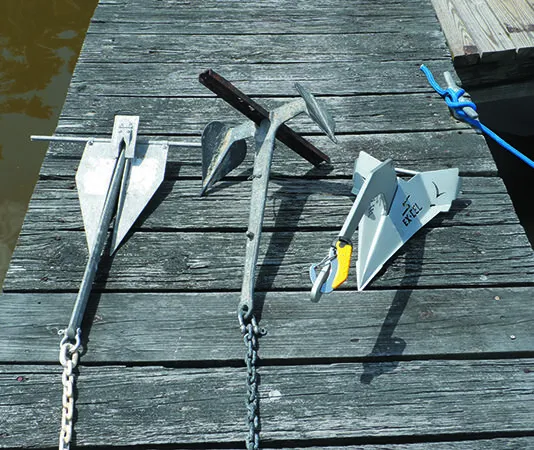
Designers of boat anchors deal in a handful of variables. The holding capacity of an anchor derives from its fluke, particularly the flukes size, shape, and the angle it makes with the shank. Other parts of the anchor-shank, roll bar, and stock-allow the fluke to set and hold as the designer intended. Based on the shapes and relationships between these components, an anchor fits into one of several broad categories: fluke (Danforth, Fortress, Manson Racer), plow (CQR, Delta, Kobra, SARCA Excel), claw (Bruce, Lewmar Claw, Manson Ray, Super Max), or fisherman (Luke).
Anchor Shackle Re-Test Modifies Initial Findings
In the August 2015 and October 2016 issues, we reported the preliminary results of our anchor-shackle tests. However, more recent testing has raised questions about the conclusions-most notably our Best Choice designation of the Peer-Lift brand anchor shackles, sold by Peerless.
Winches Part 2
In our second look at sailboat winches, we put the deck hardware into action, sea trialing traditional winches that have stood the test of time as well as the newest trends in winch design. Our goal was to hone in on the operational aspects of each winch, scrutinizing how each drum handled line loads and noting which drum shapes were less prone to overrides. Testers also compared the effectiveness of self-tailing systems and the various drum surface finishes used to keep the line from slipping.

Winches: Ratios and Reality
When comparing winches, its important to understand how input and output interface. The winch handle is a rotary lever that is the first stage of power amplification. The ratio of drum radius-to-handle length is the first force multiplier. An 8-inch handle and a 2-inch radius drum, therefore, deliver a 4-to-1 boost in pulling power and a 4-to-1 decrease in line-hauling speed.
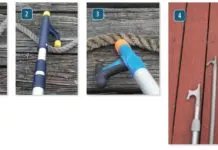
In Search of the Ultimate Boat Hook
The basic design of the humble boat hook hasn't changed much over the years, but it has seen upgrades in construction and materials, along with some minor design tweaks. For this report, we set out to determine what constitutes the ideal boat hook. We evaluated boat hooks currently on the market and took a look at some old models still in service.

Installation Tips for Deicers
When it comes to deicers, proper installation is key. Here are some tips to ensure your setup will optimize ice removal.

Testing Winches with Dale
Part 2 of our winch test this month brought back fond memories of the man who helped steer me into my position as PSs skipper, the late Dale Nouse, our former executive editor who died of cancer less than a year after I took over as editor in 2005. Dale was in charge of a winch test that year. He passed away a few months later, at the age of 82-working nearly to his last day after 13 years with Practical Sailor.

Anchor Shackles Round II
In this report, we continue our investigation into shackles, re-testing one shackle that fell below the makers specifications, Canada Metal Pacifics black-pin Titan shackle, and testing for the first time a widely used shackle from West Marine. We also offer our initial findings on two stainless-steel shackles: the Tecni-lift 316 bow shackle and a no-name stainless-steel shackle marked Hong Kong, which is representative of the many generic stainless shackles youll find in hardware stores and some chandleries.

Lithium Batteries on Sailboats: The 3 Mistakes Everyone Makes
Lithium batteries are one of the most popular sailboat upgrades today—but they’re also one of the most misunderstood. In this Practical Sailor Saturday episode,...



Latest Sailboat Review

Island Packet Estero Used Boat Review
Florida-based Island Packet targets a relatively narrow niche, so the toughest competitors to its new boats are often older Island Packets. Introduced in 2010, the 36-foot, shoal-draft Estero is the company’s latest attempt to introduce a distinctive model that doesn’t stray too far from the company’s proven formula for success: moderate displacement, full-keel cruisers designed to be lived on, sailed far and in comfort, and endure the bumps, scrapes, and storms that cruising boats inevitably encounter. After sailing the Estero on Florida’s Sarasota Bay and inspecting its interior, construction, and systems, Practical Sailor testers noted that the shoal-water cruiser will appeal strongest to Island Packet fans who’ve been waiting for a shoal-draft, easy-to-sail boat that compares to the IP37 in terms of interior space. These strengths will be most apparent on intracoastal or riverine adventures like the Great Loop.