




Screw types prove their mettle in load testing.
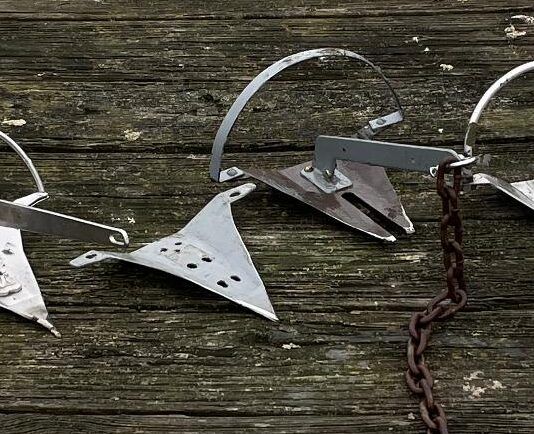
The mechanics at work at the other end of your mooring line matter as much as the mooring line and pendant. In 2009, Practical Sailor reported on two pull tests held 12 years apart (See Mooring Anchors for Sensitive Seabeds, Practical Sailor August 2009). We also reported on the results of a third test being carried out by contractors for the City of Sarasota, which at that time was about to become one of Floridas seven pilot mooring fields. Boot Key Mooring Field, which took a near direct hit from Hurricane Irma in 2017, was another harbor participant in the program (see adjacent article).
Most well-made cleats fit the bill, but beware.
In the 90s, the Boat US Foundation performed a study of deck cleat strength. Testing was performed using 6-inch cleats of a number of materials and designs, which were pulled from several directions. The standard vendor recommendation is 1/16-inch of line size for each inch of cleat, so these cleats are recommended for use with 3/8-inch line (breaking strength 4,200 pounds, working load limit 525 pounds). All but the nylon cleat had working load limits (assume 4:1 safety factor for metals) greater than nylon rope. Most were nearly as strong as the rope, but only two were stronger than the rope in all directions. We can expect strength to go up roughly as the square of size, roughly matching rope strength as we go. Only a few broken cleats were noted among the boats damaged by Hurricane Irma. More commonly, the cleats pulled out of the deck.
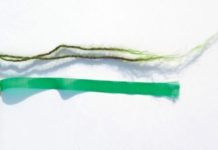
Adding Yarn Telltales to Your Sail
Fixed wind indicators tell the direction of the wind relative to the boat, but it is the flow within a few inches of the sail that really matters (see Top-notch Wind Indicators, January 2018).
How to Stitch a Yarn Telltale to Your Sail
We tested three methods for threading yarn telltales; direct threading using a #18 sailmakers needle (0.080-inch), pulling through with upholstery thread using a #16 needle (0.061-inch), and pulling through using a large household sewing needle (0.034-inch). We used acrylic/wool blend yarn, 65-weight upholstery thread, and medium stiffness 6-ounce polyester sailcloth.

Re-evaluating Eye-splice Thimbles
A great many sailors believe a splice intended for high loads is not complete until it is fitted with a thimble. Undoubtedly, a thick layer of steel provides the ultimate in abrasion resistance when attaching to a rusty, galvanized mooring shackle. And the thimble also increases the turning radius, which more evenly distributes the load among the fibers that make up the weave. But are thimbles best, and is a thimble best or even required in all circumstances? We are especially interested in strength.
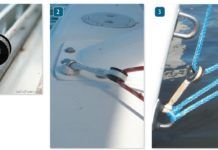
Low-friction Rings
Ever since lightweight ball bearing blocks were introduced they have been the standard anywhere a line needed to change direction. Tackles run smoother, and no maintenance is required, other than an occasional cleaning.

Adding on a Ring? Let Us Count the Ways.
When it comes to attaching rings there are at least a dozen ways that work, each requiring different skill sets. In most cases, installation should take only five minutes once a few simple tricks are learned. For splices, remember that deeper ring grooves will be tolerant it will be of a loose splice.
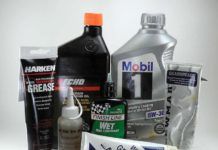
Penny Pincher Pawl Lube
Winch pawls require a different lube the rest of the winch. The only time they are moving is under practically no load, clicking along the ratchet wheel until the handle stops turning. A heavy packing of grease can stick and prevent full engagement, resulting in broken pawls, gouged ratchet wheels, and in the worse case, crew injury when the handle spins backwards.
Sticky Luff Track Cure
Racers demand lightning-fast hoists. Cruisers tire of the effort required to grind a heavy main up a sticky track. Roller furler foils that have been left vacan't over the winter can always do with a quick clean and lube before hoisting the genoa. But how can we accomplish this with minimal effort, without climbing the mast? Although it seems like the most common of tasks, the local chandlery doesn't carry what we need, and its slim pickings on the internet. Even calls to sailmakers and lube vendors yielded sparse information. Oddly, patents abound, but no products.
Undoing Mainsheet Twist
What kind of line do you use in your davit tackle? My lines keep twisting, chafing, and jamming. The ropes run crooked in the blocks no matter how often I restring them, asks Sailor One.
Latest Logbook

Practical Sailor Logbook – September 2026
In September we tour the Hans Christian 48T — the offshore cruiser many sailors call the holy grail — walk the custom Antigua 60...

Video: The BEST Sailboat You Can Buy for $35,000 – Catalina...
If you’re searching for a mid-30-foot sailboat, affordable cruising sailboat, liveaboard sailboat, first sailboat, or a capable used sailboat for coastal cruising, the Catalina...



Latest Sailboat Reviews
Learning by Doing on a $5,000 Catalina 30 Mk II
When Davis’s mother started talking about wanting to do something “big” for retirement, Davis and Gloria half-jokingly threw out an idea that seemed suitably...