



Does G70 Have Risk of Hydrogen Embrittlement?
Mention galvanized G70 chain in any discussion, and one of the first comments will be a question of the risks of hydrogen embrittlement. Though hydrogen embrittlement is very real, there have been no well-publicized cases of galvanized G70 anchor chain failure, nor cases of hydrogen embrittlement in new galvanized G70 anchor chain, and negative comment is apocryphal, in our opinion. Scare mongering at its best, or worst.

Galvanized Coatings Test
Corrosion attacks anchor chain long before it has reached the end of its useful life, and corrosion begins as soon the galvanized coating fails. Re-galvanizing can breathe new life into old chain, but it is not so simple or affordable as it used to be. As we saw in our most recent report on chain (see Practical Sailor June 2014 online), some of the high-tensile grades require specialized skills to galvanize, and others can't be galvanized at all. Even if galvanizing is an option, removing rusty old chain from the boat and delivering it to the galvanizer can make moving pianos seem like a cinch.
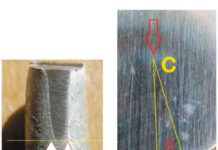
Estimating Galvanized Coating Thickness
There are no industry standards for how thick a galvanized coating should be on an anchor chain or mooring chain, and manufacturers don't publish this information. Fortunately, with a bit of sleuthwork, you can determine just how good the galvanized coating is on your chain by carrying out a couple of tests on some sample links you can obtain from your local chandler.
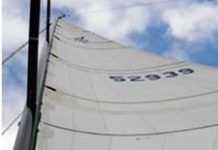
Survey: Mainsail Track Hardware
Its been almost 10 years since Practical Sailor weighed in specifically on mainsail track hardware. (See Practical Sailor, Feb. 1, 2005 online) At the time, we offered a summary of the products designed to manage what we termed the three Ss of mainsail handling-setting, shortening, and striking. In that article, we focused on the gear used with full-battened mainsails, which were becoming increasingly popular among a broad spectrum of sailboat owners then.
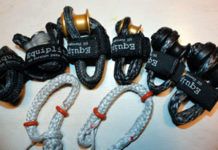
UV Protection for Dyneema
In your recent review of shackles (PS, September 2014), you tossed in a statement about recoating the soft shackles bimonthly with a UV protectant. Why? And what part of the shackle needs treatment? If Dyneema loses its UV resistance that readily, its news to me. Do my Dyneema lifelines need similar treatment?
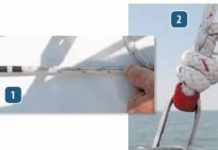
Top Whipping Twines
The term whipping twine is somewhat misleading, suggesting a single purpose for a product with seemingly endless uses. These are the thin-woven strands that all hand-sewing projects depend upon, and in the process of exploring various stitching projects, weve gone through spools and spools of it.

Higher Loads Call for Careful Installation
Rope clutches are a great innovation that can help sailors better control the lines that lead aft to the cockpit and those that cluster around the mast base. But as with many good things, there is the risk of over-doing the benefit.
Break and Break Again
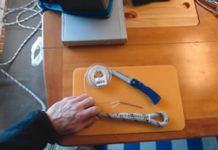
All lines were broken once to determine approximate breaking strength without a stitched eye. A simple chain fall and load cell provided a means of pulling test samples up to 5,000-pound loads. The samples were then sewn or knotted into dog bones 6 to 8 inches long with an eye on each end, and the load was again applied until failure. This allowed the testers to compare breaking strengths with and without a stitched eye or knot. The test was broken into two parts, laboratory and field testing.
Other Stitching Techniques that Work Well
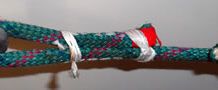
We principally looked at three means of seizing an eye without splicing-basting, round-stitching, and seizing-used alone and in combination. Round stitching is described in the accompanying main article. Here are some of the other stitching patterns we tested.
Getting to the Top
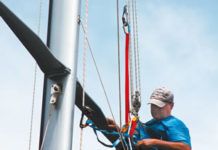
There are times when getting to the top of a mast is a far easier solo proposition than hunting for help. The first time I saw a middle-aged man go it alone, he hoisted a 3:1 block and tackle, rigged with 5/8-inch line, up a jib halyard. At the bottom end of the rig, he attached a bosuns chair. He simply pulled on the haul line, hand over hand, to the elevation he needed, then doubled the haul line through a convenient part of the chair and tied it off. With the 3:1 purchase, he was muscling one-third of his weight.
Lithium Batteries on Sailboats: The 3 Mistakes Everyone Makes
Lithium batteries are one of the most popular sailboat upgrades today—but they’re also one of the most misunderstood. In this Practical Sailor Saturday episode,...



Latest Sailboat Review
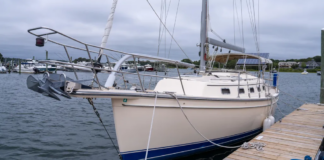
Island Packet Estero Used Boat Review
Florida-based Island Packet targets a relatively narrow niche, so the toughest competitors to its new boats are often older Island Packets. Introduced in 2010, the 36-foot, shoal-draft Estero is the company’s latest attempt to introduce a distinctive model that doesn’t stray too far from the company’s proven formula for success: moderate displacement, full-keel cruisers designed to be lived on, sailed far and in comfort, and endure the bumps, scrapes, and storms that cruising boats inevitably encounter. After sailing the Estero on Florida’s Sarasota Bay and inspecting its interior, construction, and systems, Practical Sailor testers noted that the shoal-water cruiser will appeal strongest to Island Packet fans who’ve been waiting for a shoal-draft, easy-to-sail boat that compares to the IP37 in terms of interior space. These strengths will be most apparent on intracoastal or riverine adventures like the Great Loop.