




User Report: Lasdrop Shaft Seal
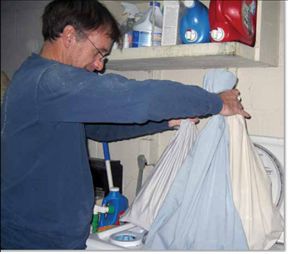
On my 40’ wood boat Daybreak I had a stuffing box problem. The gland leaked worse and worse, especially when motoring. It is very inaccessible, and could not be further tightened. The stuffing box needed to be repacked, but this couldn’t be done without major effort because of insufficient space between the gland and the shaft coupling at the transmission. The Lasdrop shaft seal looked like it might solve several problems at the same time.
The Multifarious Mainsheet
The mainsail is a big part of the motive power of almost every sailboat. The art of mainsail control, however, is a relatively modern one. One tool that greatly facilitates mainsail control is the traveler.
Checking and Replacing: Keelbolts, Part 1
The largest fasteners in any sailboat with outside ballast are likely to be the bolts holding the ballast keel to the hull. As a rule, designers specify keelbolts by a tremendous factor, on the order of ten to one or more. Nevertheless, this safety margin does not guarantee eternal life for keelbolts. Corrosion takes its toll, sometimes more quickly than you might think.
Boat Clinic: Minor Repair to Cored Decks
A fairly common ailment with cored decks is the presence of soft spots where the outer skin has delaminated from the core material. Typically these areas are found around the mast and on the foredeck where heavy-footed spinnaker handlers have trod, but they are candidates to occur anywhere in a relatively large, flat span of unsupported deck.
The Rig: Keep it Standing
When was the last time you went carefully over every detail of your boat’s rig? The chances are good that it may have been a few years, and it’s possible that you may never have looked at it in the detail it deserves.
Choosing Ground Tackle for Cruising
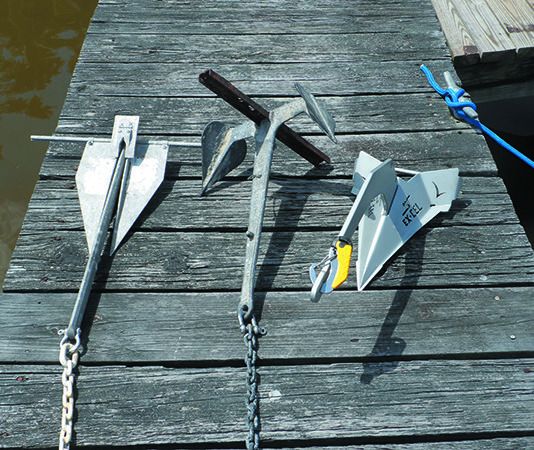
Choosing an anchor best suited to your cruising style must take into account the area you are cruising, the type of boat you will be sailing, and the demands you will make on your gear. Purchasing an anchor and its chain and rode can be an expensive proposition.
Stemming Troublesome Deck Leaks
Deck joints don’t leak as much as they used to. Most builders have switched to less leak-prone types of joints, and most are more conscientious about fastening and sealing them.
Upgrading the C&C 33 Part II
For hull bottom and topside repair, we love our Porter-Cable random orbit sander and WEST System Microlight Fairing Compound.
Boat Clinic: Tuning the Masthead Rig
Tuning the rig of a boat is one of the necessary -and pleasant -tasks which must be done to achieve good performance. In an untuned boat, the mast bends in odd ways, and this in turn causes the sails to set badly. By contrast, on a well tuned boat, the rig bends in a controlled fashion, allowing the sails to do their best.
Improve Your Catalina 30: Upgrading the Worlds Most Popular 30-Footer
The Catalina 30 is a remarkable success story. We suspect that more Catalina 30s have been built than any other boat of that size anywhere in the world. While the basic boat has remained unchanged since it was introduced in1975, there have been dozens, perhaps even hundreds, of minor developments in the boat in the course of a production run that is approaching 4,000 hulls.

Lithium Batteries on Sailboats: The 3 Mistakes Everyone Makes
Lithium batteries are one of the most popular sailboat upgrades today—but they’re also one of the most misunderstood. In this Practical Sailor Saturday episode,...



Latest Sailboat Review
Island Packet Estero Used Boat Review
Florida-based Island Packet targets a relatively narrow niche, so the toughest competitors to its new boats are often older Island Packets. Introduced in 2010, the 36-foot, shoal-draft Estero is the company’s latest attempt to introduce a distinctive model that doesn’t stray too far from the company’s proven formula for success: moderate displacement, full-keel cruisers designed to be lived on, sailed far and in comfort, and endure the bumps, scrapes, and storms that cruising boats inevitably encounter. After sailing the Estero on Florida’s Sarasota Bay and inspecting its interior, construction, and systems, Practical Sailor testers noted that the shoal-water cruiser will appeal strongest to Island Packet fans who’ve been waiting for a shoal-draft, easy-to-sail boat that compares to the IP37 in terms of interior space. These strengths will be most apparent on intracoastal or riverine adventures like the Great Loop.